| Prescott
Air Fair (Arizona Skyfest) 2005 |
| The
Prescott Air Fair, also known as the Arizona Skyfest, is so good that they
had to name it twice! Last
year's show was the first after a break of many years, but it's expanding
rapidly and becoming a "must see" on the airshow circuit. This
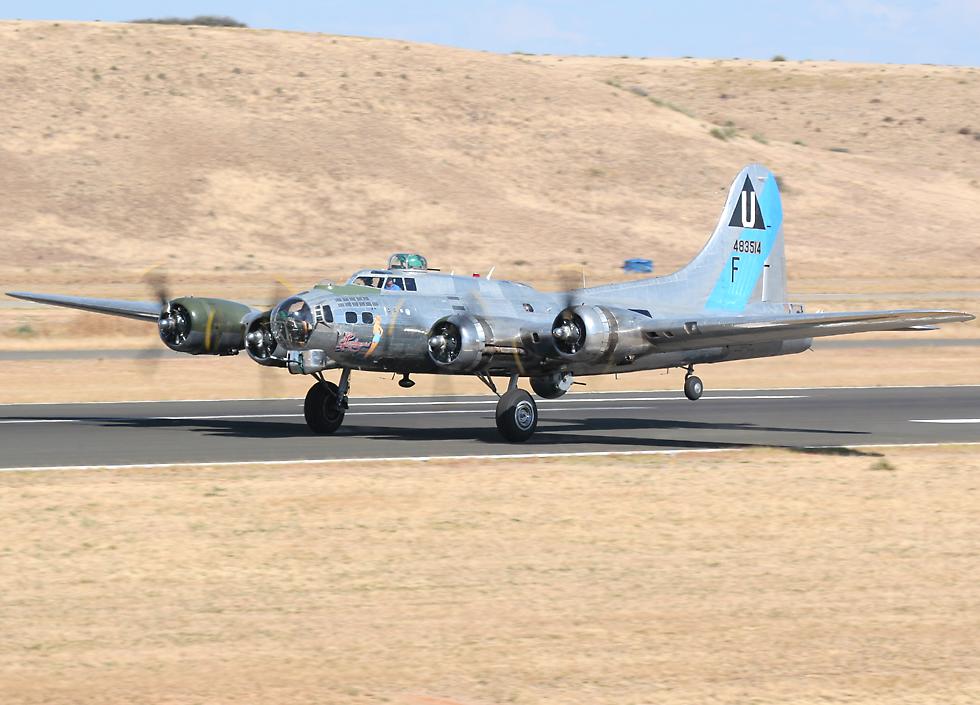
year the Arizona wing of the Commemorative Air Force brought along their
world war two B-17 Flying Fortress bomber called "Sentimental Journey",
flying it several times during the day and raising money for its continuing
operation by giving people the opportunity to ride in it. |
 |
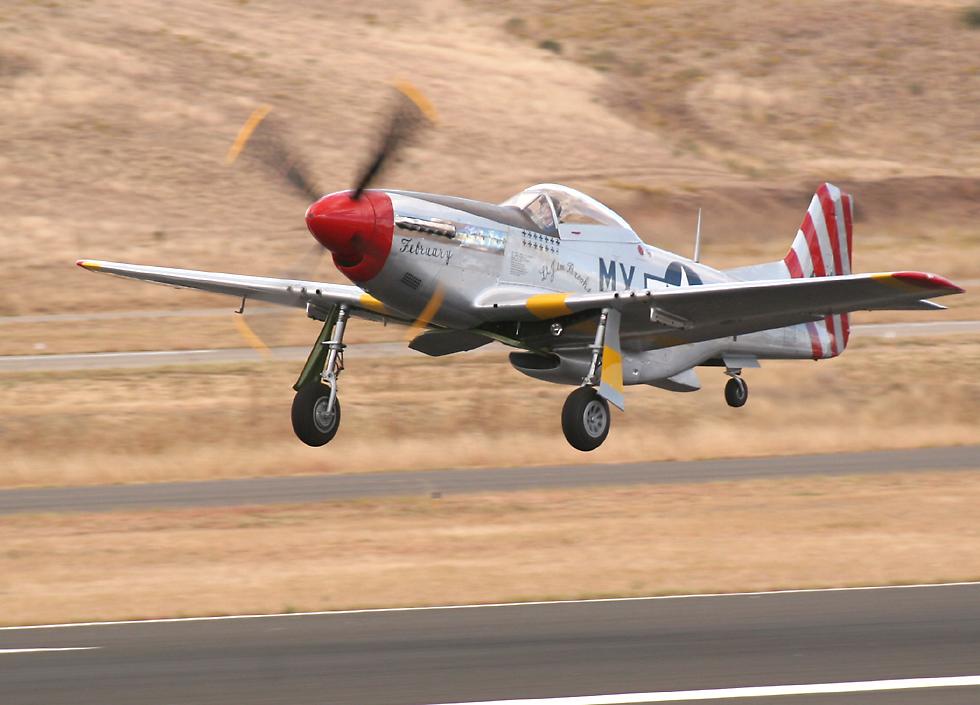
| Prescott
is home to a number of interesting aircraft, including this world war two
P-51D Mustang fighter painted in the colors of Jim Brooks' P-51 called
"February", which he used to shoot down 13 Axis aircraft during 1944.
Although painted in the colors of "February", this particular aircraft
was built too late to serve in the war, and eventually ended up with the
Guatemalan Air Force before being brought back to the United States. |
 |
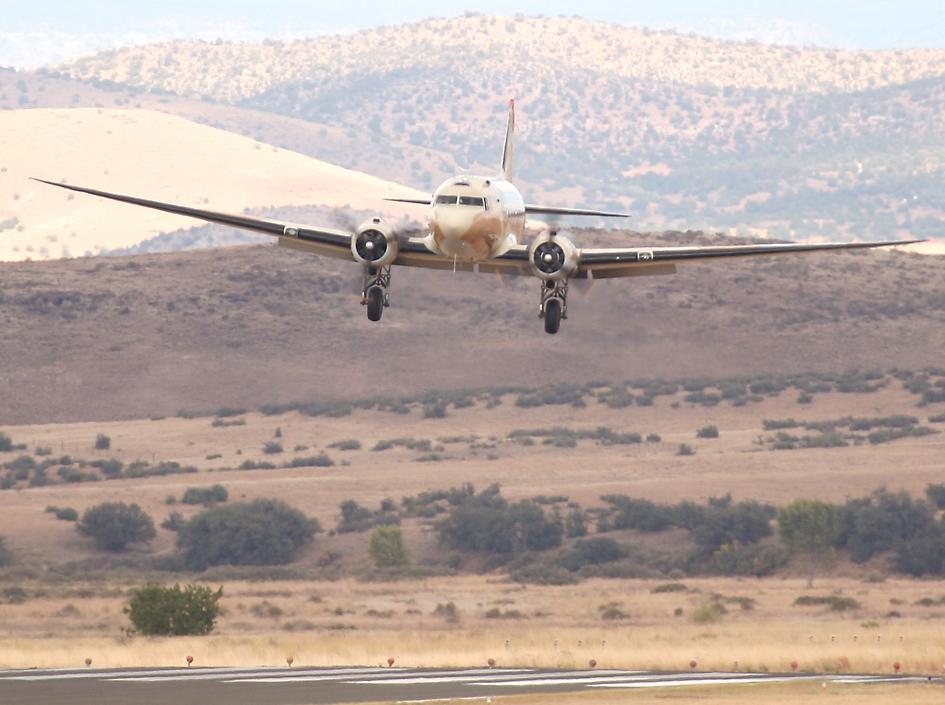
| This
C-47 Skytrain, which dropped paratroopers during the Normandy landings,
is another world war two veteran based in the area. The Skytrain
was the military version of the Douglas DC-3 Dakota airliner, the main
differences being that the Skytrain had a cargo door and different engines.
Surprisingly only about 300 DC-3s were ever built compared to more than
10,500 C-47s, another 2000 were built under license by the Russians as
the Lisunov Li-2 (Nato reporting name "Cab") and even the Japanese built
485 as the Showa L2D (Allied code name "Tabby"). As well as
this C-47 which flew during the show, there was also a Vietnam era AC-47
"Spooky" gunship on static display operated by the American Flight Museum
of Topeka, Kansas. |
 |
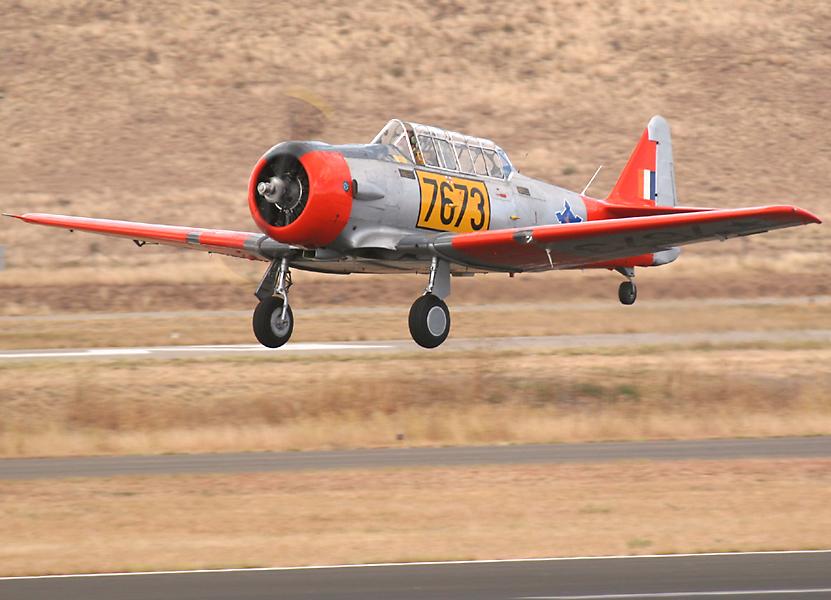
| This
was one of the world war two trainers which also flew, built by the North
American company, which also built the Mustang. You might think
that this is a T-6 Texan, but in fact it's actually a Harvard, which is
the name applied to Texans flown in the British Empire. This
particular plane was operated by the South African Air Force and is still
in an authentic SAAF color scheme. The day before the show
I flew in the back seat of this plane to do an air-to-air photoshoot of
the C-47 and a pair of Texans. |
 |
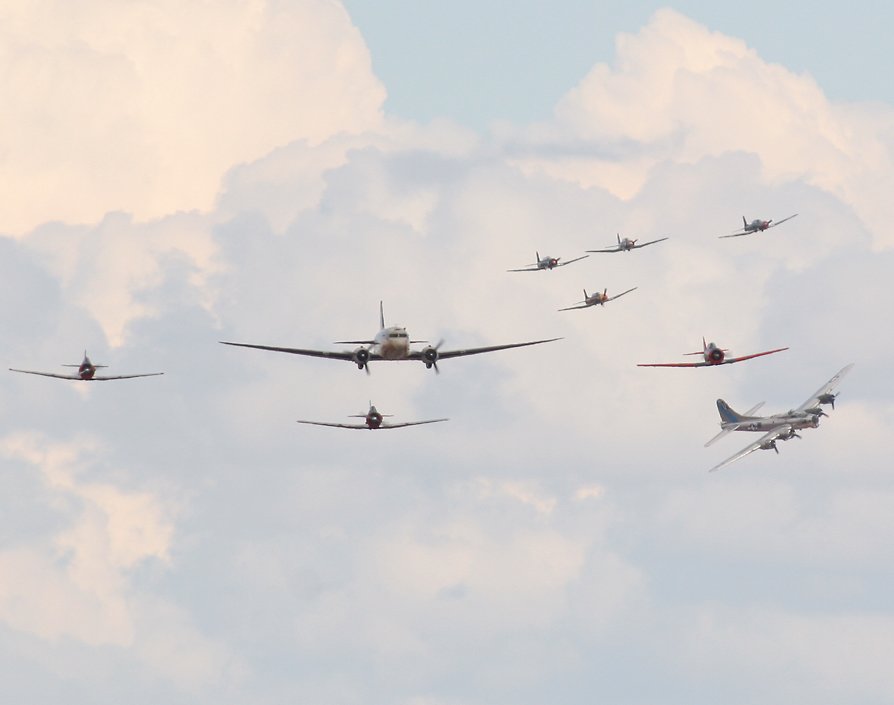
| The
world war two aircraft were put up in a mass warbird flyover, here you
can see the C-47 flanked by Texans, with Chinese Nanchang CJ-6 trainers
behind and then the unmistakable Flying Fortress. |
 |
| Here's
the
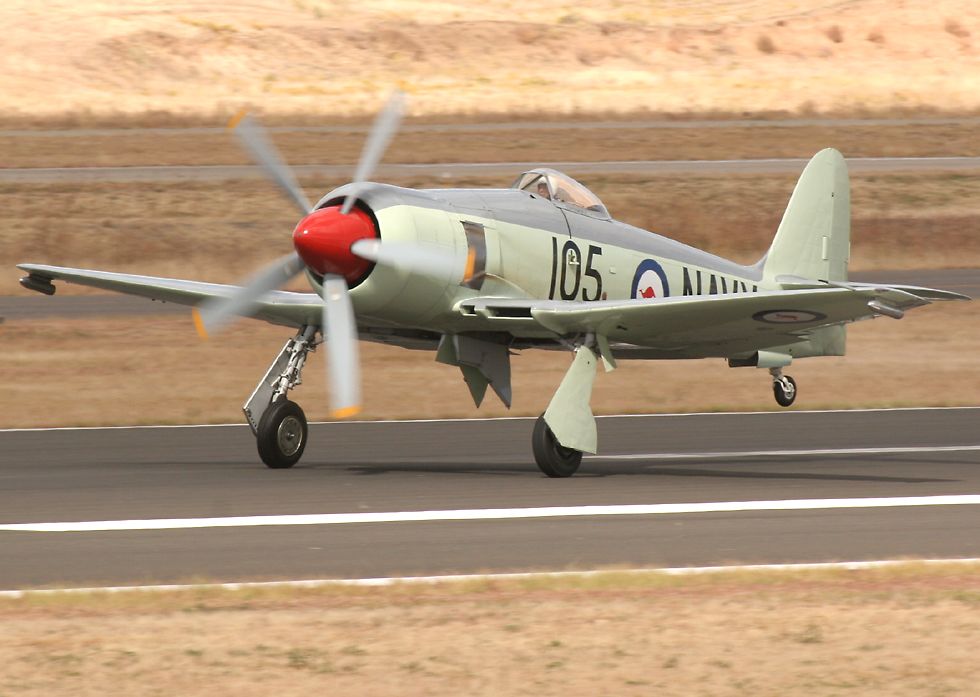
star of last year's show, the British "Sea Fury" naval fighter in Royal
Australian Navy colors. Like the American F8F Bearcat, the
Sea Fury was produced too near the end of the war to have any real impact,
but both were built in small numbers and went on to enjoy a successful
combat career, in the Sea Fury's case even shooting down MiG-15 jet fighters
in Korea. It's a very powerful aircraft, with an 2,480 horsepower
18 cylinder radial engine and four 20mm cannons. As well as
doing a full aerobatic display during the show, Ellsworth Getchell also
demonstrated on the ground how the wings of this aircraft can be folded
for carrier operation. |
 |
| Not
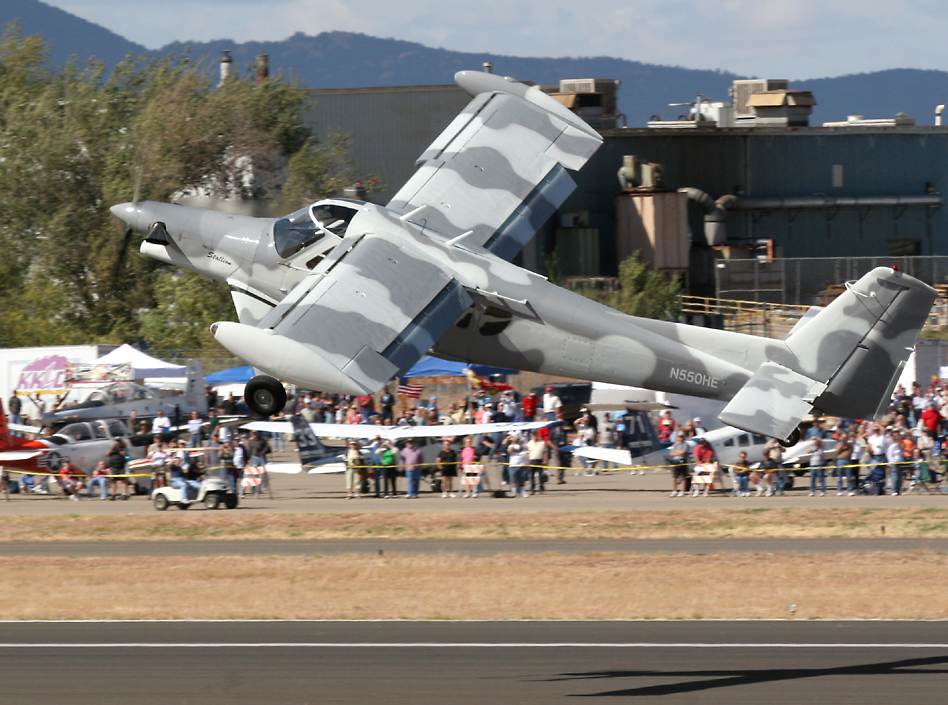
all of the aircraft at the show were military types. As well
as aerobatic performances by some of the top names on the circuit like
Rob Harrison, there were other civilian aircraft like this little-known
ten seat Helio Stallion, which put on an extraordinary demonstration of
its short takeoff and landing performance, using only a few hundred feet
of runway to make a very steep banked takeoff. The Stallion
first flew in 1964 and its exceptional abilities made it popular both with
civilian and military customers like the CIA, who operated them from primitive
and sometimes mountainous airstrips in Laos and Cambodia. |
 |
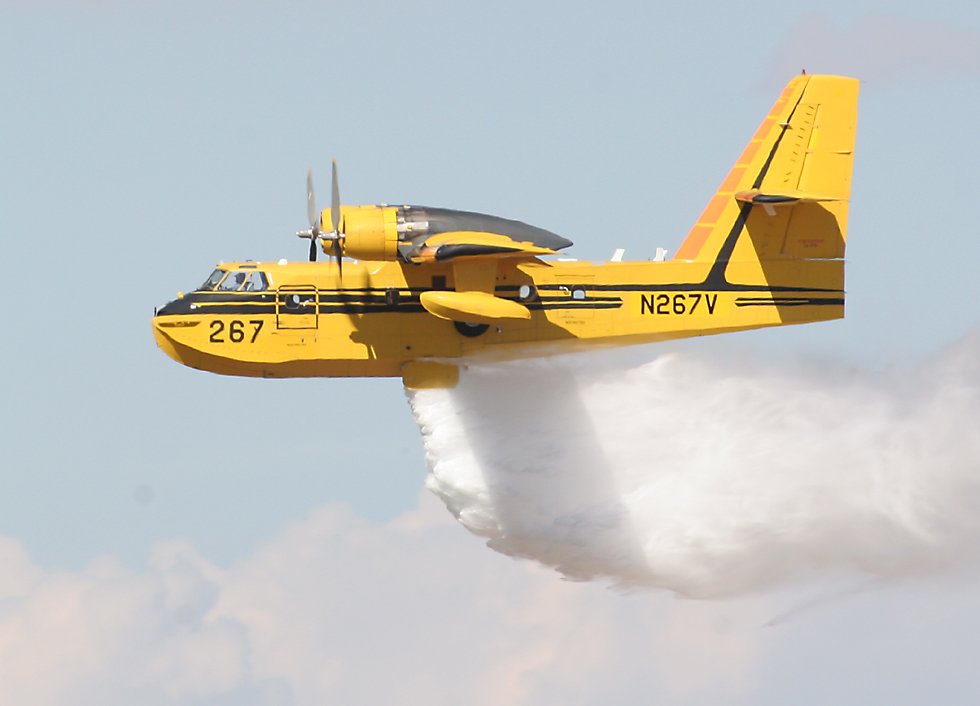
| I
got pretty excited when I saw a large, bright yellow aircraft orbiting
far away from the airshow grounds, because I figured it was probably a
Canadair CL-415 "Super Scooper" flying boat water bomber, designed to extinguish
forest fires. I was slightly wrong, because when it came in
to do its demonstration it turned out to be the CL-415's predecessor, the
CL-215, which has radial engines instead of the 415's turboprops and lacks
the 415's extra vertical stabilizers. They're both amazing
aircraft, purpose-designed for the water bomber role and built like a tank.
The 215, affectionately called "the yellow duck", can carry 1400 gallons
of water compared to the 415's 1600 gallons, and it can fill its tanks
in only 12 seconds while making a high-speed run across a lake. |
 |
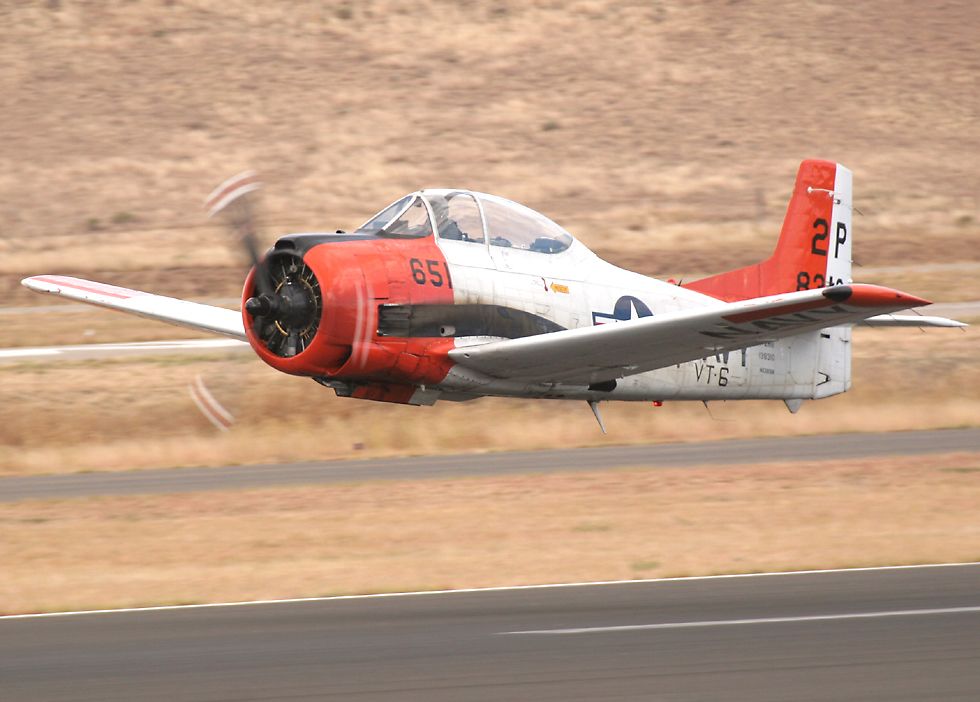
| Back
to the military aircraft, here's a low-speed flypast by a US Navy T-28
Trojan training aircraft. As you can see, although it's a radial
engined propeller driven aircraft like the Texan, it's miles ahead in terms
of design and capability. |
 |
| And
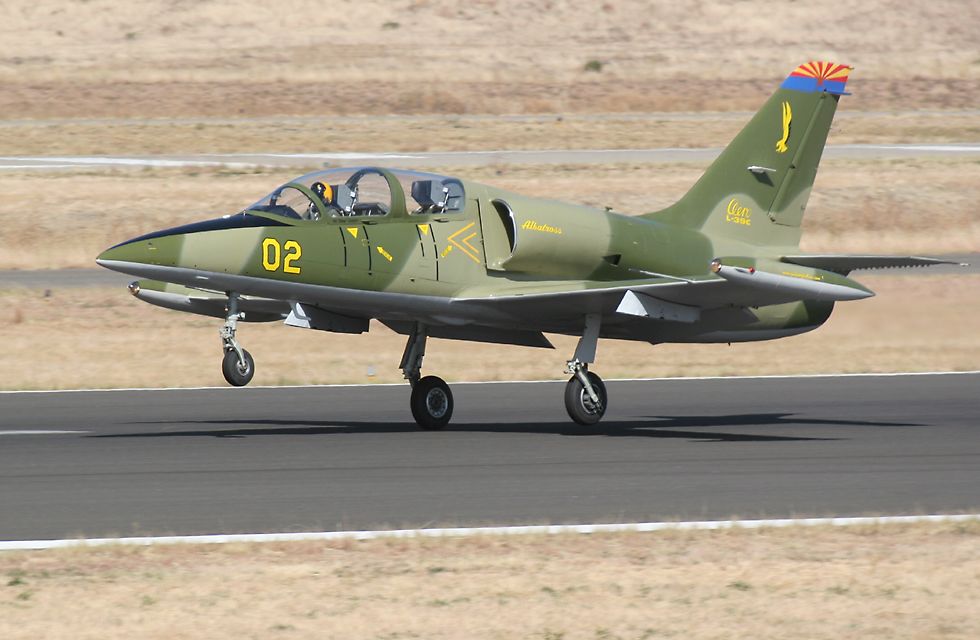
moving ahead a couple more generations, this attractive plane is the Czechoslovakian
designed L-39 Albatross, which was the standard Soviet bloc jet trainer.
Since the breakup of the Soviet Union the Albatross has become a very popular
high-performance aircraft for well-heeled American aviation enthusiasts. |
 |
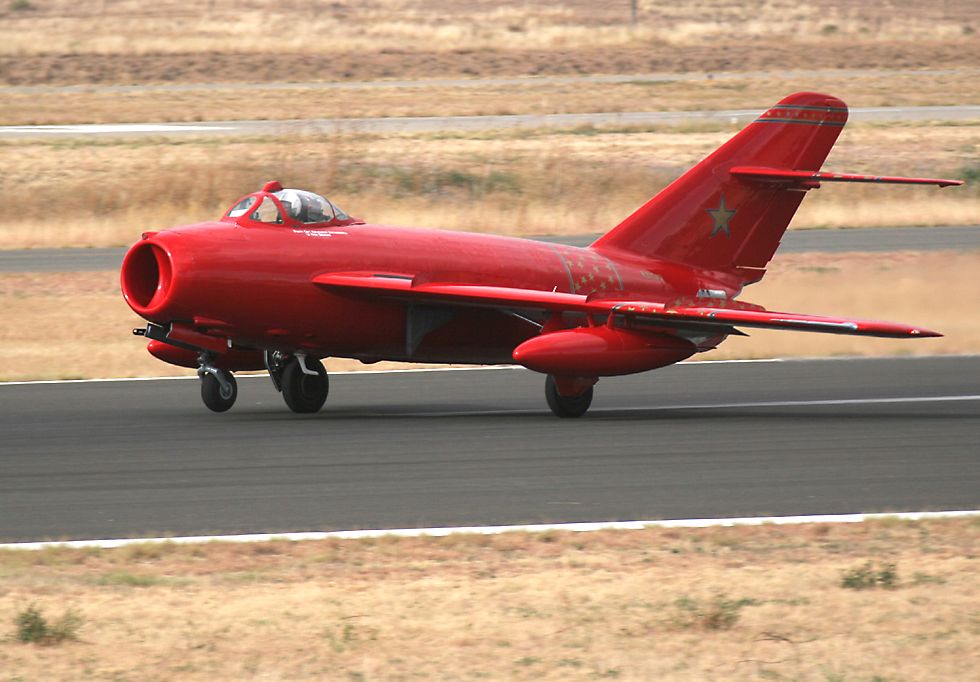
| The
Albatross wasn't the only Soviet jet at the show, there was also this slightly
fancifully painted MiG-17 "Fresco" jet fighter. The MiG-17
was a development of the MiG-15 "Fagot" of the Korean War, but able to
fly higher and faster because of its more powerful afterburning engine.
The MiG-17 carried a lethal 37mm cannon, which you can see protruding past
the nosewheel door on the right-hand side, and it also had either two or
three 23mm cannon. It was used by many communist countries
including North Vietnam. |
 |
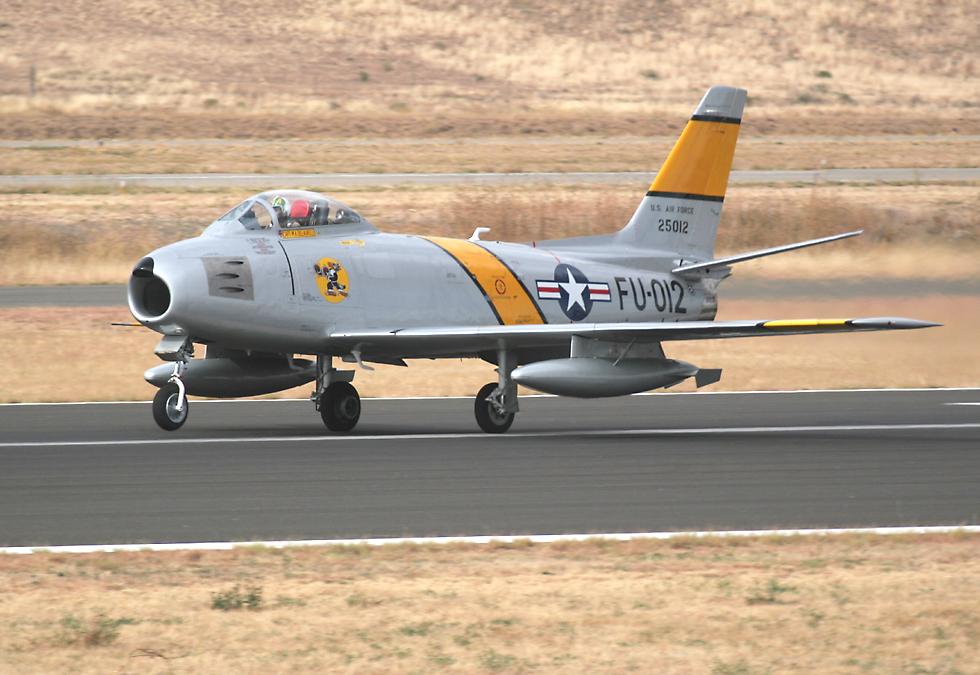
| Here's
the Chino Planes of Fame F-86 Sabre, which America used to control the
threat of the MiG-15 during the Korean war. The American and
Russian designs were very well matched in terms of performance, though
the MiG could fly higher and turn slightly faster. In addition,
the Sabre was armed with six machine guns, three of which you can see on
the nose of this plane, whereas the MiG had much more lethal high-caliber
explosive cannon. Nevertheless the Sabre, designed by the same
company responsible for the Texan and the Mustang, achieved about a ten-to-one
kill ratio against the MiG, mostly due to better tactics and pilot training. |
 |
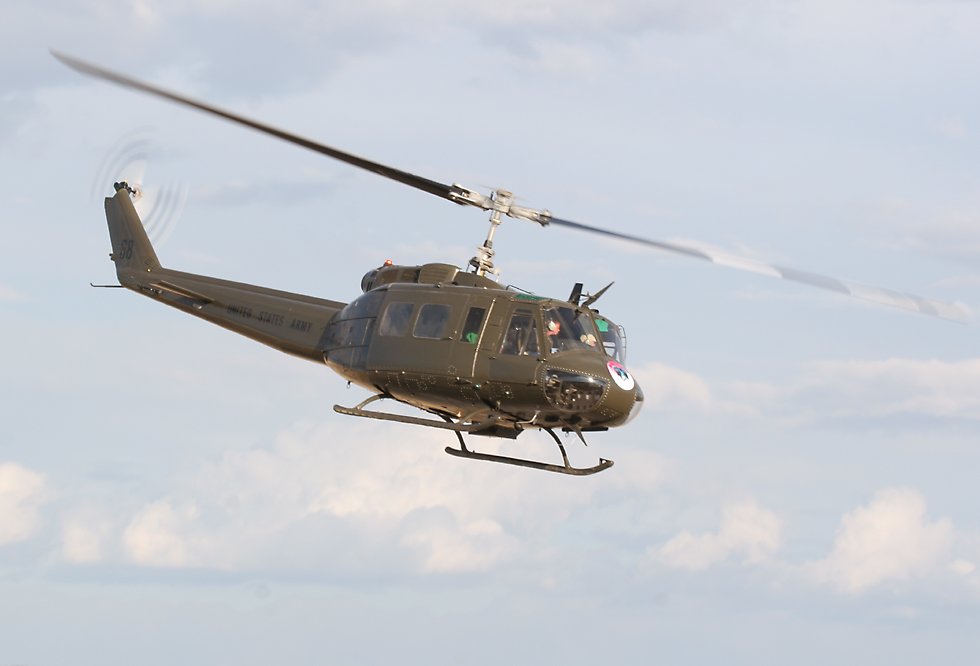
| This
immaculate UH-1 Iroquois helicopter, popularly known as "Huey" was on static
display during the show, so I had to wait until the end of the day to get
this photo as it departed. The Huey is synonymous with the
American war in south-east Asia, transporting troops, evacuating casualties
and acting as gunships - this particular one has a mini-gun mount in the
left-hand door. Although the pilots told me that they didn't
think that anyone would be interested in seeing them display, I think there
would be many veterans and others who would get a thrill from just a few
passes by this historic aircraft. |
 |
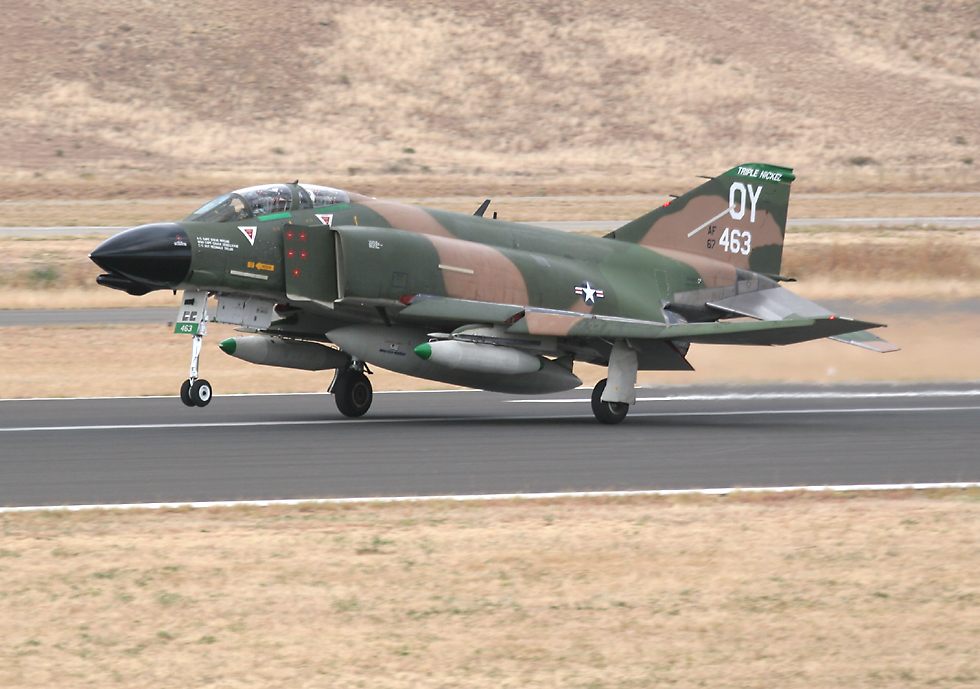
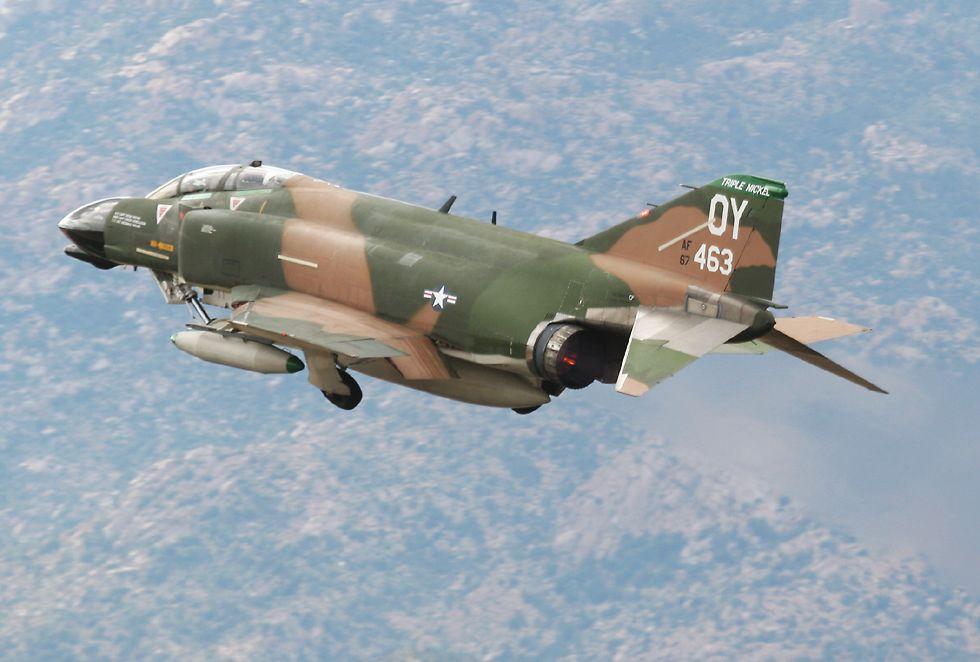
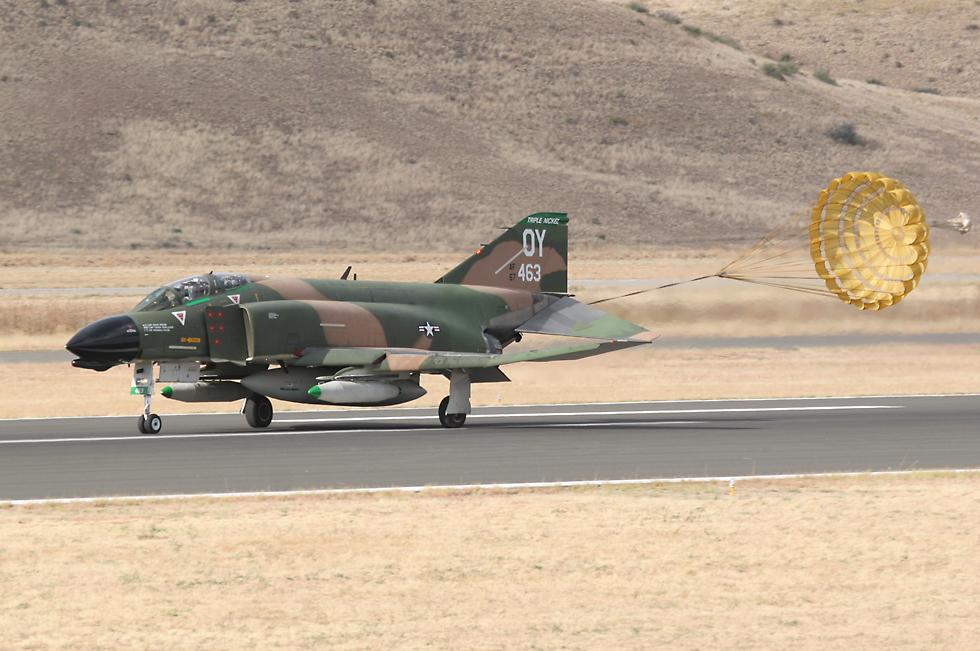
| The
Sea Fury might have been the star of last year's show, but there was no
doubt that the star of the 2005 show was the Collings Foundation F-4D Phantom
II, which like the Huey was a veteran of the Vietnam war. The
Phantom was America's top of the line fighter during this period, and has
been operated by several nations. First flown in 1958, it remained
in service in the United States as a "wild weasel" anti-missile aircraft
into the 1990s, and is still in service in Germany, Greece, Turkey and
Japan. It's one of the world's classic military aircraft, with
a large following of "phanatical" enthusiasts. |
 |
| The Phantom is one
of the very few aircraft which has ever succeeded as both an air force
and a navy fighter. Attempts by politicians to create such
aircraft (such as the F-111 "Aardvark" and the upcoming F-35 Joint Strike
Fighter) usually result in an aircraft which is so compromised that it
can't perform any of its tasks properly, but the Phantom performed well
against Russian aircraft like the MiG-21 "Fishbed" mach 2 fighter, and
even excelled in the ground attack role using napalm or up to 13,000 pounds
of ordnance. |
 |
| This is not to say
that the Phantom was a perfect aircraft. The unusual shape
of its tail, the bent wingtips and various other features were all crude
fixes for major aerodynamic deficiencies. The main reason this
aircraft became a classic and not a forgotten footnote is its very powerful
J79 jet engines - as someone once said, you can make even a brick fly if
you give it powerful enough engines! Nevertheless, the kill
ratio was far lower in Vietnam than the Sabre had enjoyed in Korea, at
times the US forces were loosing one of their own fighters for every enemy
fighter destroyed. This poor result led to the creation of
the navy's famous Top Gun fighter training school, which brought the navy
kill ratio up to 13-1 and later 21-1. |
 |
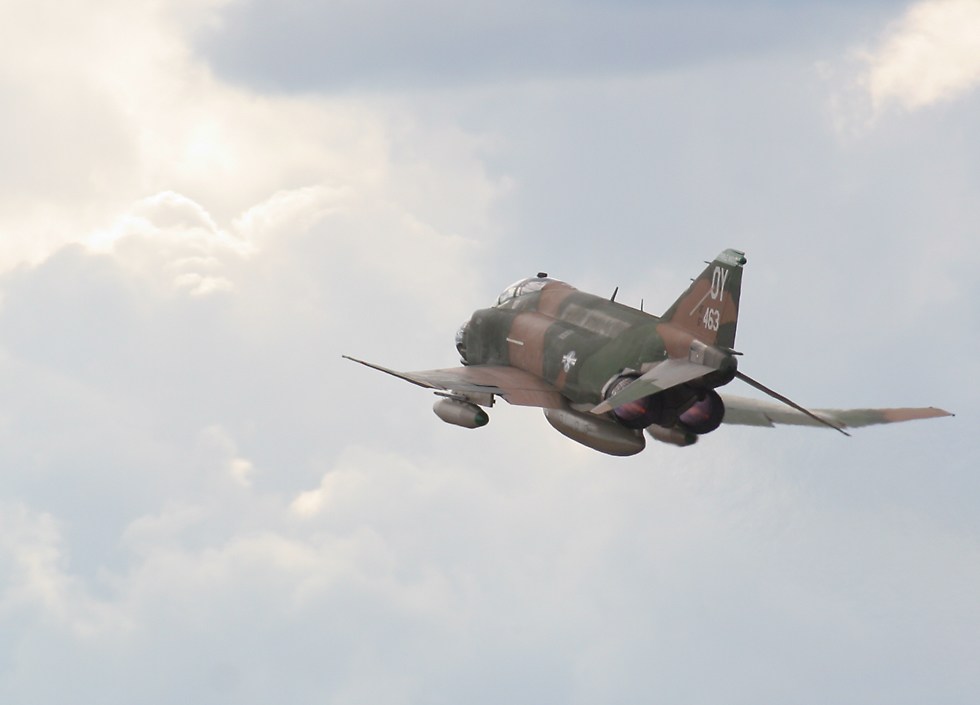
| This aircraft is
the only privately owned Phantom in the world. The Collings
Foundation needed an Act of Congress to allow them to buy and operate the
aircraft, which is painted up in the color scheme of perhaps the most famous
F-4 pilot during the Vietnam war, General Steve Ritchie, who introduced
several innovative tactics and also pushed hard for the introduction of
a cannon on the navy's Phantoms, which had been operating with an all-missile
armament before that time. |
 |
See
the
2006 Prescott airshow and the
2004 Prescott airshow.
 |