
Highlights of Brunei

Of the more than 25 countries I've visited, Brunei would certainly be the last I'd go to again. One reason is the oppressive sense of intolerance brought about by the folks who inhabit this building, the Religious Affairs Ministry in the capital city of Bandar Seri Begawan. They keep a pretty close rein on everyone in the country, whether they share their religious views or not. Surprisingly, only two-thirds of the population are Muslim, with 13% Buddhist and 10% Christian and another 10% of indigenous beliefs. Perhaps the Christian population is swollen by the number of oil workers from the UK and places like the Philippines, and the local Chinese probably accounts for the Buddhists. Around 15% of the permanent population is Chinese, and even if their families have lived in the country for hundreds of years they're still not citizens; if they want to travel then they're issued with International Certificates of Identity. It's official government policy that the majority Malay Bruneians hold all of the top posts in the country, and no matter how skilled a Chinese Bruneian is, they will never be promoted above a certain level while working any place where the government has influence. Democracy is not a priority in Brunei - the sultan is an absolute monarch, so there are no elections and no functional political parties. The sultan decides who serves on his advisory panels, which include the council of cabinet members, the religious council and the privy council. The press is very restricted and never criticizes the royal family, which is no surprise since journalists can be imprisoned for up to three years for reporting "false news". Criticism of any kind isn't tolerated - while I was there a British guy I worked with and his wife were thrown out of the country with 24 hours notice after it was discovered that they'd played a game of "hangman" with "Bloody Bruneians" as the phrase to be guessed! Of course it's an ill wind that blows no good, and it's certainly true that visitors to Brunei don't have to worry about theft or violent crime. |
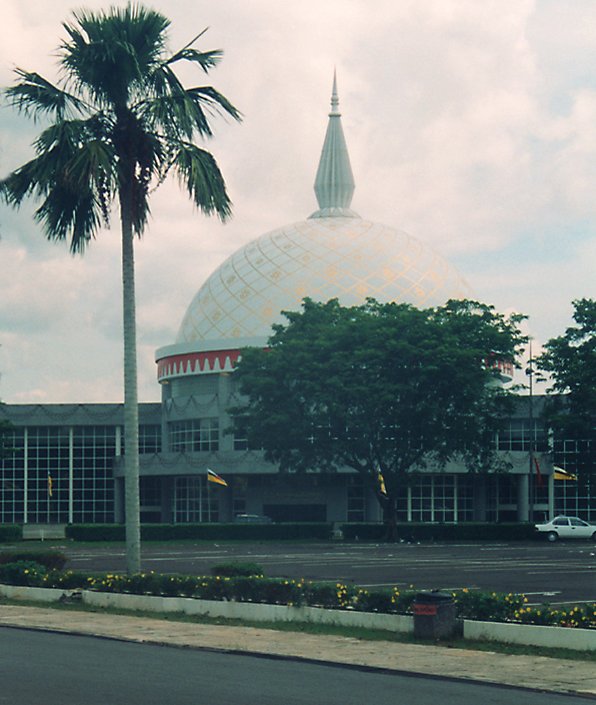
Tourists aren't high on the list of desirable visitors for most government officials, perhaps because of the criticism they would probably voice and which might spill over into the local population. Although noises are occasionally made about wanting to increase tourism, in fact little promotion is done and recently several of the main attractions have been eliminated, rather than added to. For instance, the previous sultan Omar Ali Saifuddin had an extensive collection of Winston Churchill memorabilia and also built a large aquarium to display tropical fish from the area. However, both of these displays were done away with and replaced with the much less interesting Constitutional History Museum, which locals call The Big Mac because of its shape and the ketchup-colored trim under the bun! As you can see from the car park, empty except for the rental car I was using, it's hardly the sort of place that packs the crowds in! The only things I remember from the museum were a very baroque looking coach used for the coronation of the sultan, and a photograph of the current sultan as a 13 year old boy just before his circumcision. He was smiling, so perhaps the ceremony hadn't been explained to him very well! Another reason why people don't come is that Brunei is a very small place, with only 370,000 inhabitants as of 2005, and less land area than the small American state of Delaware. There's just not a lot to see here, so it's hardly surprising that it's not on the top of anyone's list of "places to go before I die". Nevertheless, there are a few things worth seeing, and for certain people like naturalists it might be something of a paradise. Although the Churchill museum and the aquarium are gone, there is a National Museum on the banks of the Brunei River at Kota Batu, with a Malay Technology Museum nearby; however, I didn't have time to visit either of them. |

The same family has ruled Brunei for six centuries and once wielded influence over most of Borneo and parts of the Philippines. However the arrival of the European colonial powers led to a major decline in their power, with the "White Rajah" James Brooke and those who succeeded him swallowing more and more territory, including a chunk in the middle of Brunei which led to the current ridiculous situation where the country consists of two non-contiguous blocks of land! It's likely that Brunei would have been swallowed up entirely except for the discovery in 1929 of large oil deposits in the remaining territory. The oil income allowed the sultans of Brunei to consolidate what little power they still had, and today there's little doubt who is in control. Given the place's history it's surprising that the current sultan was reluctant to become independent from Great Britain, a step finally taken in 1984. While I was there the sultan celebrated his 48th birthday, which led to the annual ritual of constructing ceremonial arches and displays to celebrate the event. There's a lot of emphasis on strengthening the sultan's legitimacy, a little leaflet handed out to incoming foreign visitors tells them not to criticize him because local people love him so much. In 1962 a coup was masterminded by local rebels opposed to the unification of Brunei together with the neighbouring territories of Sabah and Sarawak into a Malaysian Federation. Indonesia attempted to invade in order to support armed opponents of the sultan's government who were attacking government facilities. In the end, British and commonwealth troops defeated the Indonesians and the rebels; however sultan Omar Ali Saiffudin decided to stay out of the federation, preferring to keep the oil wealth under his own control.
|
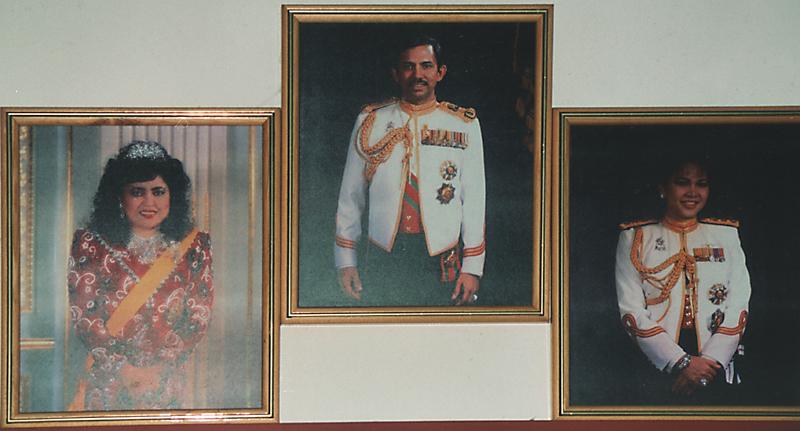
And here's the current sultan, who usually goes by the name Hassanal Bolkiah, although his full name is Yang Maha Mulia Paduka Seri Beginda Muda Hassanal Bolkiah Mu'izzaddin Waddaulah. Here you see him with his two wives; it's mandatory that every shop and office in the country displays photos of this royal menage a trois. It seems somewhat kinky to have one wife dressed in exactly the same military-style uniform that the sultan himself is wearing, but I guess it's better than having her in a French maid's costume! The sultan apparently tired of this wife, who was formerly an airline hostess, so he divorced her, but in 2005 he married a Malaysian TV newsreader, choosing to have the wedding in Malaysia rather than Brunei. The royal family ran into quite a bit of trouble around the turn of the new millenium, with an American beauty queen accusing the sultan of imprisoning her as a sex slave in his palace, and then the sultan's brother Jefri had to skip the country after losing a huge chunk of state funds. It probably didn't help that one of Jefri's acquisitions was a super-yacht called "Tits" which had two tenders called "Nipple I" and "Nipple II". |
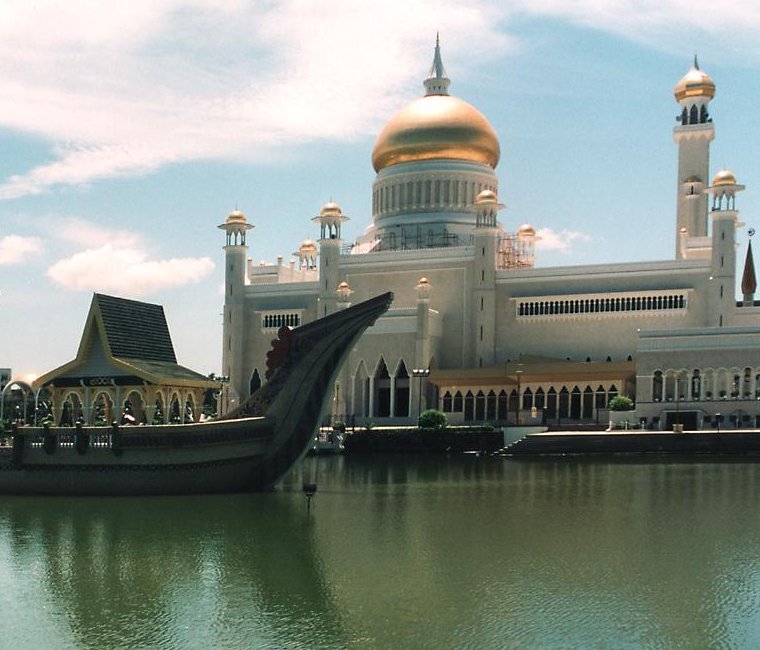
There's some very attractive architecture in Brunei, chief of which is the Omar Ali Saiffudin mosque in the heart of Bandar Seri Begawan, which is usually abbreviated to just "bandar", the Malay word for "town". The replica of a royal barge in the pond surrounding the mosque is used for events such as school children reading from the Koran, with both boys and girls participating. |
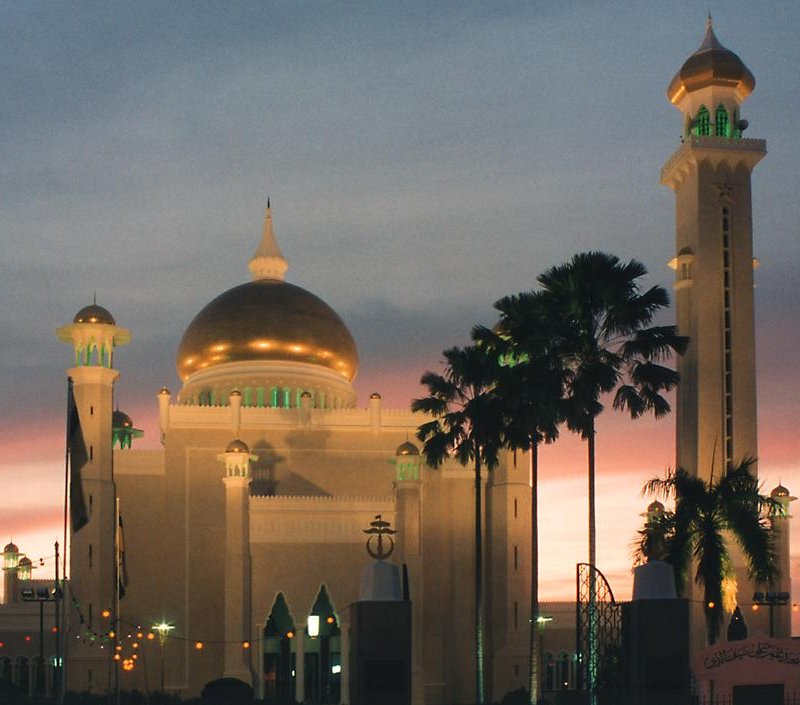
Like several of Brunei's other main buildings, the mosque is lit up at night. It was designed by an Italian architect and built in 1958 using Italian marble and granite from Shanghai. The golden dome is 52 meters tall and is visible from most of the city. |
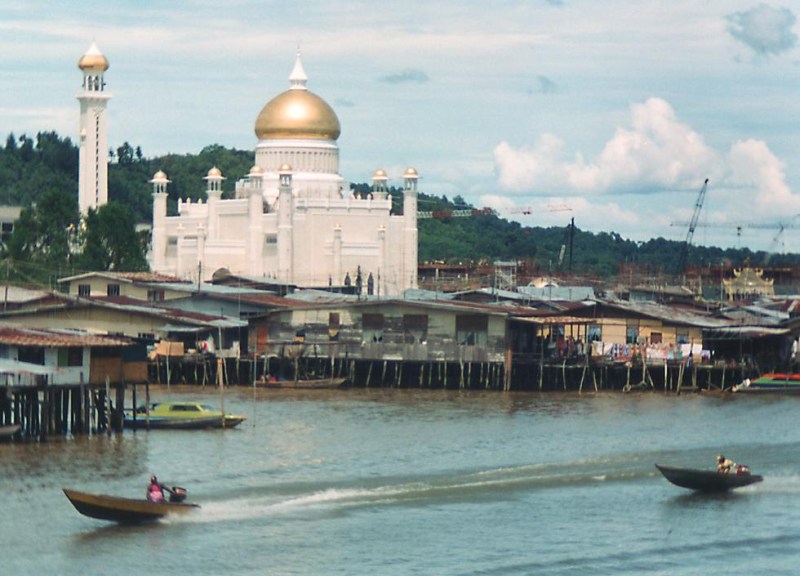
Right next to the mosque is Kampung Air, which in a quirk of the Malay and English languages translates as "water village". Thousands of houses, together with schools, shops and mosques are built on stilts embedded in the Brunei River, which keeps the people cool in the very hot and humid climate. It might look like a slum, but people actually choose to live here and there aren't too many slums whose inhabitants all own cars, which they park on the opposite river bank. |

It's not just the Omar Ali Saifuddin mosque which stands in luxurious contrast to Kampung Air; on the opposite side of the river you can see Istana Nurul Iman, which is the palace where the sultan lives. The royal family has a well-deserved reputation for financial and other excesses, but they're able to get away with it because there's enough oil money to be extremely wasteful and yet have plenty left over to "trickle down" to the remainder of the small population. Education up to university level is free, housing is heavily subsidized, there are no income taxes and the government pays for muslims who want to make the pilgrimage to Mecca. |

Here's a closer view of Istana Nurul Iman, which is the largest residential palace in the world with 1788 rooms, 257 bathrooms and a floor area of 200,000 square meters (2,200,000 square feet). It cost $US400 million to build, but that was no great worry for the sultan. At the time I visited Brunei he was estimated to be the richest man in the world, with $US40 billion in his savings account, though a few years later he was overtaken by some computer geek called Bill Gates. |
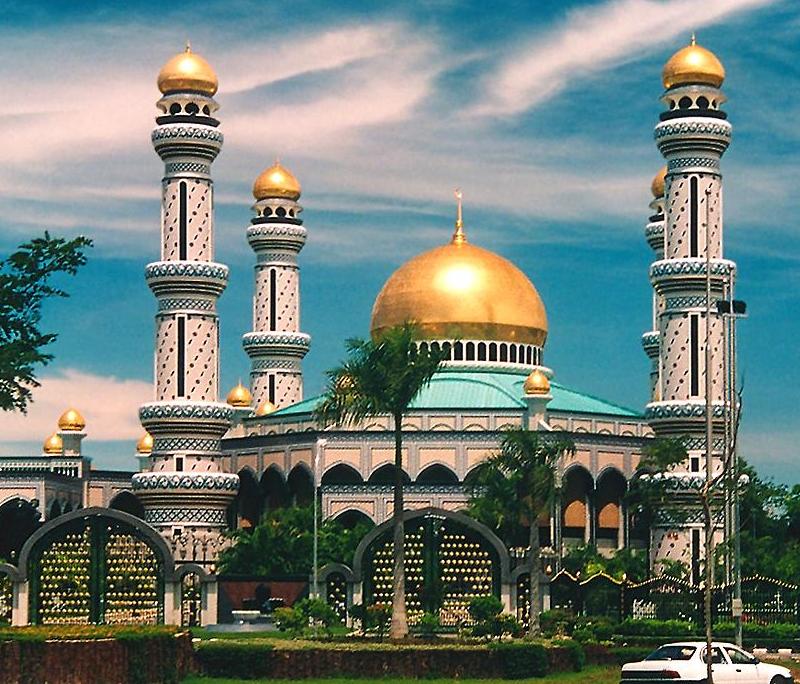
The current sultan built this mosque in Kiarong to celebrate his silver jubilee. It's officially called "Jame 'Asr Hassanil Bolkiah", the Hassanil Bolkiah mosque. It's even more spectacular than the Omar Ali Saifuddin mosque, and well worth a visit. |
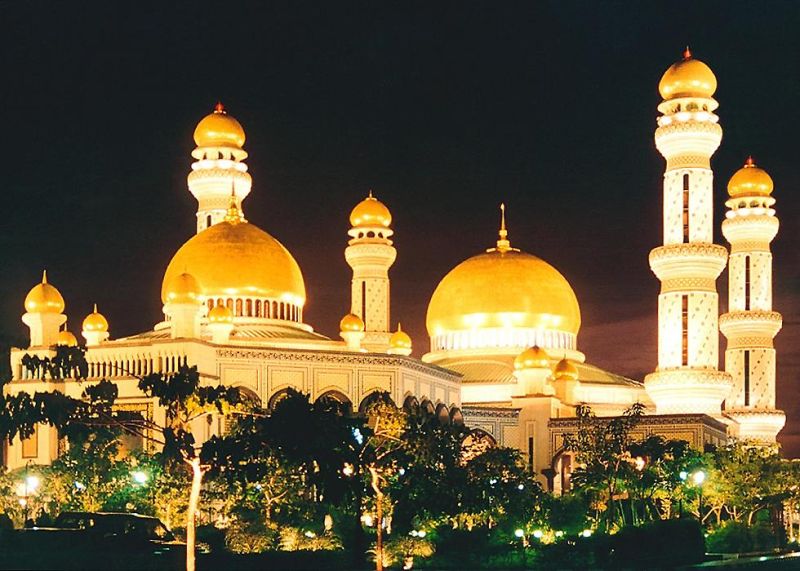
It's also lit up at nighttime. |
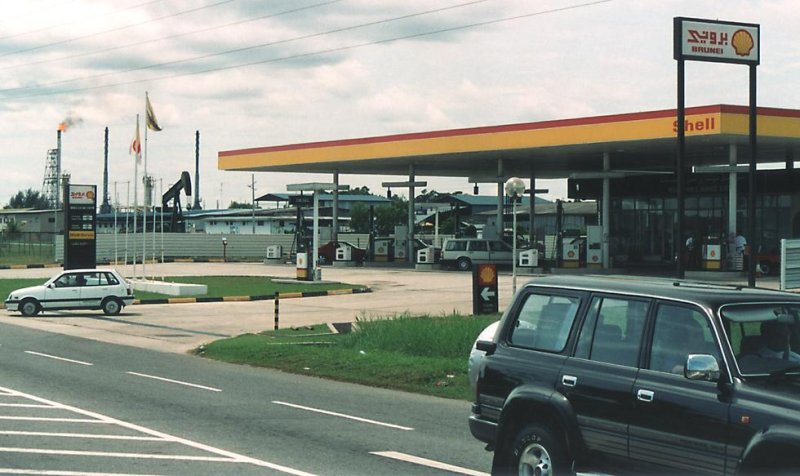
Here's a photo which shows almost the whole oil industry from start to finish - a "nodding donkey" outside the fence pumps oil from the ground, an oil refinery in the background burns off excess hydrocarbons during the distillation process, a petrol station retails the end product and happy consumers use the petrol to make the world a better place. Royal Dutch Shell has exclusive rights to operate the oil fields and they're by far the largest employer in the country. Incidentally, you can see the use of Arabic characters on the tall sign outside the petrol station; most of the road signs in Brunei are both in Arabic and Roman script. |
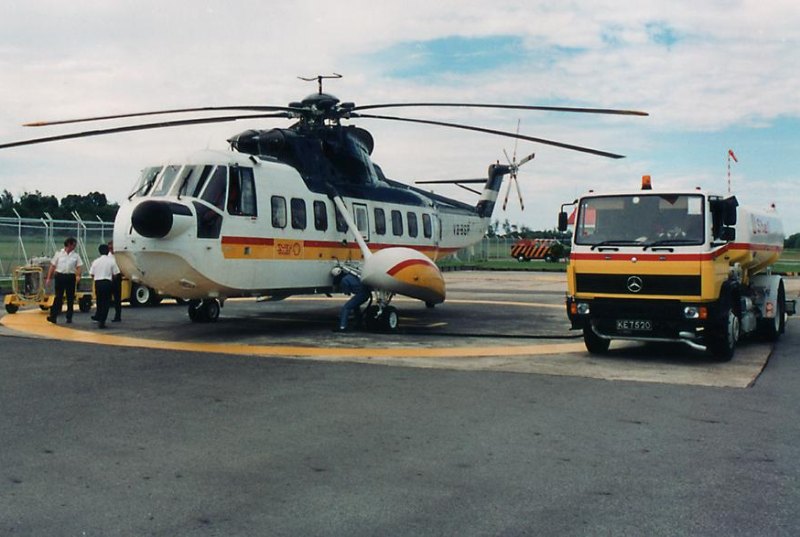
Oil was the only reason I came to Brunei, staying for a month down in Kuala Belait in 1994 in order to help install radio systems on the offshore oil rigs. Shell operates these Sikorsky S61N helicopters to transport workers to and from the rigs from the airfield at Anduki. |
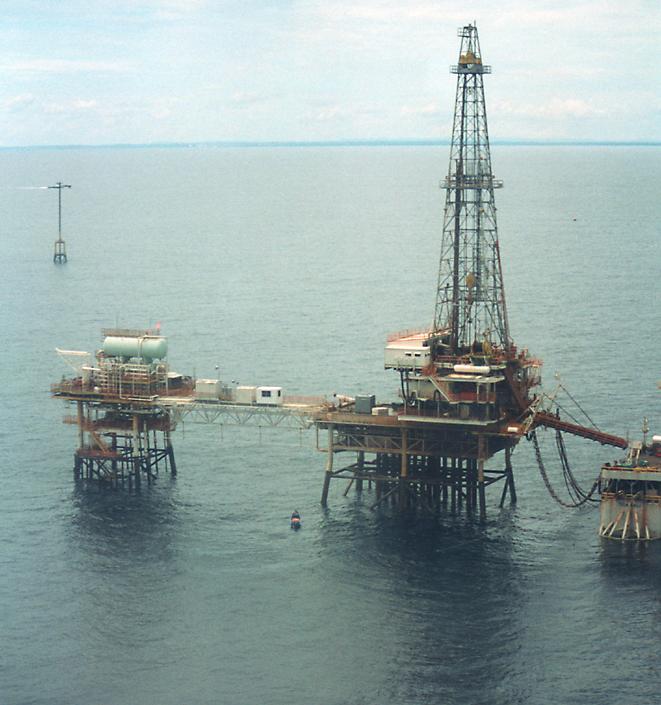
Here we are arriving at one of the many oil rigs. The religious leaders exert much less influence out here than on shore. Although each rig has a muslim prayer room, the videos labelled "romance" in the lounges were much more along the lines of "smut". On one of the service ships the captain was even soaking up some rays while lying down in the middle of the heliport in speedos - while I got told off while on shore for wearing shorts in the intense tropical heat! Oil contributes over half of the GDP of the country, and overseas financial investment from the oil wealth makes up almost all of the remainder. Despite ongoing noises about diversifying into other areas, little real effort has been made to create a sustainable economy. |
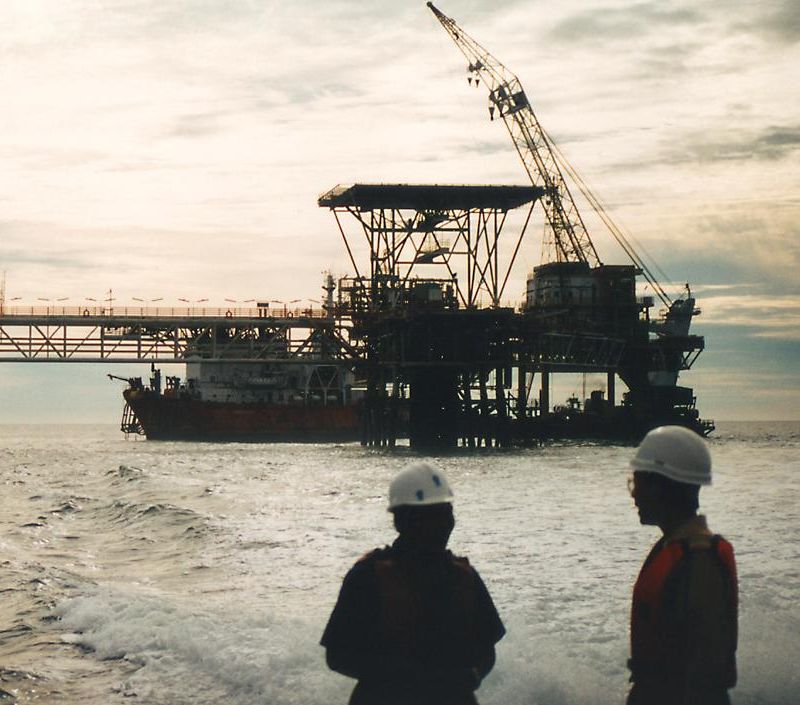
As well as the oil rigs, there are a large number of boats and ships dedicated to providing services. Each ship does a different task, like painting or engineering work such as x-raying the pipes in order to find corrosion. The radio systems I was doing the software for were used not just for oral communication, but also to send and receive faxes. The guy on the right-hand side of this photo is Haji Affendi, by far the nicest Bruneian I met - and also the most religious. The term "Haji" is a title rather than a personal name, it refers to someone who has made the "Hajj", or pilgrimage to Mecca. Most of the Bruneians I worked with were unmotivated, happy to lazily drift along on government handouts, but Haji Affendi took the job seriously and was also a very nice person. |
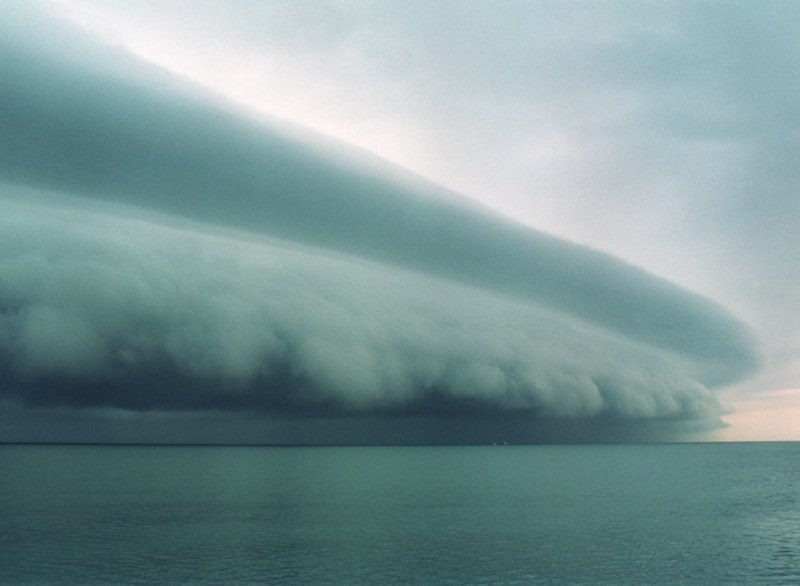
Brunei is too far south to be badly affected by typhoons, but they sure get some spectacular storms, with torrential rain and amazing lightning. When a storm comes in the ships leave the rigs, but some time after I'd returned to New Zealand we heard that one of the ships with our radio system had gone down during a storm, smashed against the rig. Apparently they'd tried to use our radio repeatedly to get help, but without success. It's a little strange, since the normal emergency communication is done on different equipment. |
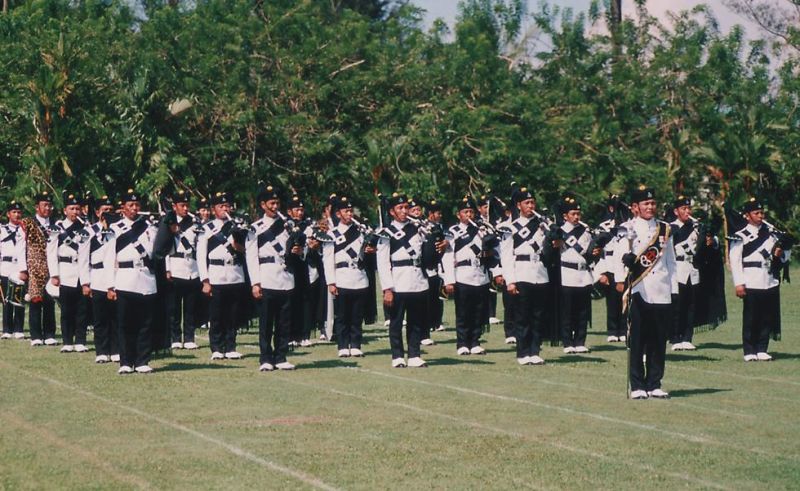
Here's an unusual event I stumbled upon - a Gurkha bagpipe marching band! The Gurkhas are an ethnic grouping in Nepal, they've served for many years in the British army, and they still serve in that capacity today in Brunei, along with other British troops. The government of Brunei pays for them, which suits everyone very well. It was the Gurkhas who held off the rebels during the 1962 coup attempt, waiting until British, Australian and New Zealand reinforcements arrived at Anduki from Singapore. |
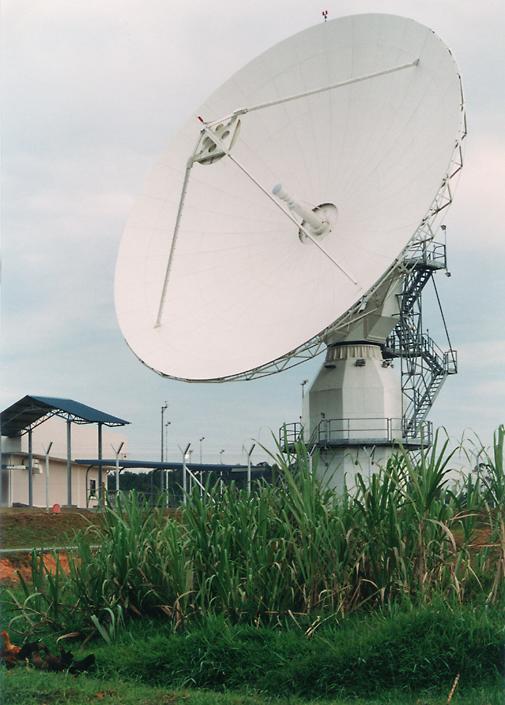
Nowadays the Gurkhas still guard the oil facilities, as well as other installations such as this satellite receiving station which is off the main road running the length of the country. Seeing this high-tech thing with the chickens running around, and with jungle surrounding it, reminds me of the Paul Simon song:
I was wandering around in the area looking for wildlife to photograph, but my shoes ended up caked a couple of centimeters thick with the gooey red clay you can see in this photo. While I was walking outside the fence a Gurkha soldier guarding the facility called me over and brought me inside the fence to use a hose to wash off the clay. It was very strange to hear him speak with a very upper-class English accent - I guess he must have picked it up from his British officers. |
 These are the days of lasers in the jungle
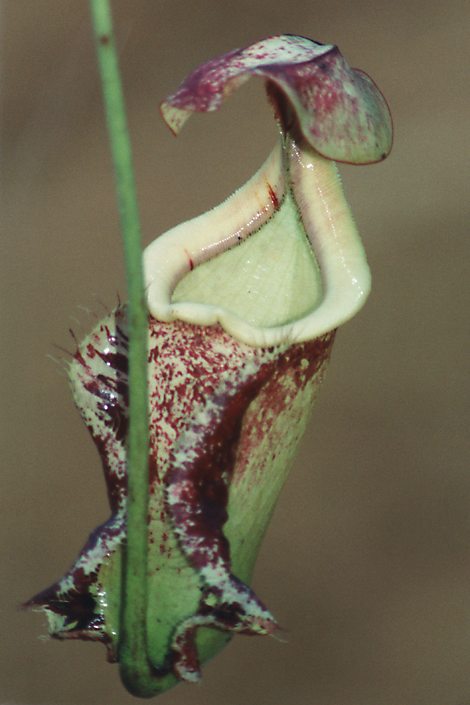
I'd been looking around at various locations around Brunei for pitcher plants, which I'd heard are quite common on the island of Borneo. As it happens, this satellite station was the only place I saw them, and not just large ones like this, but a much smaller variety as well as one where the pitcher wasn't more than one or two centimeters long. Pitcher plants digest insects which fall into the liquid inside the container you see here. The plants do this to obtain nitrogen, which is a very rare commodity in water drenched areas like tropical jungle. The soil in such places is usually very poor, which might seem surprising, since there's such a variety of wildlife there. |
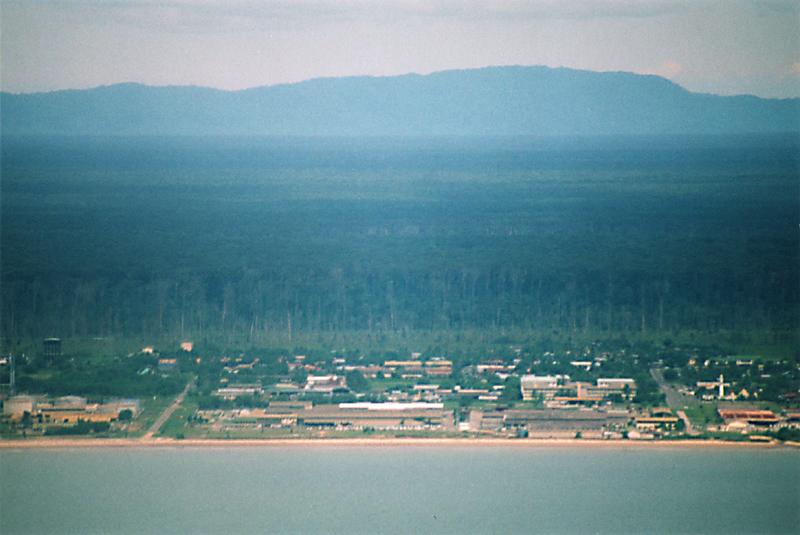
Here's a view of the town of Seria. This photo gives a pretty good sense of what Brunei is like - a beach which few people use because of the religious outlook, a narrow strip of inhabited land and then vast areas of jungle reaching to the Malaysian border. Oil, which has done so much to destroy large areas of the planet, has had the opposite effect here. Nobody can be bothered doing hard physical labour like farming, so less than one percent of the country is cultivated. |
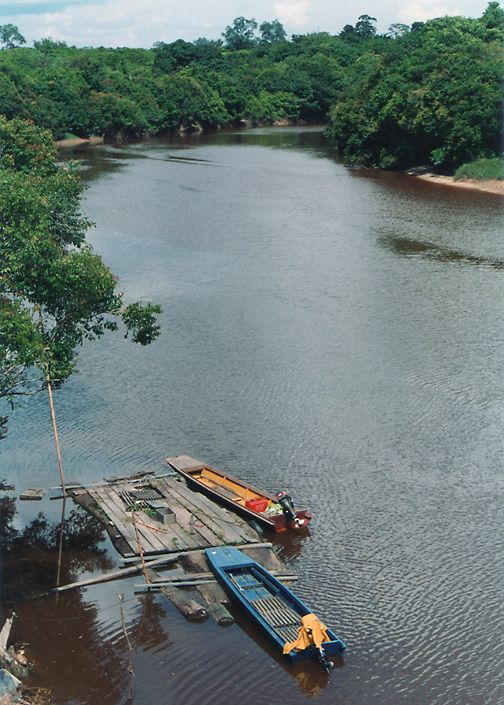
The abundant areas of untouched forest are one of the few reasons why I can imagine returning to Brunei. This particular scene is on the Belait River, near where we were staying in Kuala Belait, which I always thought of as a "Belait on the landscape". At the time I visited I wasn't as deeply involved in wildlife photography as I am now, but Brunei might be where that latent interest first received a large boost. I took quite a few photographs of birds like kingfishers, as well as dragonflies and other insects - none good enough to put up here, though. I visited a couple of nature preserves, including Tasik Merimbun, which has the largest lake in Brunei. There are other facilities such as the Kuala Belalong Rainforest Field Studies Centre, which mostly caters to scientific researchers. In the eastern part of Brunei, tours go into the mangrove forests to see proboscis monkeys, so named for the huge noses sported by the males. There are even tours into the rainforest at night, which is a major pastime for me nowadays when I'm travelling. |