| I
visited Bali in the early 1990s, spending almost all of my time in the
southern tourist trap of Kuta, surrounded by drunken Australians.
I enjoy the
sophisticated delights of Australian culture as much as anyone, but
when I went to Bali again in 2007, I was determined to stay as far from
Kuta as possible, so I spent my first night in the cultural center of Ubud.
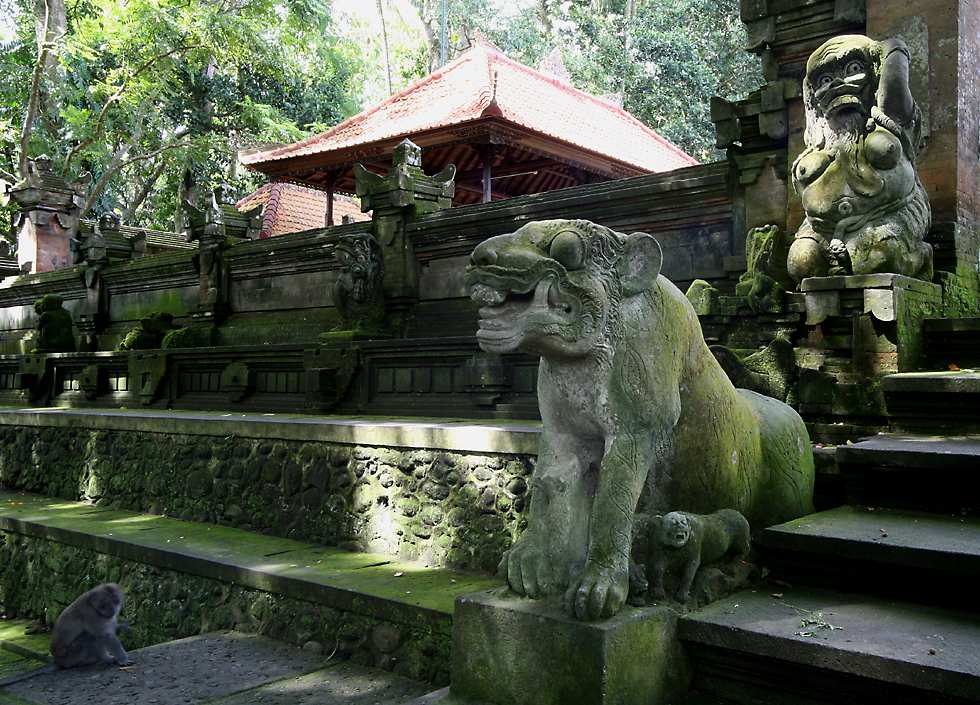
There are plenty of sites to see around Ubud, such as the Monkey Forest,
one of several small sacred monkey forests in Bali, all of which have Hindu
temples within them. |
 |
| The
first time I was here I didn't even own a camera, so I revisited all of
the places I'd been before and made up for this deficiency. That
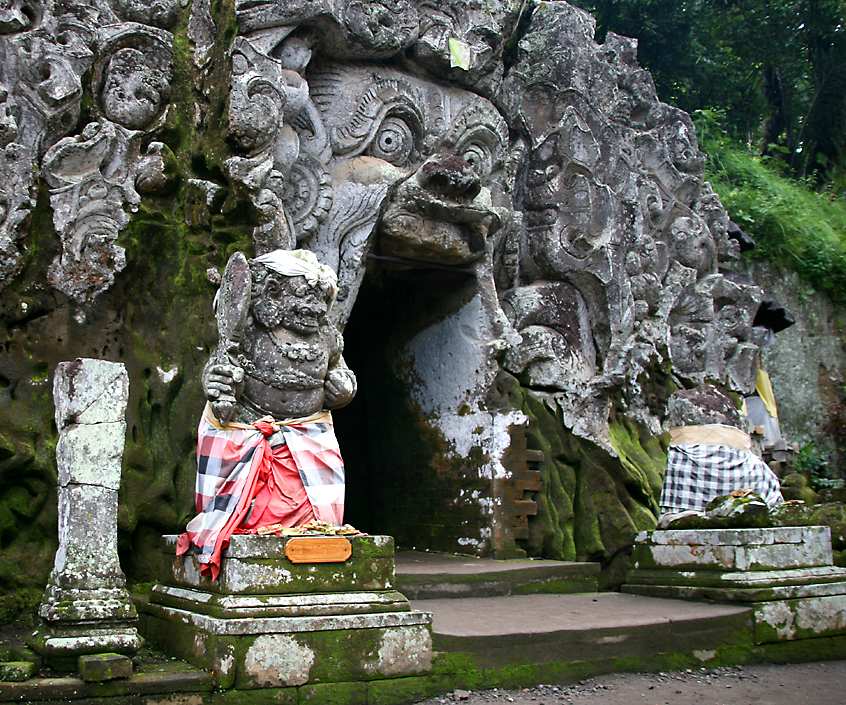
included an hour or so at Goa Gajah, the Elephant Cave, one of the oldest
Hindu temples on the island, dating back to about the 11th century AD.
Long obscured by jungle, the cave wasn't rediscovered until 1923 and the
nearby fountains and pool weren't dug up until 1954. |
 |
| After
visiting other sites like Yeh Pulu and Gunung Kawi near Ubud, I headed
to the north coast, and over the next few days I visited some of the temples
up there. If you're expecting antiquities everywhere then you'll
be disappointed, because these are active temples rather than just tourist
attractions, and most of the famous sites are only 100 or 200 years old.
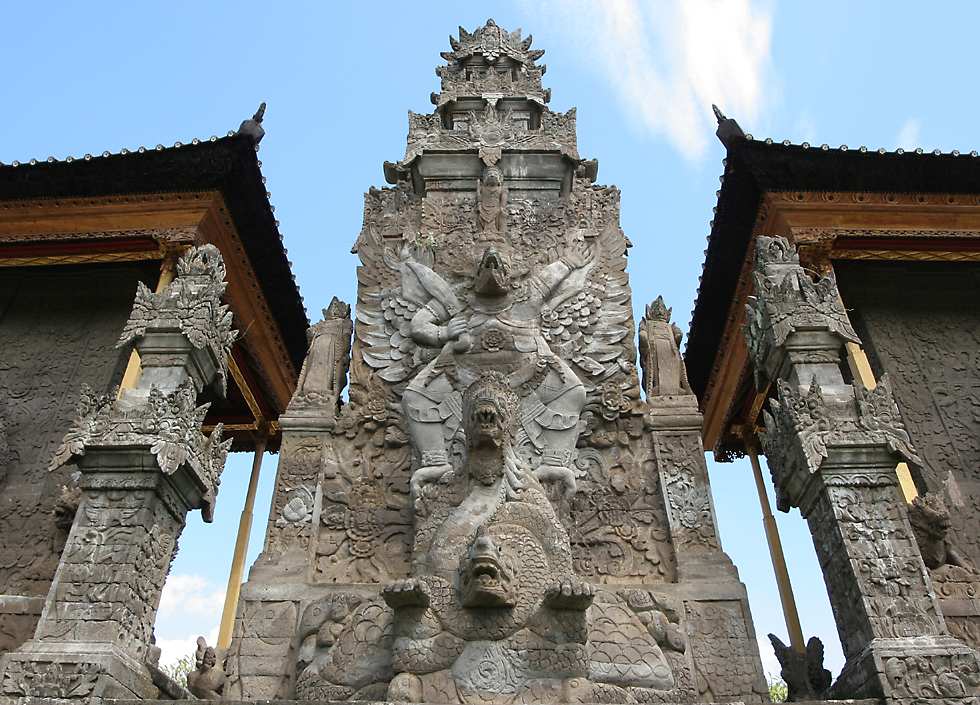
This one is called Maduwe Karang, and it's chock full of marvellous carvings. |
 |
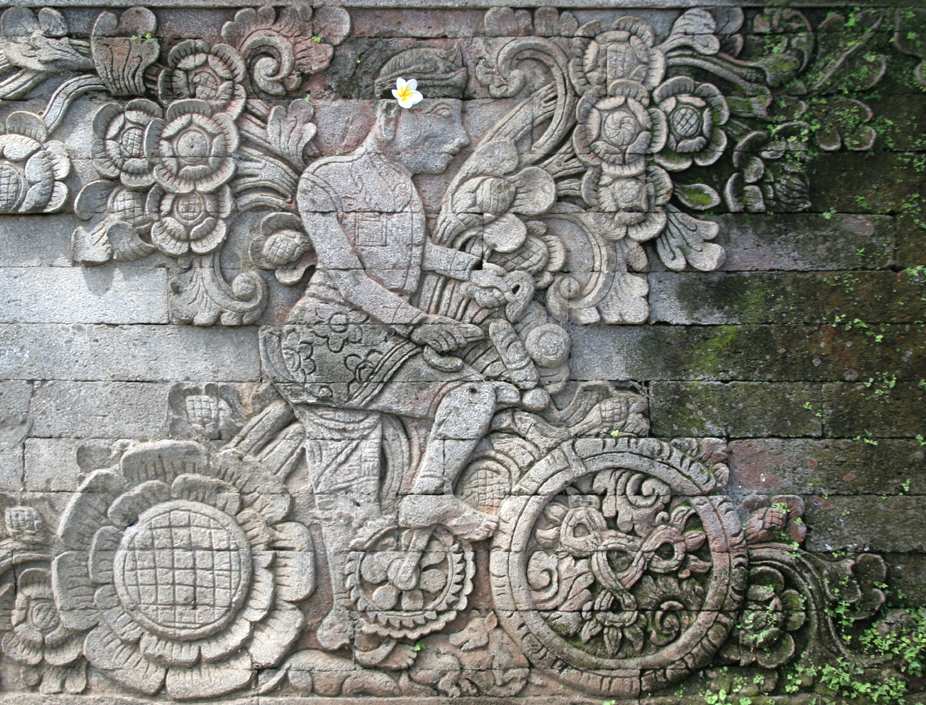
| The
relative newness of the temple and its carvings is made very clear by this
piece, a famous and rather psychedelic image of what looks like a native
Balinese worker in the colonial government, riding on a bicycle with a
flower for its rear wheel. |
 |
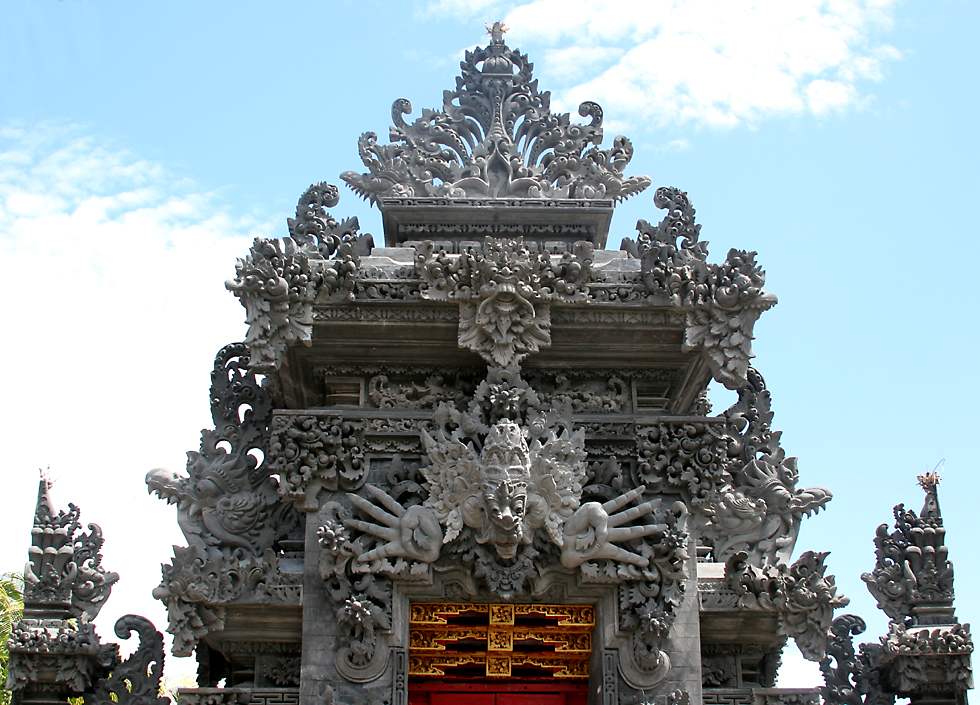
| As
you've already seen, the temples are extraordinarily ornamented, perhaps
none more than the pura dalem at the town of Sangsit.
I particularly like the being with the large outstretched hands above the
gate, a motif that appears in a number of temples around the island. |
 |
| The
temple at Jagaraga also has modern scenes carved on the walls, including
a panel which shows Dutch aircraft attacking inhabitants of the village
who were rebelling against colonial rule. The biplanes make
this seem like a scene from the 1920s or 1930s, but after world war two
both the British and the Dutch engaged in bloody fighting against the local
population throughout what was then called the Dutch East Indies, a struggle
which wasn't resolved until independence was achieved at the end of 1949. |
 |
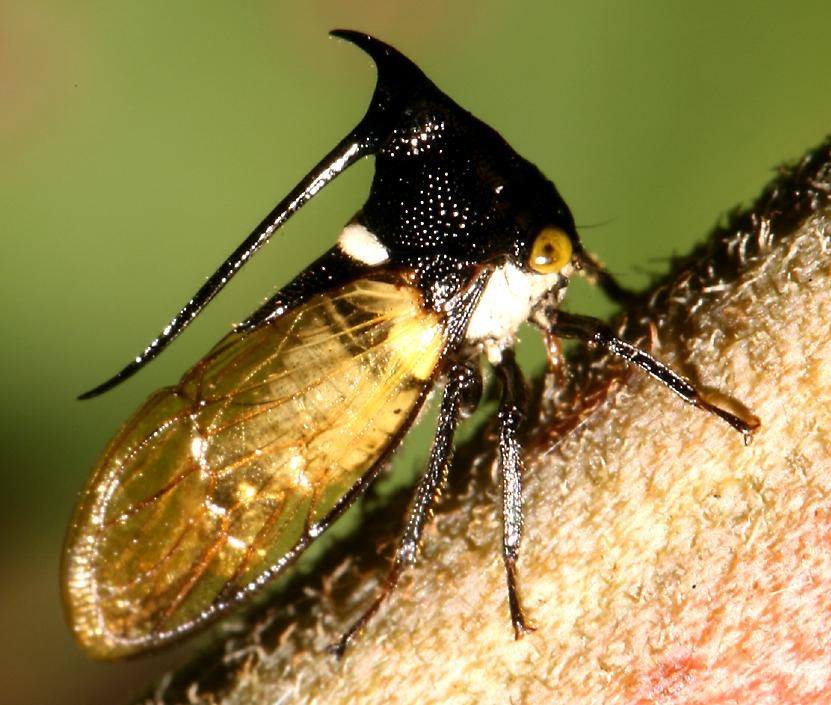
| The
temples turned out to be a very good place to photograph some of Indonesia's
insect life, including way-out treehoppers like this one, an extraordinarily
colored and patterned grasshopper, stick insects (called walking sticks
in the USA) and the other types of critter that one finds only in the tropics.
I also came across a variety of butterflies during a half-day walk in West
Bali national park, very near the town of Pemuteran, where I spent most
of my week in Bali. |
 |
| The
park itself doesn't have any spectacular scenery, but the rest of the island
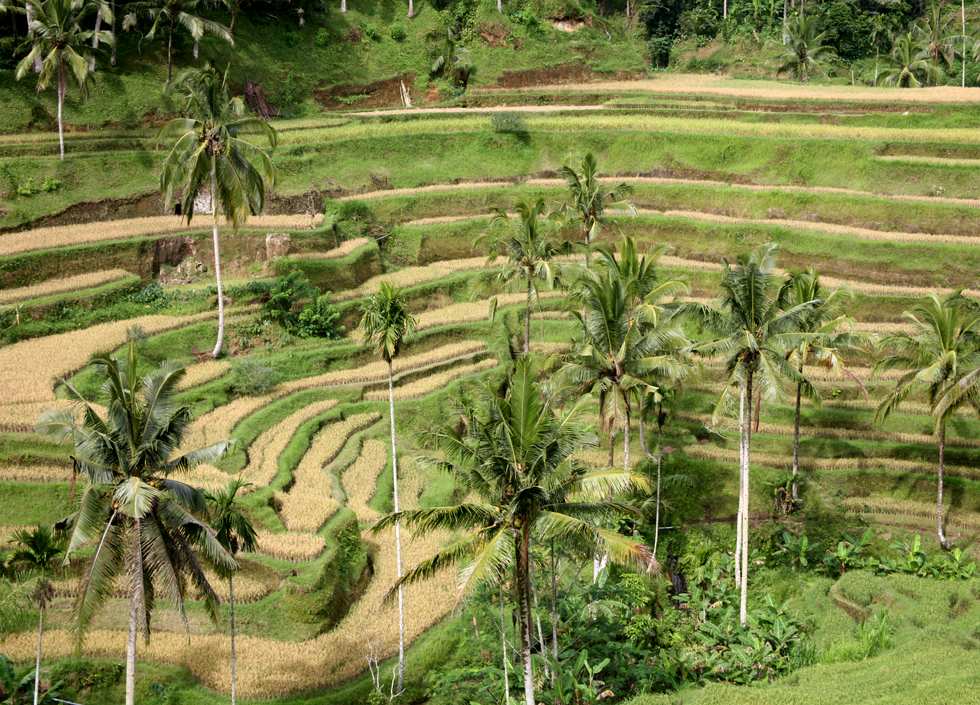
certainly does, some of it man-made like these rice paddies at Triwangsakeliki,
which I accidentally bumped into after getting lost driving between Ubud
and Gunung Batur. However most of the beauty is of natural
origin, a result of the country's volcanic geography. Indonesia
has a front-row seat to the Pacific's Rim of Fire, making it the most volcano-prone
country on the planet, with about 130 which are currently active. |
 |

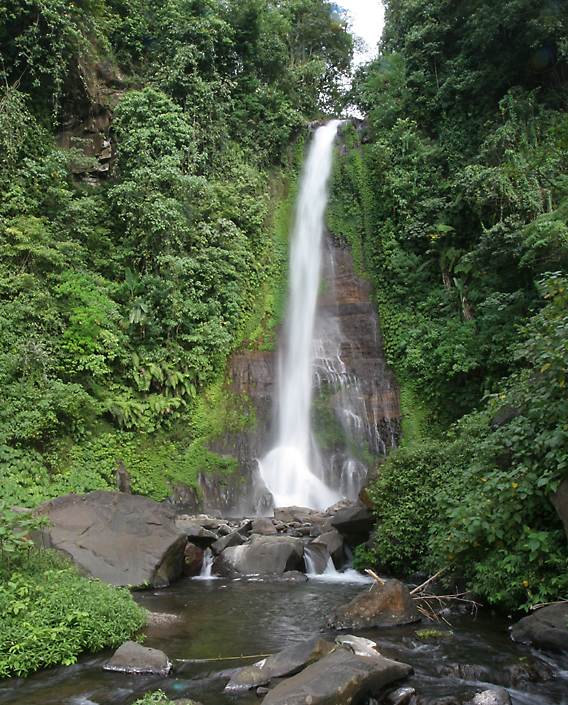
There are two sets of waterfalls near the town of Gitgit, as well as others
scattered around other parts of the island.
This is the lower Gitgit waterfall, which like Ubud monkey forest is another
good location to see some of the area's insect life, in the form of brightly
colored dragonflies and damselflies.
There are also four large lakes in central Bali; I visited three of these,
the best being the very attractive Danau Buyan, which has a road running
high above it, affording excellent views of the lake and its surrounding
area. |
| Ever
since I first went to Bali, soon after the travel bug bit me, I've felt
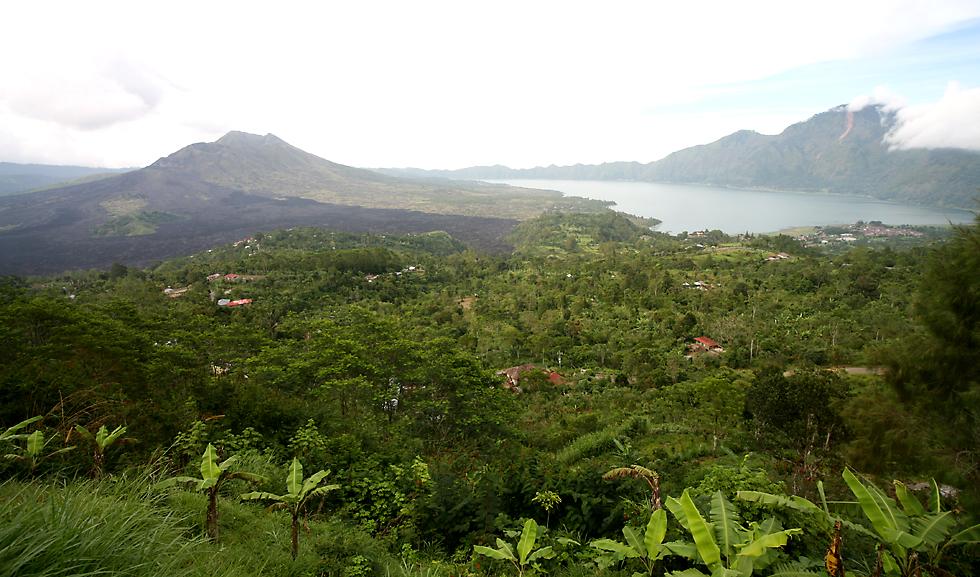
that Gunung Batur (Mt Batur) is the most spectacular piece of scenery in
the world. Gunung Batur is a volcano next to a lake, all contained
within the 10 kilometer wide crater of an even larger volcano called Gunung
Abang, whose highest remaining point is covered by cloud on the right-hand
side of this photo. As you can see from the black lava field
in this shot, Gunung Batur is still active, its most recent eruption being
in the year 2000. Danau Batur (Lake Batur) is the largest lake
in Bali, measuring 8 kilometers by 3 kilometers. |
 |
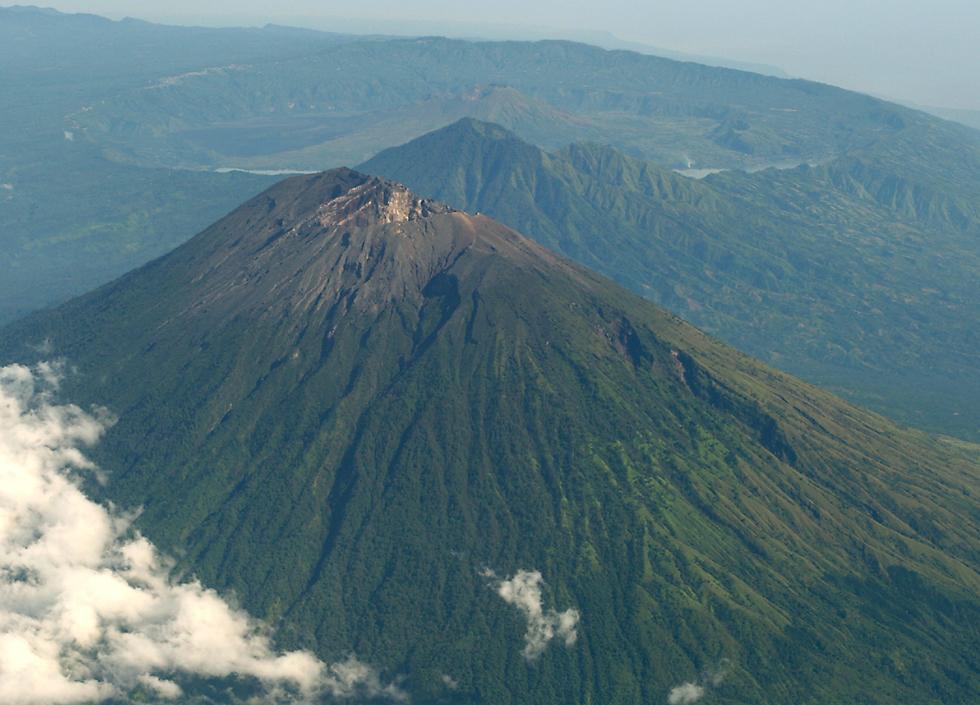
| Here's
a shot from a different perspective, taken as I flew out of Bali.
In the foreground is Gunung Agung, the spiritually important "mother mountain"
of Bali, and directly behind it is Gunung Batur within the crater of Gunung
Abang. |
 |
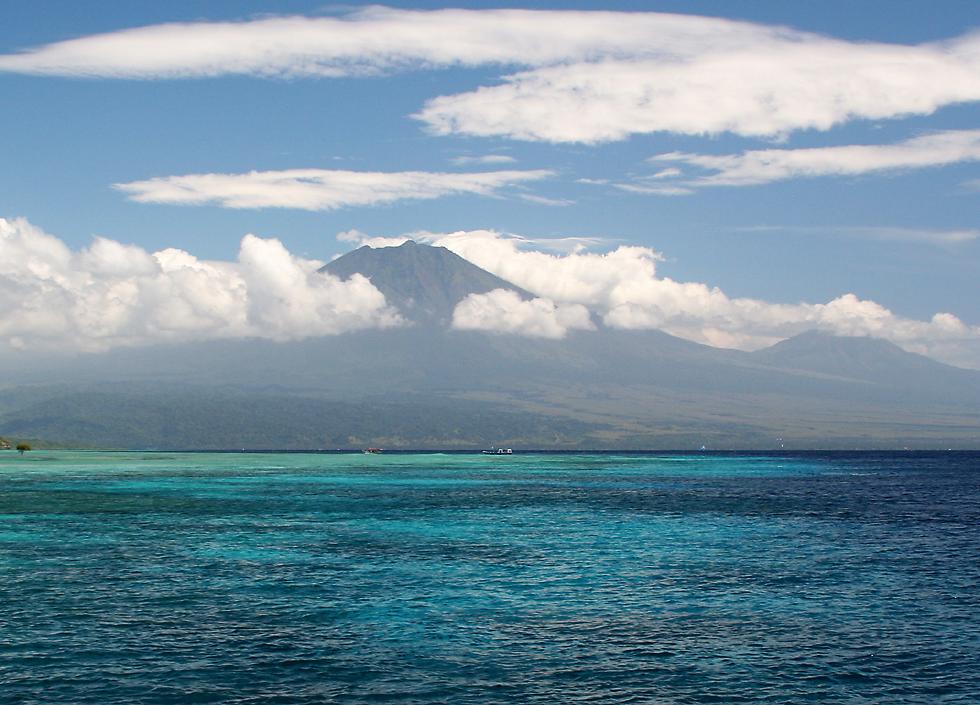
| As
I mentioned earlier, the town of Pemuteran on the north-west coast of Bali
is a great place to stay if you want to make forays into West Bali national
park, but it's also the ideal place to base yourself for scuba diving trips
in the area, most notably off the small island of Pulau Menjangan (deer
island), which is within the park boundaries. As a bonus, you
can often get a clear view of several spectacular volcanoes on the nearby
island of Java, including Gunung Merapi ("fire mountain") and Gunung Ijen
which contains a crater lake of sulfuric acid. The Gunung Merapi
you see here is not to be confused with Gunung Merapi on Sumatra or the
more famous Gunung Merapi near Yogyakarta, which is also on Java. |
 |
| Although
I could easily have spent three weeks just in Bali, on this trip I also
wanted to hit Java. I planned to avoid the cities as much as
possible because of the pollution, traffic congestion and lack of compelling
sights, but the long drive from Surabaya meant that it was already late
when I arrived in the cultural center of Yogyakarta. I made
the most of the situation by staying overnight and spending the next morning
touring the kraton, the sultan's palace within a small walled city
in the center of the modern city of Yogyakarta. As in Bali,
devotees of great antiquity would be better off visiting Egypt,
Mexico
or Guatemala,
since Yogyakarta and its kraton were only established in 1755.
However it's a great place to see traditional Javanese palace architecture,
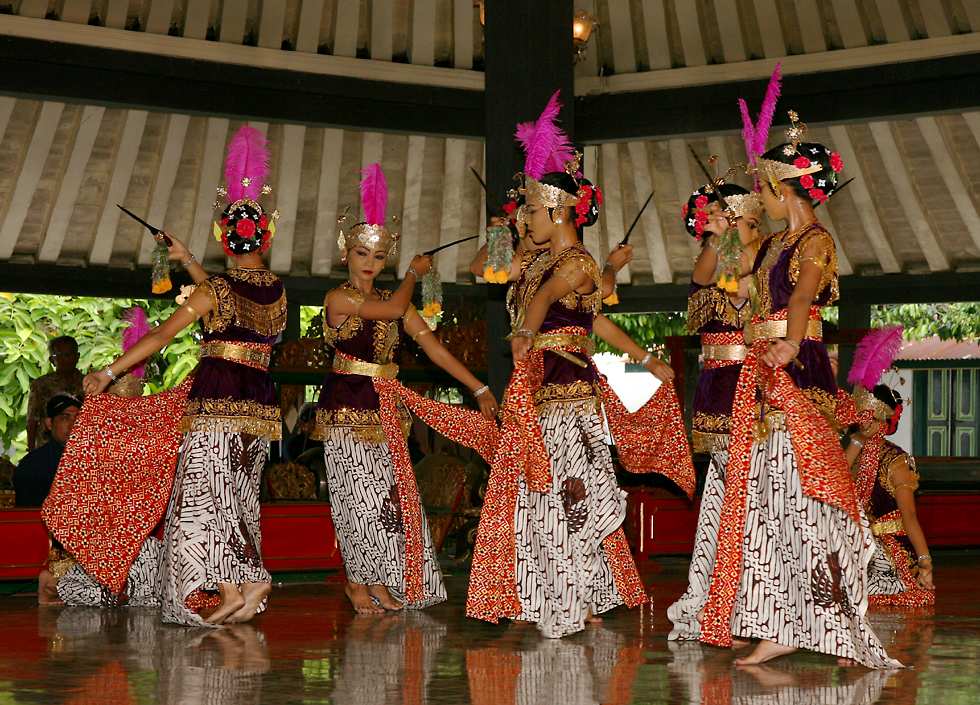
and several times a week there are free cultural performances by dancers
backed by a gamelan orchestra with singers, playing scenes from traditional
epics. I'm not quite sure of what's going on in this photo,
but I think of it as "sweaty young girls with sharp knives", and the music
was certainly very appealing. |
 |
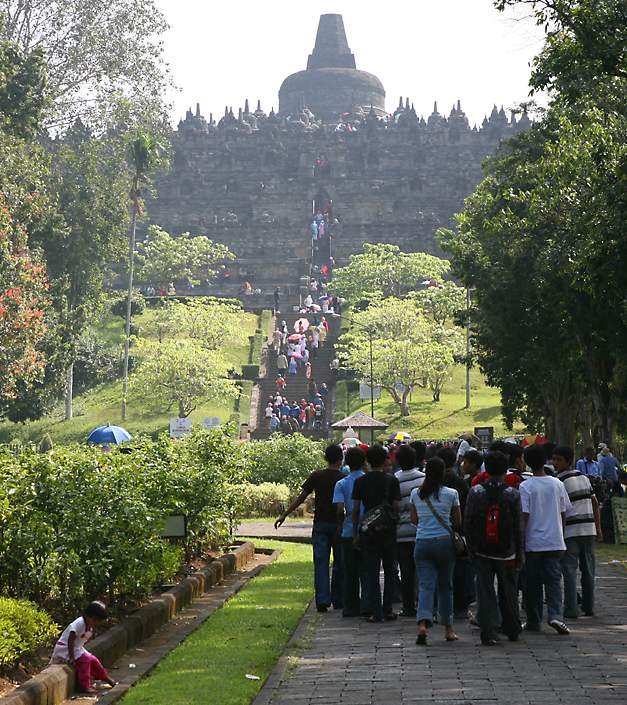
The main reason I visited this part of Java was to go to Borobudur, the
most popular ancient site in Indonesia, flooded by both foreign and local
tourists all day long. It's widely considered one of Asia's
most spectacular archaeological sites, ranking right up with Angkor Wat
in Cambodia.
Borobudur is a large Buddhist monument built about 1200 years ago from
60,000 cubic meters of stone, which had to be carved and then transported
to this spot. Political and religious developments led to its
abandonment and after being buried by the jungle it was only excavated
again in 1815, and a huge restoration project between 1973 and 1983 finally
brought it back to its original glory.
About two million stone blocks were used in its construction, structured
in very symbolic fashion as ten levels, each representing a different stage
in the passage of the soul from earth to heaven. Carved panels
stretching all of the way around each level of the structure tell the story
of Buddha's various incarnations, as well as the lives of his parents and
others. A total of 432 Buddha statues adorn the structure,
some visible in open niches and others inside the bell-shaped latticed
stupas on the top three levels. |
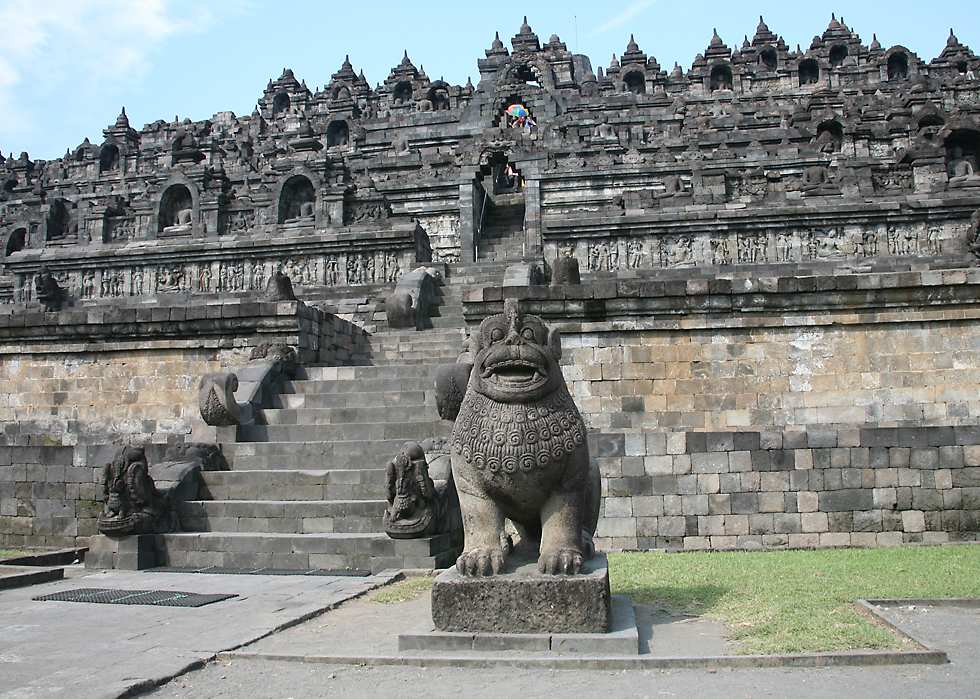
| To
be honest, I was rather disappointed by Borobudur. It was certainly
nice and undoubtedly an amazing feat of construction, but for me it was
lacking in visceral impact, I think because its great width of around 118
meters on each side gave it a somewhat squat appearance. |
 |
| Borobudur
isn't far from Yogyakarta, and nor is the temple complex of Prambanan,
which originally wasn't even on the list of places I was planning on visiting,
even though I would be driving right past it. This was mostly
due to a report I heard, which turned out to be true, that the site had
been fenced off to allow them to deal with some serious earthquake damage
which had occurred the previous year. In spite of my misgivings,
after visiting Borobudur I decided to drop in on Prambanan late in the
afternoon, to decide whether it was worth spending time on the next day. |
 |
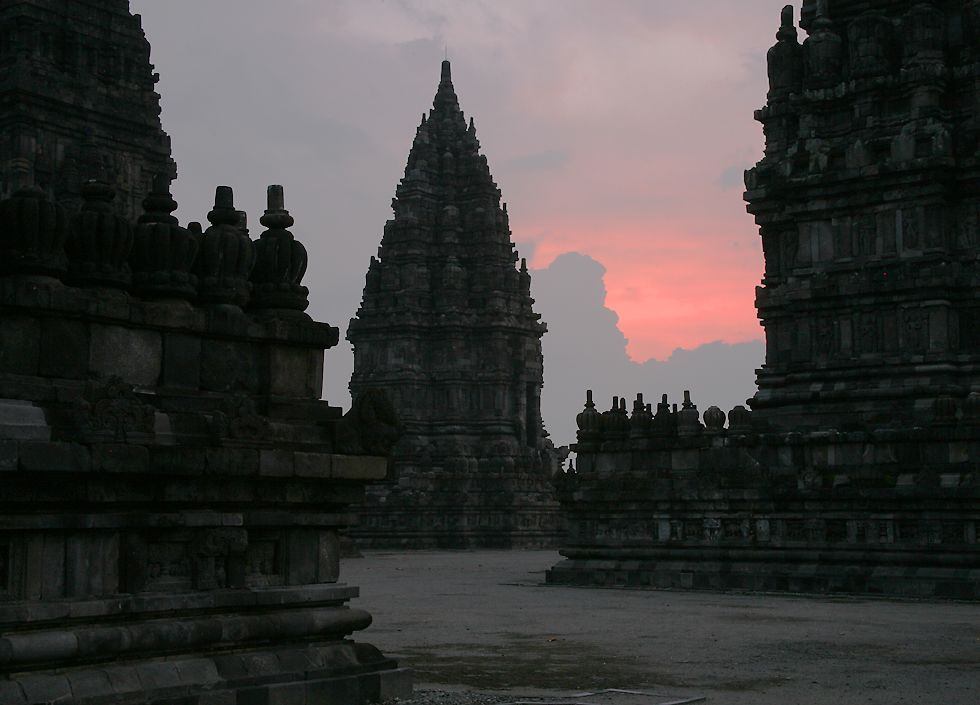
| I
was most impressed, and made an extended return visit the next morning,
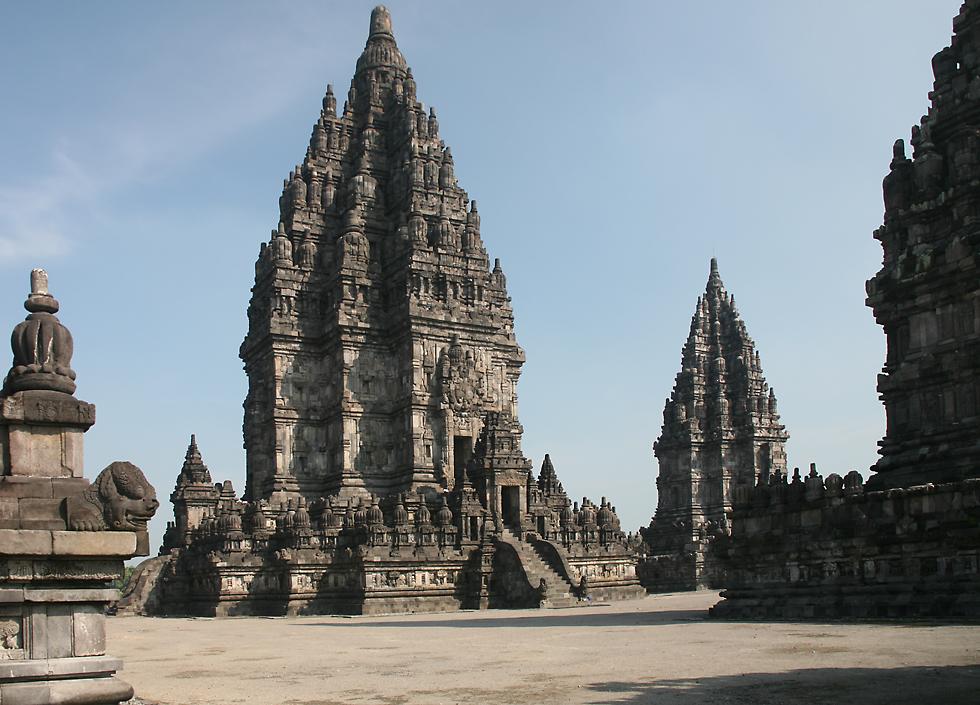
after also redoing Borobudur in the morning light. Prambanan
is the largest and most impressive complex of Hindu architecture in Indonesia,
and one of the best in south-east Asia as a whole. The height
and majesty of the temple buildings, particularly the largest one dedicated
to Shiva the Destroyer, more than made up for what they lacked in bulk
compared to Borobudur, which was built about 50 years earlier.
Candi Shiva (Shiva temple) is 47 meters tall and flanked on either side
by Candi Brahma and Candi Vishnu, with smaller temples (visible on the
far left and right of this photo) dedicated to each of the three gods'
animal mounts, namely the bull Nandi for Shiva the Destroyer, the goose
Angsa for Brahma the Creator and the eagle Garuda for Vishnu the Preserver.
The whole complex was surrounded by 244 minor guard temples, only two of
which have been rebuilt because most of the stonework was removed long
ago by people looking for building materials. |
 |
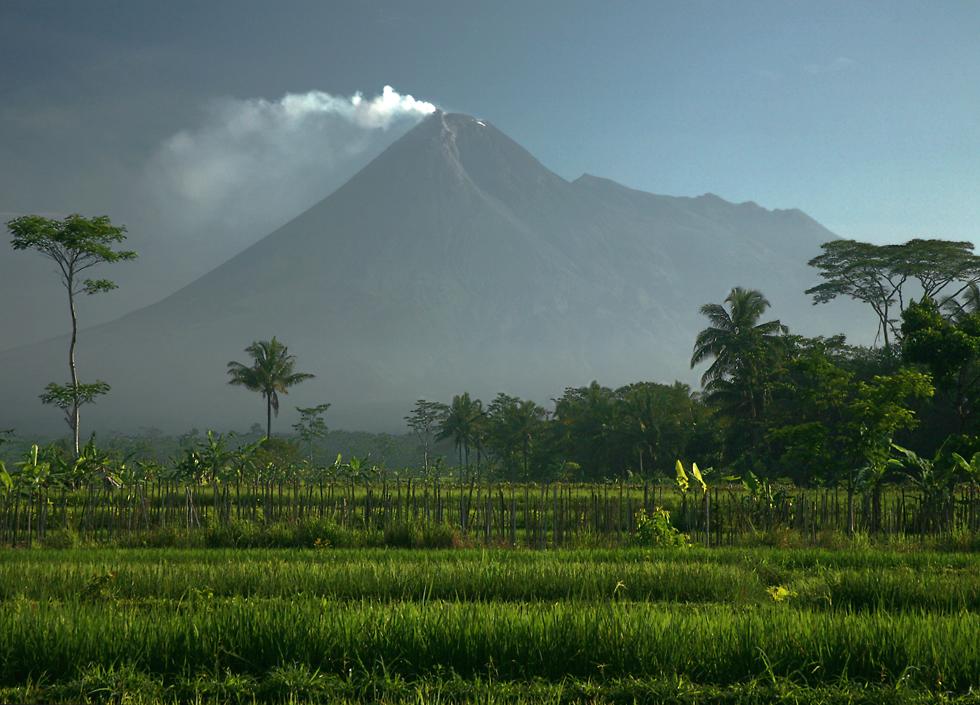
| The
guidebook promised magnificent views of Borobudur, Prambanan and other
sites with Gunung Merapi towering over them in the background, but these
statements proved to be farcical, since the tropical haze and cloud made
all of the mountains completely invisible except early in the morning.
Eventually I did get photos of Merapi when I was driving between Borobudur
and Prambanan. It's an extremely active and dangerous mountain,
killing tens of thousands of people over the past few centuries, the most
recent major eruption being in 2006. The sultan of Yogyakarta
and his subjects continue to make annual offerings here to placate the
mountain, as was done in pre-Islamic Java. |
 |
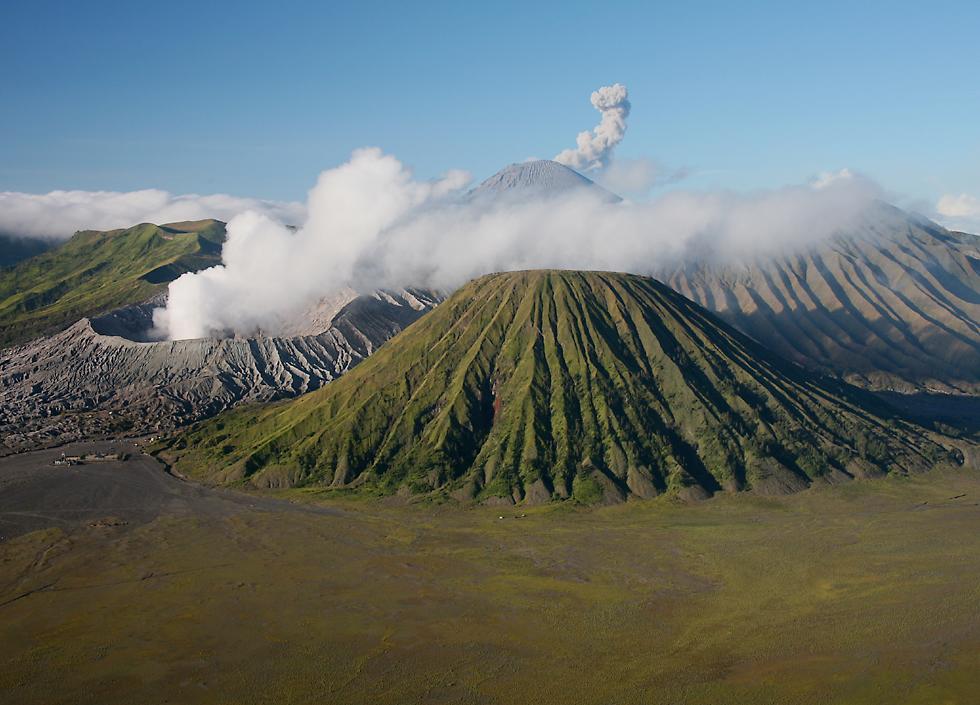
Gunung Batur move over, you're no longer the most sublime piece of scenery
in the world! After leaving the vicinity of Yogyakarta I headed
400 kilometers to the east, an all-day drive over the congested main roads,
arriving at night at Gunung Bromo. After my previous experiences
of hazed over and clouded up volcanoes I had a sinking feeling that the
picture postcard images I was hoping for wouldn't eventuate.
However a 5AM start followed by a tricky six kilometer drive and a half-hour
walk brought me to the Penanjakan II viewing area above a spectacular and
constantly changing scene which I continued photographing for several hours.
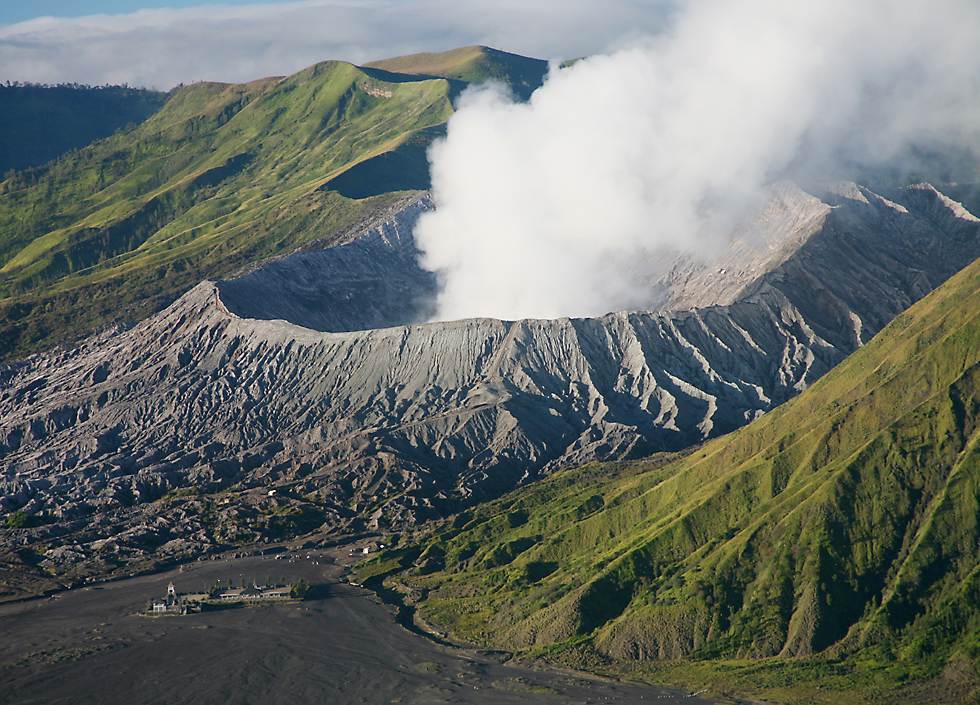
Like Batur, Bromo is a volcano rising up from the ten kilometer wide caldera
of a much larger volcano, in this case Gunung Penanjakan, which itself
is part of the Tengger massif. There's no lake within the caldera,
however the steaming cone of Mount Bromo is sandwiched between Gunung Batok
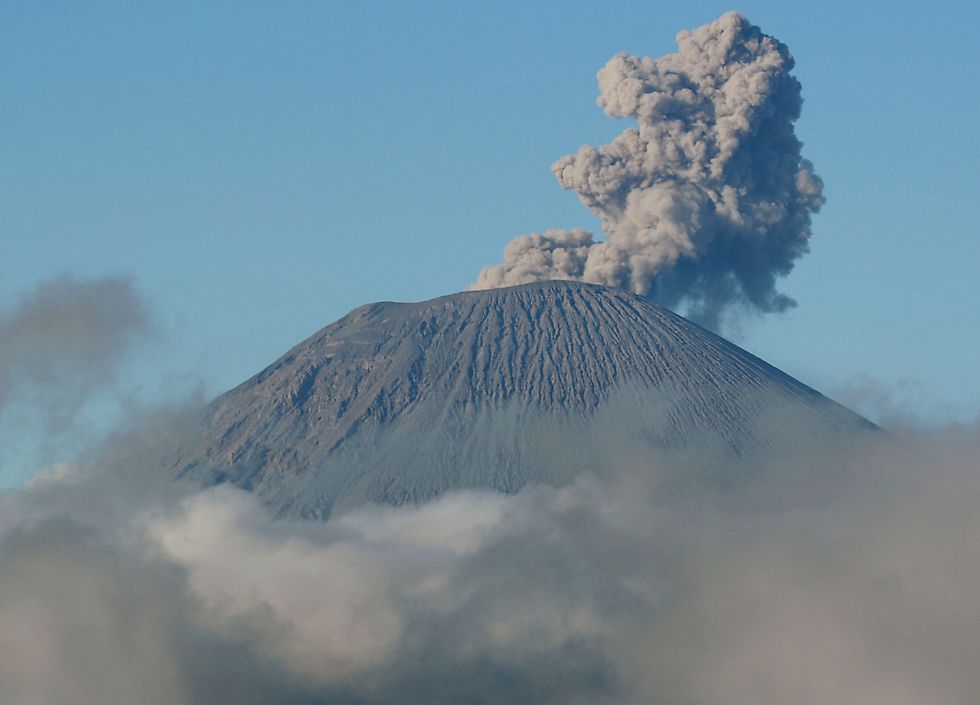
in the front and Gunung Kursi behind with Gunung Semeru, the highest mountain
in Java, smoking about 20 kilometers away in the background.
The grandeur of the scene is further emphasized by the almost complete
flatness and emptiness of the "Sea of Sand" at the bottom of the caldera,
and by the clouds which by mid-morning start pouring over the caldera walls
and adding another dimension to the landscape. |
 |
| It's
possible to stay captivated for a long time, since the whole scene changes
as the morning light develops and the steam of Bromo and the ash of Semeru
visually interact. The reason that the name of Bromo, the smallest
of the five volcanoes, is given to the whole is because of its significance
in local tradition and religious beliefs. According to the
area's inhabitants, the Hindu prince and princess who came and established
their rule here after the rise of Islam were childless, so they prayed
to the god of the volcano, who gave them 25 children but demanded that
the youngest be sacrificed by throwing him into the volcano.
After much tribulation this was eventually done, and to this day a Hindu
temple lies at the foot of the mountain, with a walking trail and 253 steps
leading up to the lip of the volcano. Each year offerings are
thrown into the volcano to ensure continued peace and prosperity, and apparently
human sacrifices are relatively common too, in the form of foreign tourists
who venture too near the crumbling edge and fall into the crater to their
deaths. Tourists have also been killed in recent years when
molten rock was hurled out of the mountain, reaching as far as the temple. |
 |
| The
whole scene changes not just during the course of a day, but also over
the course of a year, as wet season turns to dry season. At
times the whole floor of the caldera is covered in thick mist, with the
three peaks within poking through the top of the cloud layer.
At other times both Bromo and Semeru are quiet, with neither steam nor
smoke, though I was very grateful to have both, Semeru letting out a large
ash cloud every 10 or 15 minutes. Since I was on a whistle-stop
tour, I didn't go into the caldera or visit anywhere else on the massif. |
 |
| I
was on my way to Kawah Ijen, a few hours drive further to the eastern edge
of Java, where I planned to stay for about 3 days before heading back to
civilization. Ijen is one of the mountains visible in that
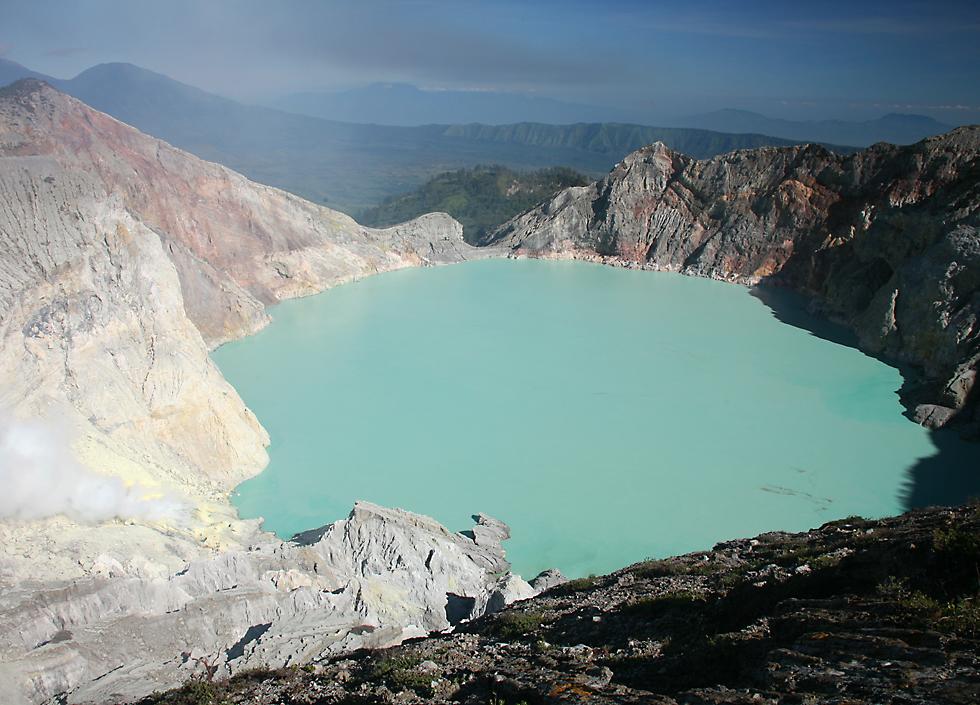
previous photo taken from Bali, and Kawah Ijen is the crater of the volcano,
famous for its turquoise colored lake of sulfuric acid, which is undoubtedly
attractive but probably not the best place for a relaxing swim!
As you can see from the steaming vent on the left-hand side of this photo,
it's still an active volcano, with yellow sulfur deposits visible on the
side of the crater. It's also another place where foreign tourists
periodically fall and die, a sign in French at the volcano's lip warns
of this danger, appropriately enough since on the day I was there about
a dozen French speaking tourists were present, and some years earlier a
French tourist had died. |
 |
| Amazingly,
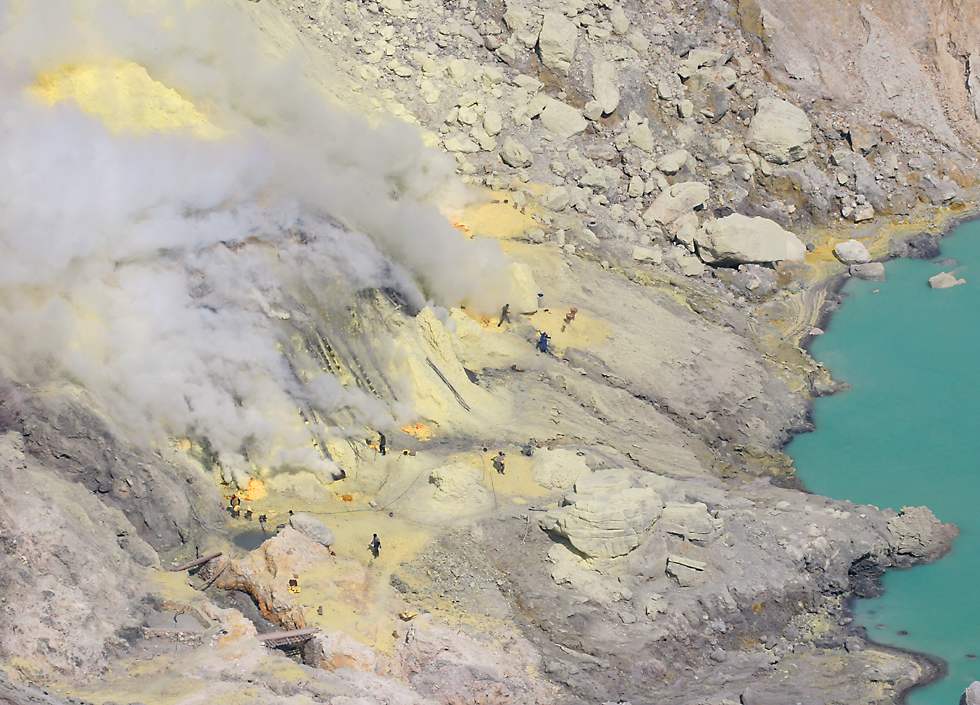
Kawah Ijen is also the site of a primitive sulfur extraction industry.
The output of the volcanic vents is routed into long ceramic pipes, and
the sulfur condenses on the inside of the pipes and then flows down to
where it solidifies into yellow elemental sulfur. |
 |
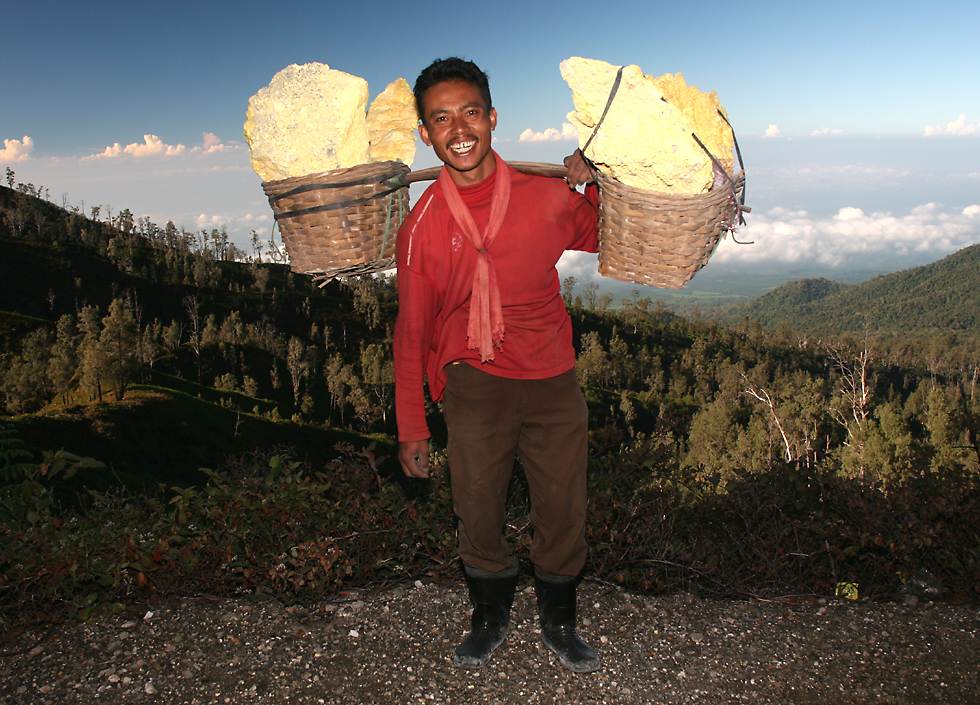
It's all very low-tech, relying on porters to carry the sulfur up from
the crater floor and then down the steep three kilometer trail to the road.
They're lucky it's downhill almost the whole way, because it took me about
two and a half hours to get to the top, admittedly I was loaded down with
about ten kilograms of camera gear in a backpack, and also unused to the
altitude, which reaches 2380 meters (7735 feet) above sea level at the
point where the trail heads down into the crater.
Even so, it's very hard work for these guys, who can manage only two trips
a day. I guessed that they must be carrying around 25 or 30
kilograms of sulfur, though I have heard the rather dubious figure of 75
- 100 kilograms (225 pounds) quoted! Whatever the facts, it's
tough, the pay is only around $US5 a day and apparently the sulfurous fumes
they breathe have serious consequences for their health and longevity. |
 |
| My
plan to stay at Kawah Ijen for several days, to enjoy the local scenery
and wildlife, was rapidly derailed. Although the whole
area is part of a national park, the entire accessible region around the
mountain is part of a huge coffee plantation, with periodic checkpoints
along the roads and rules about when you can and can't go to different
places. To add insult to injury tourists are even required
to make "donations" at the checkpoints to fund their continued operation.
So although I saw a surprising amount of birdlife on the mountain, and
just missed seeing some monkeys which I'm told had very attractive black
and red fur, I took the local park ranger's advice and headed off to another
national park called Alas Purwo, which occupies the peninsula forming the
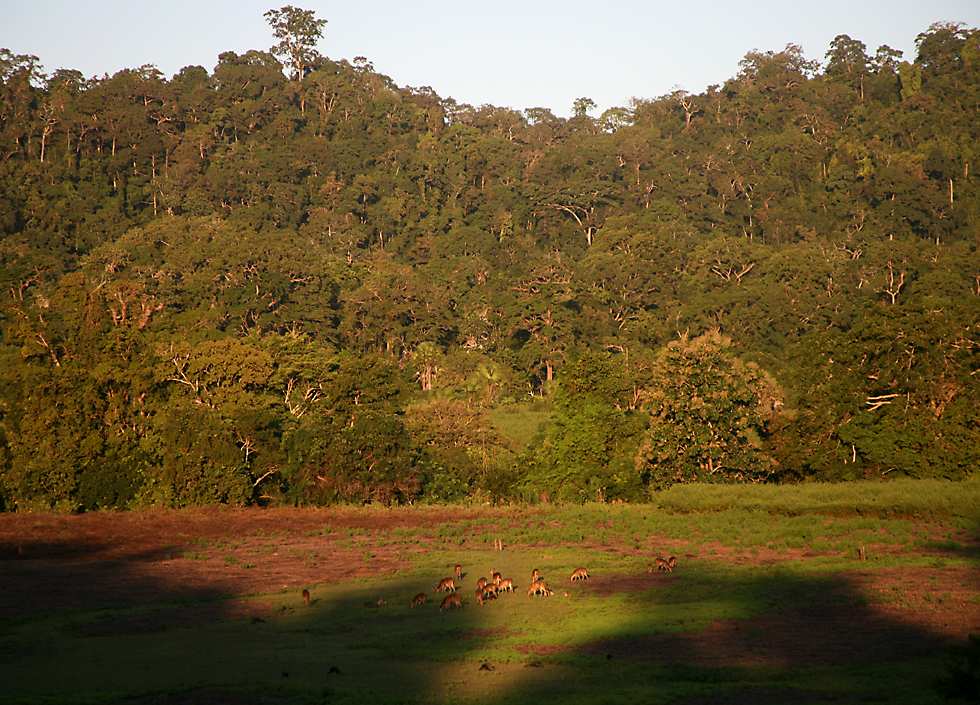
south-eastern tip of Java. As well as large areas of
good-looking forest and roads with no checkpoints, the park also has a
viewing tower above a large cleared space which is regularly grazed by
wild cattle, deer and peacocks. |
 |

There are also plenty of monkeys visible in the forest, though I wasn't
able to persuade any of them to keep still long enough for a photograph.
A night foray into the pasture area to photograph some of the cacophonous
chorus of frogs ended in near disaster as I teetered around with a flashlight
in rubber boots which threatened to sink without trace into the thick mud
churned up by the cattle. Although surrounded by the noise
of the frogs it proved remarkably difficult to actually find any of them.
My paranoia was rising rapidly due to the similarity of their croaking
to human laughter, so I eventually called the quest off after I'd only
taken a few photos. Almost falling over several times with
the same 10 kilogram backpack of expensive camera gear also made me reconsider
the sanity of my position.
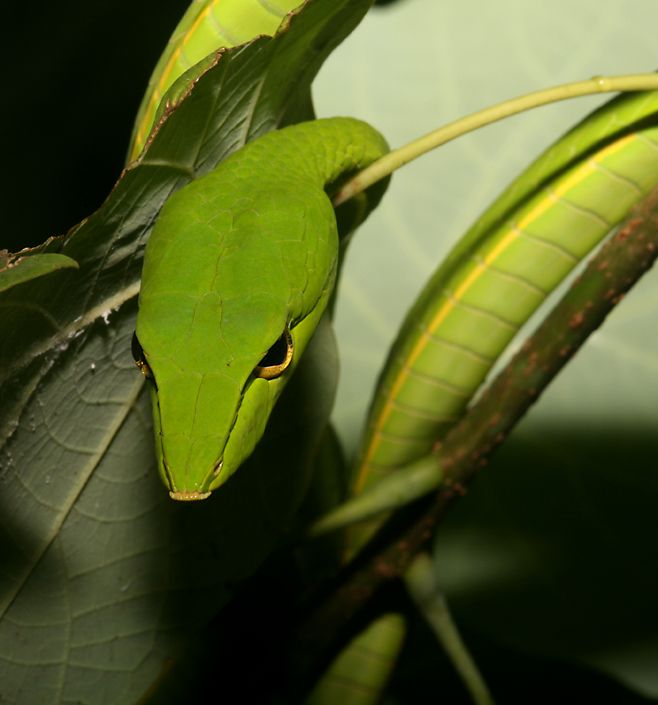
Paranoia of a different sort did lead to one very welcome discovery on
my way out through the forest, in the form of this long-nosed whip snake,
which is in the same family as the cobra. Fear of snakes while
walking through the forest at night made for very slow progress, since
I would take 3 or 4 steps forwards and then shine the light on the trees,
bushes and undergrowth around me for a minute or so, before taking the
next few steps. The pause between moving was essential not
only to allow time to scan for insects and other critters to photograph,
but also as a precaution against an accidental but potentially fatal encounter
with a snake. I made a similarly slow nighttime walk along
a river at Borobudur, moving just a few hundred meters over a four hour
timespan, encountering not one but two snakes, one of which was completely
submerged in a shallow part of the river. In my opinion, a
result well worth the effort, but you can decide for yourself by looking
at The Cold-Blooded Animals
of Indonesia! |
| Bali
and Java are the most well-known parts of Indonesia, but I also spent a
week in a more off-the-beaten-track area, the large and very curiously
shaped island of Sulawesi. I spent all this time in the far
northern tip of Sulawesi, but travelling between Bali, Sulawesi and Java
I had to fly through the city of Makassar in the far south.
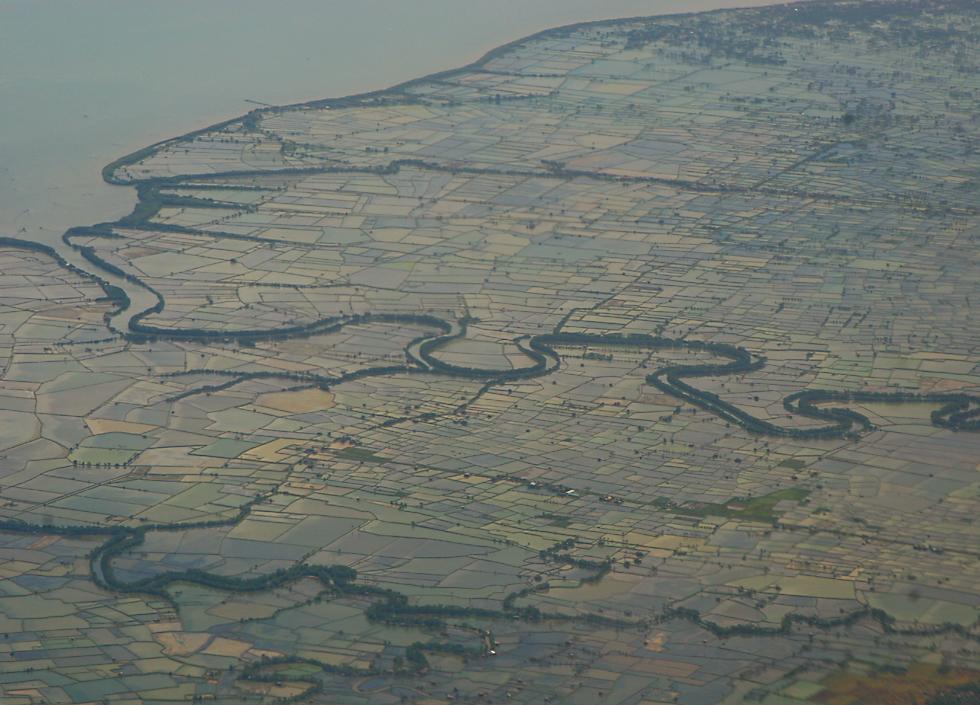
Climbing out of Makassar the plane flies over vast areas of rice paddies
stretching from far inland to the very edge of the ocean. |
 |
| I
didn't come to northern Sulawesi for the scenery, though it has some of
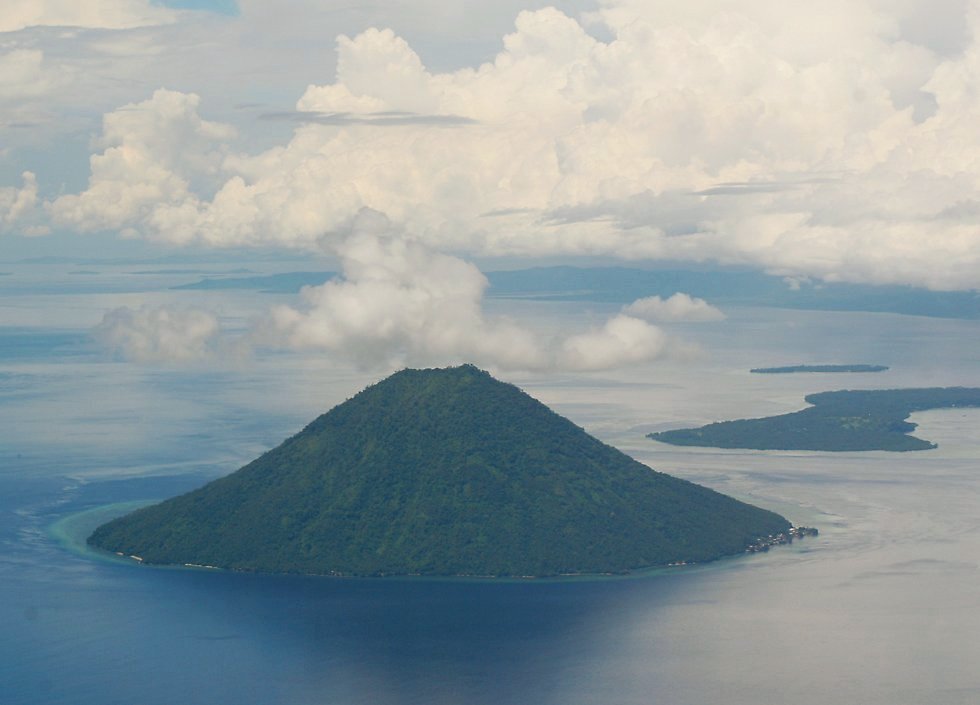
that too. The tall island here is called Manado Tua, but it's
the flat island next to it, called Pulau Bunaken, which attracts most of
the tourists to this area, drawn by the extremely good diving just offshore.
I didn't go to either of these islands, but I did spend three days in Tangkoko
nature reserve (the full name is Tangkoko-Batuangas Dua Saudara nature
reserve), which is just to the right of center of this photo, where the
land meets the bottom of the cloud bank. I spent three days
in the reserve, photographing the local wildlife, and seeing but not photographing
the local tarsiers, tiny and incredibly cute primates with relatives
living in the Philippines. |
 |
| Although
I didn't go to Pulau Bunaken, my main reason for visiting the area was
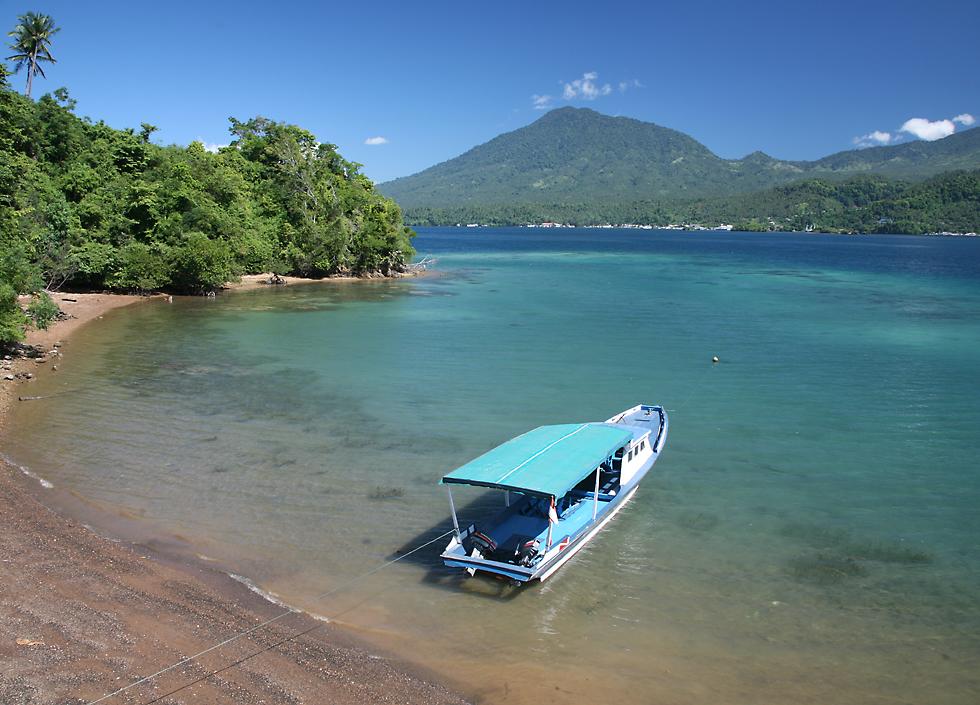
to go scuba diving in an area called Lembeh Strait, visible here between
the island of Pulau Lembeh where I was staying and the mainland.
The diving off Pulau Bunaken is entirely conventional, gliding through
crystal clear water over pristine coral reefs inhabited by vast shoals
of unbelievably attractive fish. Lembeh Strait, on the other
hand, is world famous as a center for "muck diving", which is all about
diving through somewhat murky water (I joked about one daytime dive here
that I was going to log it as a night dive) over a mud or dark sand sea
floor to find the few fish which will live in this environment, most of
which are not particularly colorful and indeed are usually either plain
or actually ugly. As an indication of what to expect, the first
muck dive I ever did was in the Philippines, at a
site called "Basura", which is Spanish for "garbage". So
why would otherwise sane people travel around the world and spend their
vacation diving in muck? |
 |
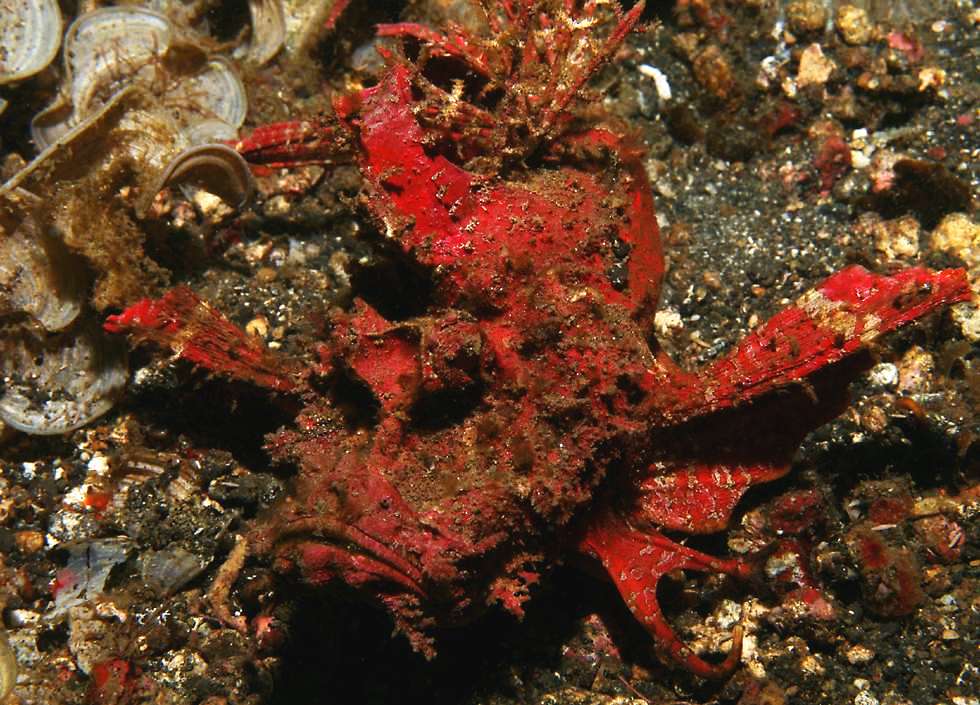
| The
answer is that there's ugly and then there's UGLY! You'll
find more weird fish here in a week than you'll find on a conventional
coral reef in a year. This particular beauty is called a bearded
ghoul, but I also saw sea horses (for the first time ever), two different
species of the very rare Rhinopias less than 10 meters apart, as
well as flying gurnards, frogfishes and a large assortment of nudibranchs
or sea slugs with extraordinary shapes and colors. Unfortunately
all of the photos I took on the first day of diving were ruined because
of a lens malfunction, and I only did one more day of diving before I had
to skip out of town, in order to avoid a run-in with the notoriously corrupt
local police force, a long story which I won't recount here!
So I had to make the trip back again the next year, so you can still see
the
Wildlife of Lembeh Strait. |
 |
See
the
Cold-Blooded Animals of Indonesia,
the
Bugs of Indonesia and the
Underwater Wildlife of Lembeh Strait.
 |