
Wildlife of Belize
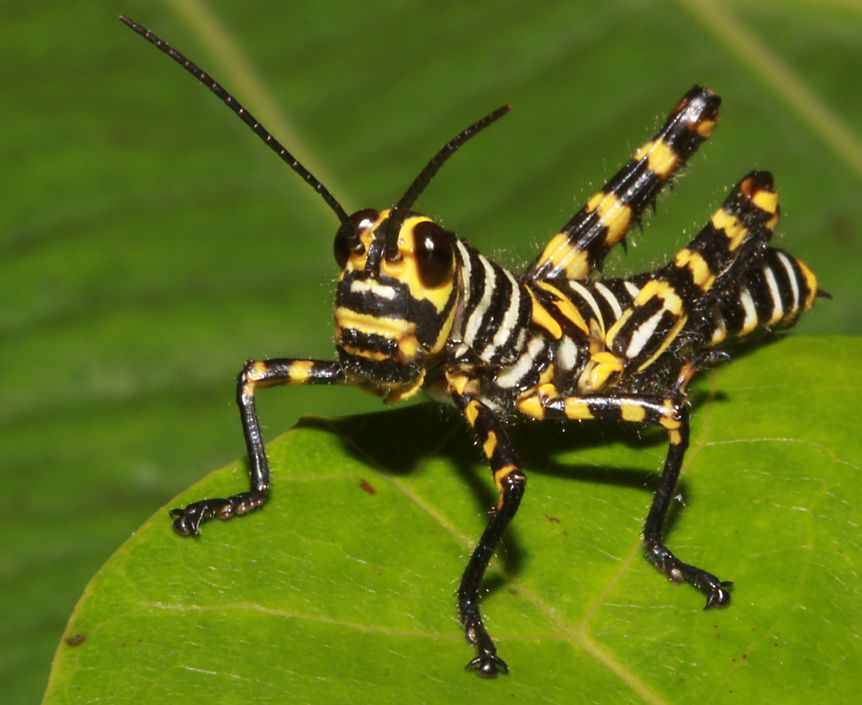
This beautiful giant red-winged grasshopper (Tropidacris cristata) was in Cockscomb wildlife preserve, though I also saw it in other places in Belize, as well as across the border in Guatemala. In several places I saw it gathered together in groups and this, together with its bright colors, suggests that it's toxic. If an inexperienced predator does eat one of them then it will quickly learn its lesson and avoid all animals with this color pattern, including the other ones in the immediate vicinity. This is an example of "aposematic" coloration as a defense mechanism, a very common occurrence in nature. |
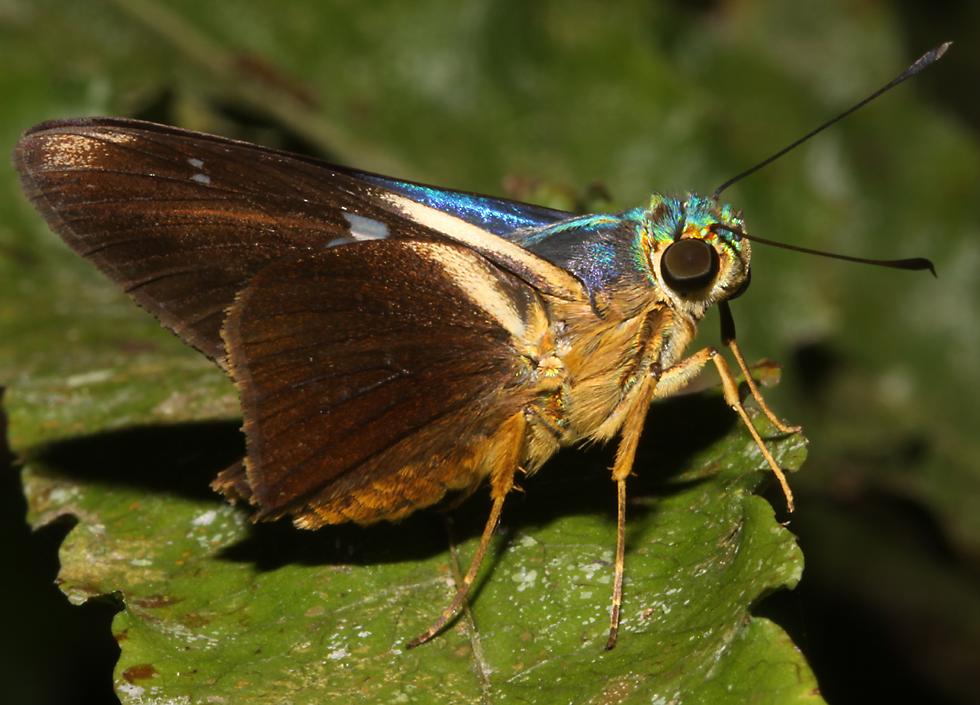
This is a member of the skipper butterfly family (Hesperiidae), photographed in the Cockscomb jaguar reserve. In temperate regions of the world almost all skippers are dull brown or yellowish-brown, but some of the tropical species like this one are quite spectacular. The undersides of this one's wings are typically brown, but the tops of its wings and body have beautiful iridescent hues, caused by the shapes of the tiny scales covering its surface, rather than by pigmentation. |
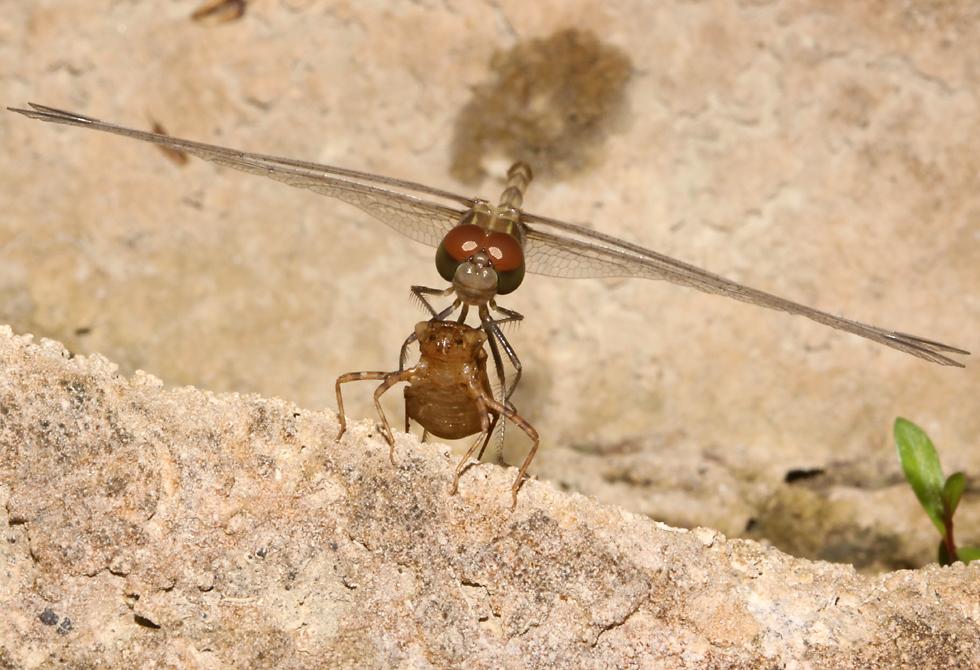
Dragonflies and damselflies spend the early part of their lives underwater as voracious predators, eating other bugs and even small fish and tadpoles. This was the first time I've ever seen them completing their metamorphosis, and I saw not just one but four in this one night at Rio Blanco national park. The newly emerged dragonfly is standing on the moulted shell of the aquatic animal it used to be. It has spread its wings and is waiting for them to dry and harden, so it can start its aerial life when the sun comes up. Emergence is a dangerous time for dragonflies because there are many things which can go wrong while it is getting its wings ready for flight. If it's windy or it rains then the soft wings can be damaged and the dragonfly will be unable to fly, making it an easy picking at dawn for any bird which finds it. Most dragonflies develop their color over a period of time, so this dull-looking newly emerged individual might end up bright red or green. |
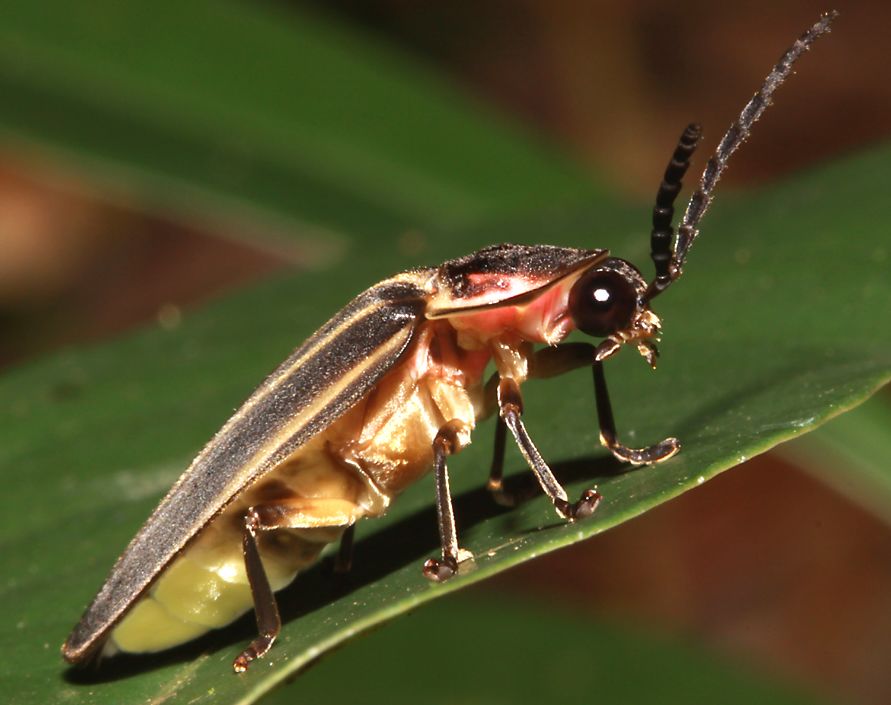
A firefly sits on a leaf in Belize's Cockscomb jaguar reserve. You can see the pale yellow light-emitting organ at the back of its body, which combines an enzyme called luciferase with pigments called luciferins in the presence of oxygen and ATP to create a flashing yellow light. Unlike human lightbulbs, this is a cold light without any infrared or ultraviolet wavelengths. There are over 2000 species of firefly scattered around the world, but despite their name they're beetles and not flies. Fireflies are not the only type of beetle which emit light, some net-winged beetle larvae also do this trick, and this species of firefly shares its forest with a bioluminescent click beetle. |
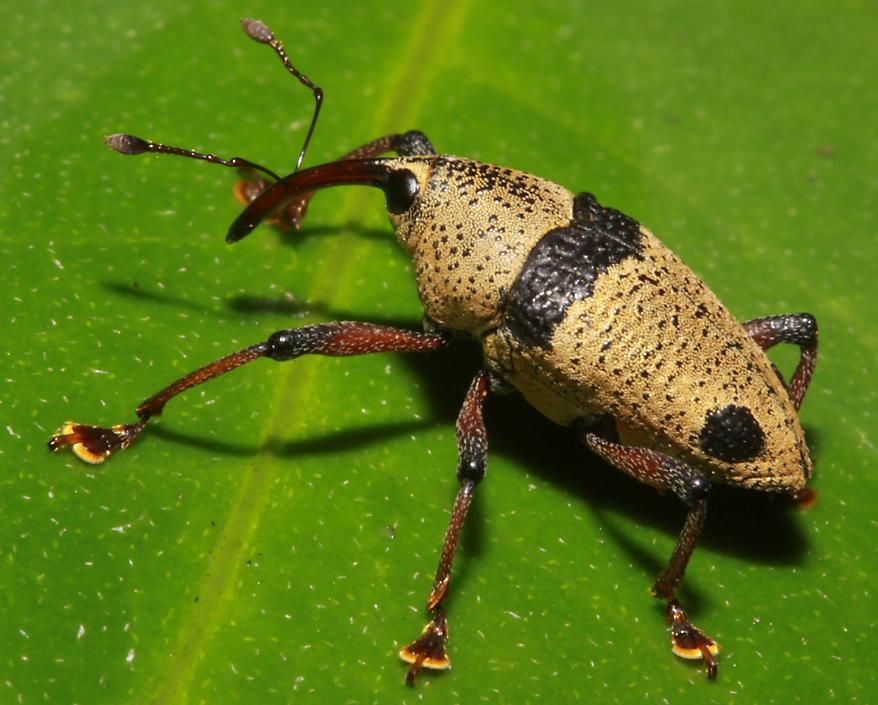
This comical looking insect with antennae poking out halfway along its long mouthparts is a type of beetle called a weevil, photographed in the Cockscomb jaguar reserve. There are more insects in the world than any other type of animal, more beetles in the world than any other type of insect, and more weevils in the world than any other type of beetle. About 40% of the 900,000 known insect species are beetles, and there are about 60,000 species of weevils, making them more numerous than any other family of animal. By comparison there are only 28,000 fish, 10,000 birds, 8,200 reptiles and 5,400 mammals. |

A beetle prepares to launch itself into flight in Cockscomb national park in Belize. Beetles all belong to an order of insects with the name Coleoptera, a Greek word which means "sheathed wings". The front pair of wings has become hard and is no longer used for flying, instead being used as a cover for the rear wings, which generate all the lift for flight. This protects the wings and body, but at a cost. The front wings, or elytra, have to be held out of the way during flight and act as drag, making it harder to fly. The rear wings have to be folded and unfolded for flight, which can be a very complicated and lengthy exercise, sometimes requiring the beetle to use its feet and abdomen to make it happen. This procedure also makes it much harder for the beetle to escape quickly when threatened. |
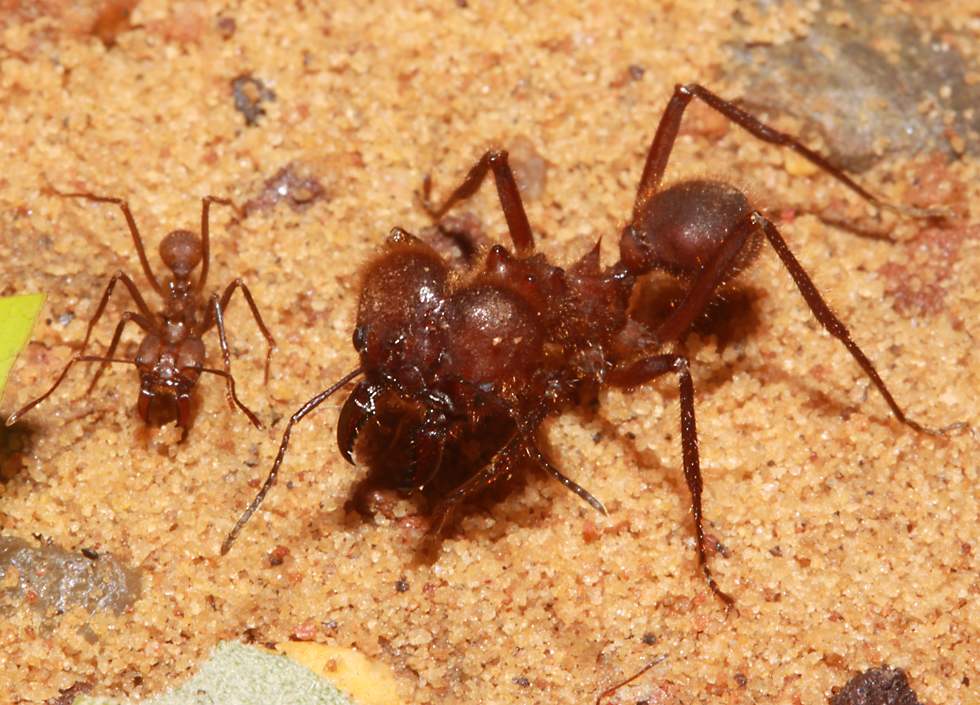
The two fully-grown ants in this photo differ greatly in size, but they belong to the same species of leafcutter ant. Leafcutter ant colonies contain five different sizes of ant, starting with the smallest ones called minims, which stay inside the nest and take care of the larvae and the fungus gardens the ants cultivate. The next size up are called minors, they're slightly larger than minims and they ride around on leaves being brought into the nest or walk around the cleared foraging paths, looking for any parasitic wasps or other enemies which might threaten the foragers. The ant on the left of this photo might be a minor, otherwise it's a mediae, the workers who do almost all of the cutting and hauling of leaves from the trees to the nest. The ant on the right is a major, also called a soldier, though they do sometimes help to haul larger items to the nest. Some can reach two thirds of an inch in length, and their large jaws can inflict painful bites, however unlike some other ants they don't have toxic stings. |
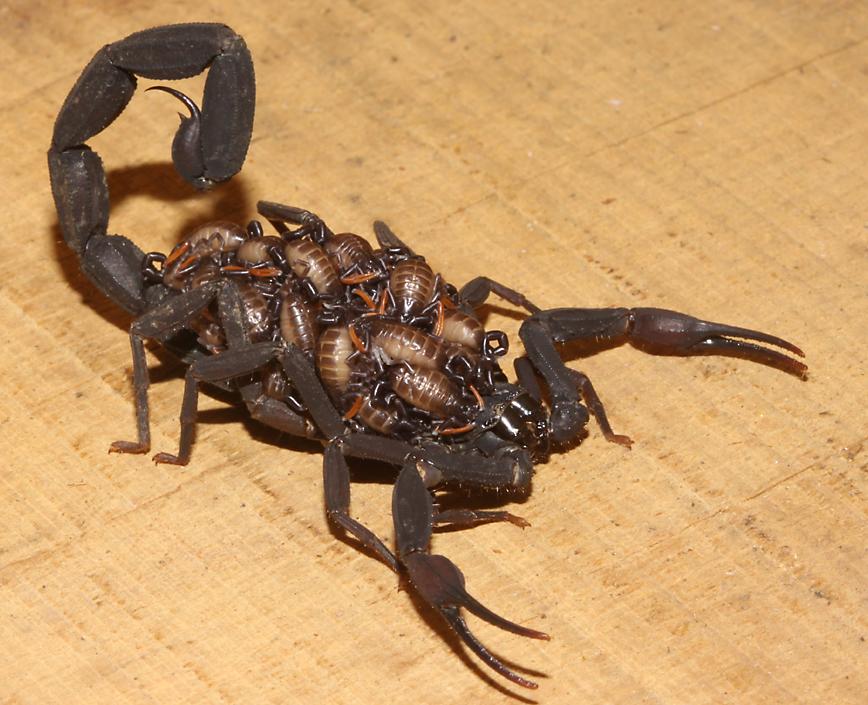
A mother scorpion carries about 20 of her babies around on her back, with pincers and stingers ready to defend them. Before I disturbed it, this scorpion was making itself comfortable under a pillow in the bunkroom at the Rio Blanco national park headquarters, where I was spending the night. The building is a great place for wildlife lovers, since it has in-house attractions like this scorpion, as well as several bats. |

Here's another critter I spent the night with at park headquarters, but this one isn't as nice a companion as the bats and scorpion! It's one of the most dangerous insects known to man, probably second only to the mosquito. This is a kissing bug (Triatoma sp.), and it's sitting on an insect net I set up the night before over my bed, against the advice of the park ranger! Kissing bugs can be found throughout Latin America, and all the way up into the southern states of the USA. They get their name from their habit of biting people near their lips as they sleep, sucking up the fluids just like a mosquito. Unfortunately, just as mosquitos sometimes carry a parasite which causes malaria, so kissing bugs also sometimes carry a parasite which causes Chagas disease. The malaria parasites enter the body as the mosquito is drinking blood, but it isn't transmitted this way with the kissing bug. Instead, after its meal the kissing bug defecates and it's when a person unknowingly rubs this into the wound or into an eye that the parasite enters the body. Malaria usually isn't fatal, but the parasites which cause Chagas disease very slowly eat into the person's body and destroy vital organs like the heart and the digestive tract. There are treatments available for malaria, but nothing works well with Chagas disease and eventually the victim will die, often not knowing that they're infected. |
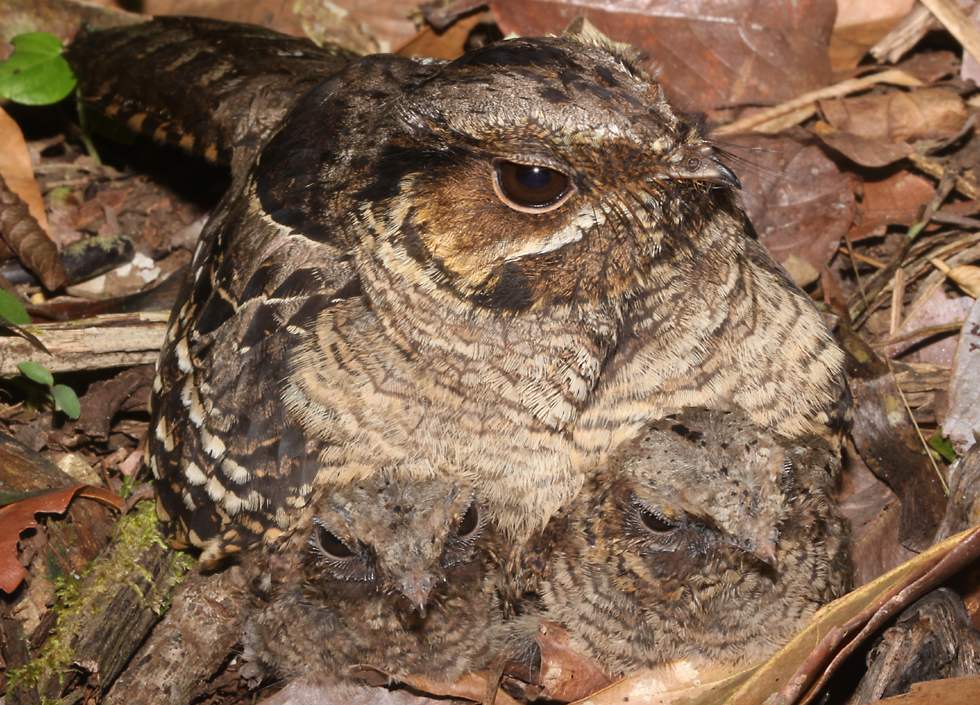
This common pauraque is one of several species of nightjar which live in Belize, out of a worldwide total of about 80 types. Like many other members of this family, this one has a cryptic brown coloration which camouflages it when it's on the forest floor. Some of the American species are also called nighthawks, and the whole family are sometimes called "goatsuckers" because of a mistaken belief that they suck milk from goats, causing them to go blind! This particular one was so confident of her camouflage that she was nesting right beside the trail at the entrance to the Rio Blanco National Park, where she's looking after her two chicks! There were plenty of nightjars around the country, and they're one type of animal which benefits from the human presence. They're unusual amongst birds because they hunt in the evening and, if there's a bright moon, even at night. They sit by the side of a road or clearing, looking upwards until they see a moth or other flying insect silhouetted against the sky, then they dart upwards, catch it and return to their original spot. Like many other insect-eating birds, they have many large whiskers on their face, to direct their prey towards their mouth. They're easy to find at night, because their eyes strongly reflect light, just like the eyes of a cat. Since they often hunt next to roads it's very common to spot them while you're driving at night. As you drive past they'll often fly away in the same direction you're driving and land next to the road, right where you're going to pass by again! After doing this several times they'll finally figure out it wasn't such a smart idea, and they'll head off in the opposite direction. As well as seeing them, you'll often hear them calling to their mate at regular intervals, since they can't see each other while they're on the ground. The sound they make resulted in some of the common names assigned to species like the "whip poor will" and "Chuck Will's widow". |
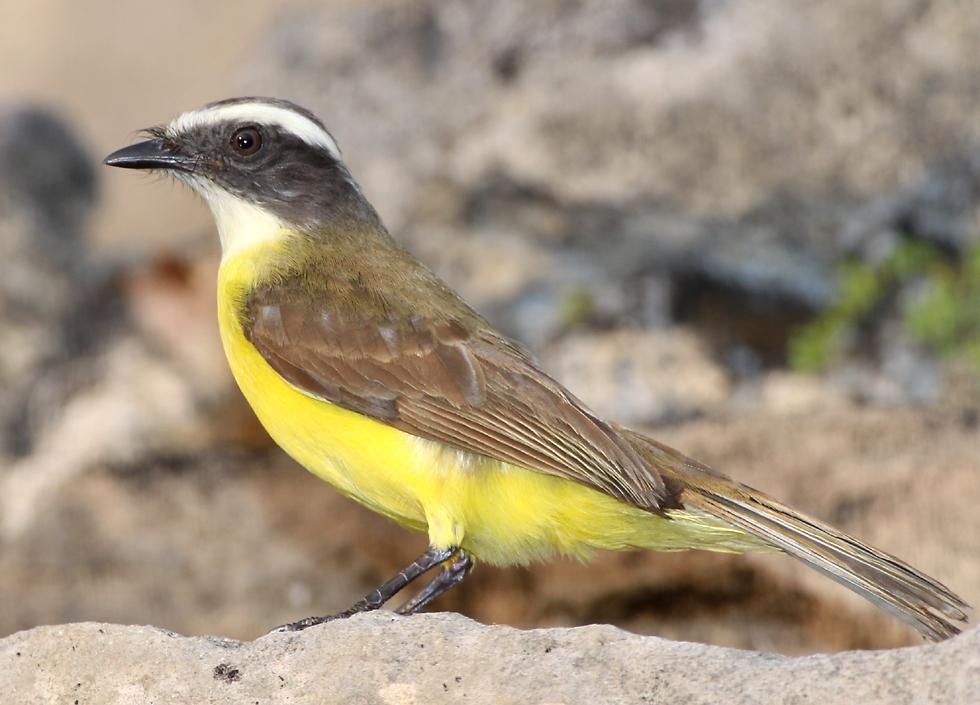
This is a boat-billed flycatcher, which belongs to a family of birds called "tyrant flycatchers". It's the largest of all bird families, with about 400 members scattered throughout North and South America. This particular bird is perched on the Maya ruins at Lubaantun, and let me take a lot of photos before it flew away. Ruins like these are often an excellent place to find all sorts of wildlife, from birds to reptiles and insects. This species looks very similar to the great kiskadee, but the feathers on its back have an olive-green tinge and, although it's not totally obvious in this photo, it also has a larger beak. Although they look so much alike, the boat-billed flycatcher isn't as closely related to the great kiskadee as you might expect, instead it belongs to a genus which only has itself as a member. It's common in most of its range, which stretches all the way from southern Texas to Argentina. |

Birds aren't the only large flying animals you're likely to encounter in Belize - there are 70 different species of bat in this tiny country! These are proboscis bats (Rhynchonycteris naso), also called long-nosed bats or sharp-nosed bats, lined up along the trunk of a tree next to Monkey River. Lines of up to 45 individuals have been seen on a single tree! The stripes on their backs are shared by other species like greater white-lined bats, but proboscis bats have distinctive white markings along their forearms, as well as a short, pointed tail. The way they perch together over water is also very characteristic of this species. Like other insectivorous bats, they use echo-location to hunt bugs, flying low over the water source they live next to. They're tiny creatures, only a couple of inches long and weighing less than an ounce! |
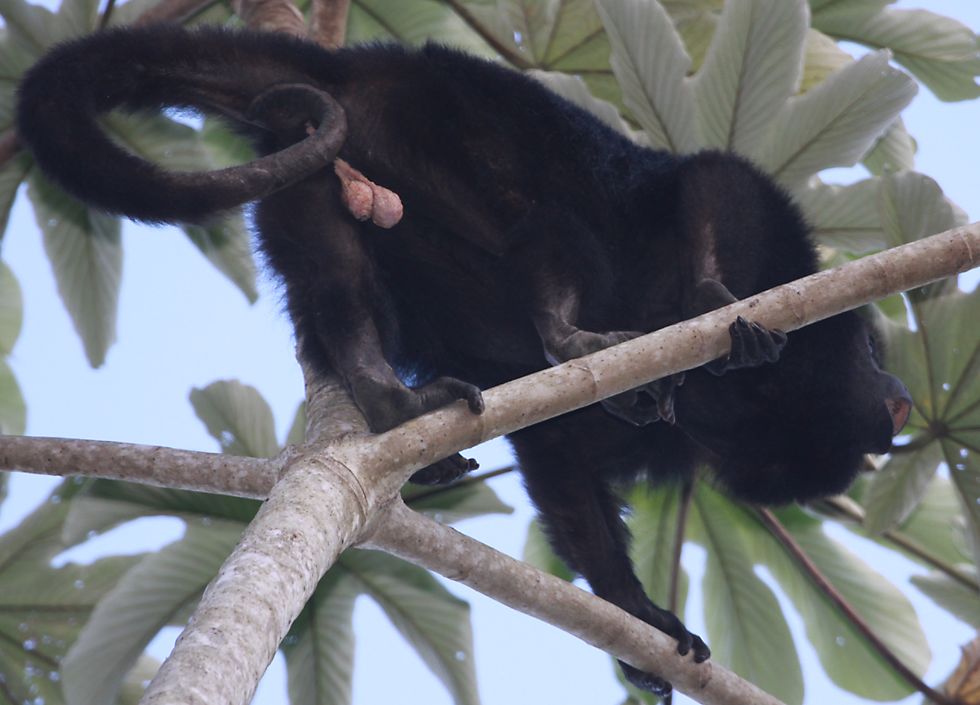
Monkey River gets its name from these guys - Guatemalan black howler monkeys (Alouatta pigra), which make incredibly loud and weird noises to mark their territories. They're the loudest of all primates - apart maybe from human beings! Often two troops will have howling matches at each other, but they usually stay where they are and no physical violence happens. They're fairly common, so there's a good chance you'll at least hear them while you're in Belize, or if you go over the border to the Maya ruins at Tikal in Guatemala. In Belize they're often referred to as "baboons", but they're not closely related to baboons. Males can weigh eleven and a half kilograms, making them the largest monkeys in Central America, and one of the largest in the Americas. They have prehensile tails which they wrap around branches in the fairly small area of tropical forests they inhabit. They eat leaves all year round, but at certain times fruit makes up most of their diet. |
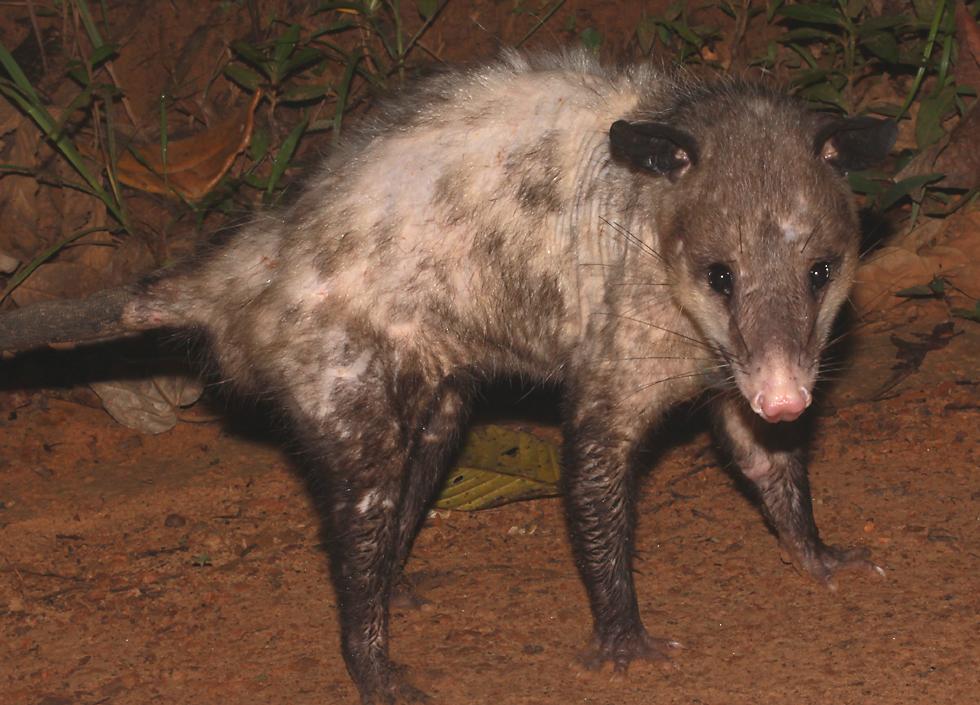
This Virginia opposum photographed at night in Cockscomb nature reserve wasn't too happy to have me waving a flashlight in its direction and using a flash to photograph it! Opposums are unusual in several ways - they have prehensile tails like the howler monkey, they have about 50 teeth, the most of any land mammal, and they're the only order of mammals outside of Australia and New Guinea which are marsupials, with a pouch where the babies live until they're too big, at which time they climb onto mama's back. Females have 13 nipples in their pouch, 12 in a circle and one in the center. It's the only marsupial which lives in the United States, and the largest of about 65 different opposum species in the Americas. If they're threatened, Virginian opposums will growl threateningly, but if that doesn't work then they'll pretend to be dead, which is why feigning death is sometimes called "playing possum". This might be an involuntary behavior, putting the animal into a coma-like state for up to 4 hours and causing it to emit several noxious liquids and odors. There are similar-looking marsupials in Australia called possums, but they're in a different order of mammals, so they're not very closely related and they're one heck of a lot cuter than Virginia opposums, which always remind me of oversized rats! Like rats they'll eat almost anything, so they're also very widespread and successful, occupying many different habitats from Canada down to Costa Rica. |

The Cockscomb nature reserve is also a great place to find mushrooms. Apart from the obvious large yellow one in this photo, there are also half a dozen much smaller ones on the log next to it! When I started one night ramble there were several mushrooms emerging beside the track, but when I came back three hours later they had fully opened into attractive little parasols like this one. Mushrooms are able to do this so quickly because their stem and cap are first created in miniature and then rapidly expanded with water. This also explains why most mushrooms appear after rain. |
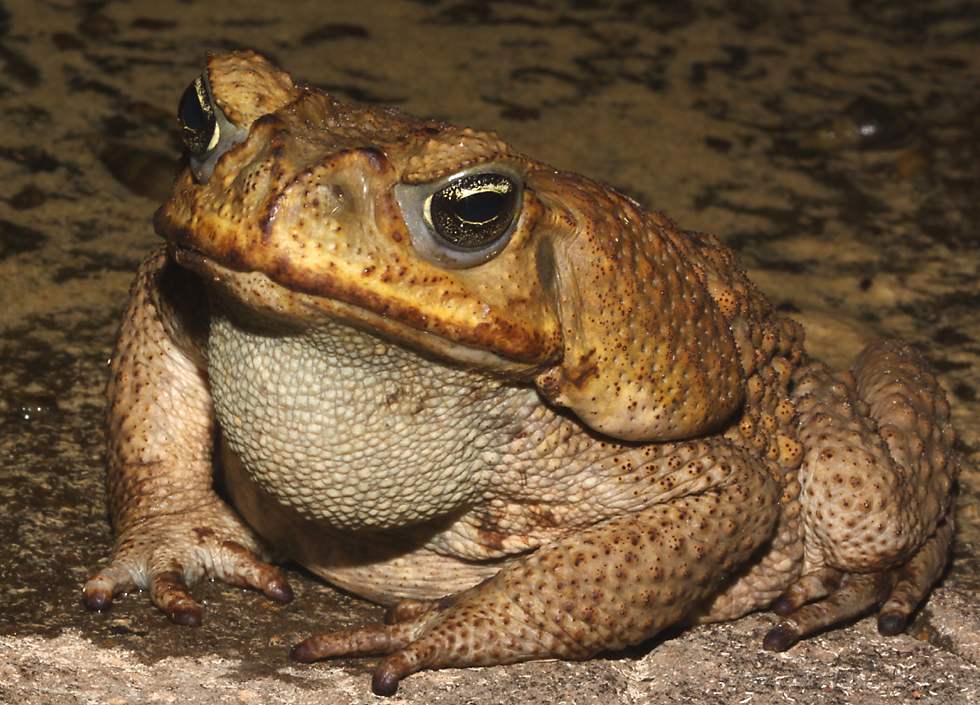
From toadstools to toads! This monster is a marine toad, also called the giant neotropical toad - the largest was measured at 38 centimeters and weighed 2.65 kilograms. It was introduced into Australia, Fiji, the Philippines and other sugar-growing areas to control insects, so it also became known as the cane toad. The name "marine toad" is derived from its scientific name Bufo marinus, which was given in the mistaken belief that it could live in the ocean. This one was at Rio Blanco, but this species has become a major problem in the places it was introduced, because of its voracious appetite, its prolific breeding rate and the poison produced by the large glands on either side of its head. It will eat anything it finds, living or dead, including native wildlife like other frogs and even snakes. It has few enemies in the places it was introduced, so it can proliferate without being held in check. If anything does eat it, including domestic dogs, there's a good chance they'll die because of the toxins in its skin. A female can lay up to 25000 eggs each time she spawns, and even the eggs and tadpoles are toxic enough to kill other animals. |
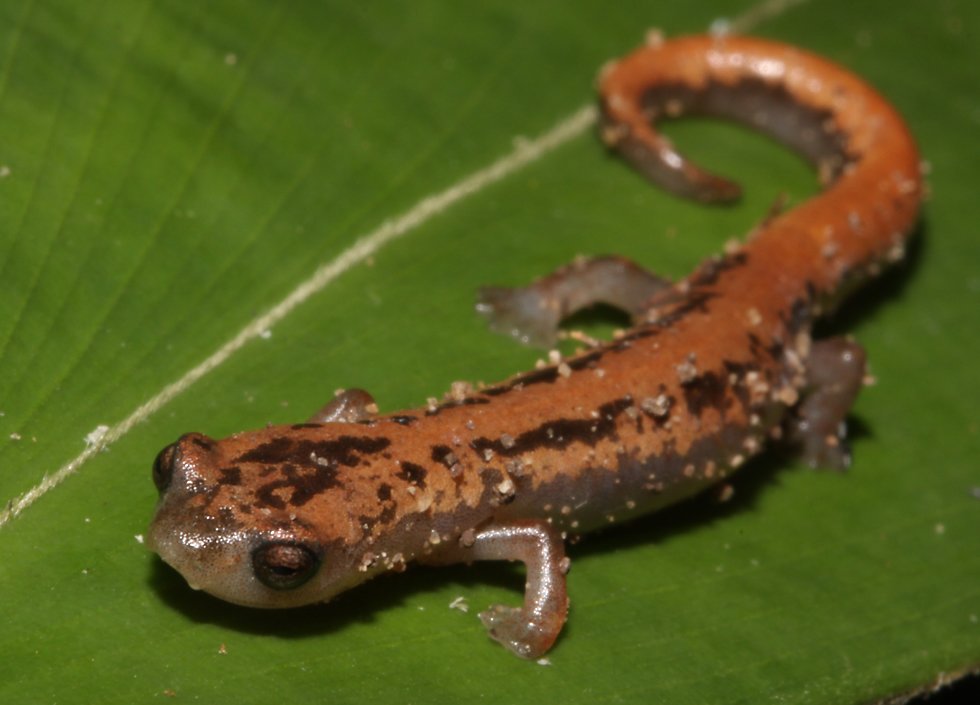
I was disappointed by how few frogs I found in Belize, but I did get a pleasant surprise one night at Rio Blanco when I found this salamander! Unusually, it was in a dry area well above the river; salamanders are amphibians like frogs and toads, so they normally require a damp environment. They do secret mucus through their skin to keep themselves moist, and they can also produce toxins just like poisonous toads and frogs. There are about 500 different species of salamander, but the only one I'd previously seen was a nice fire salamander I found on a drizzly day in the Czech Republic. They look a lot like lizards, but they have moist skin instead of scales. Their limbs are often of reduced size and don't have claws - all of the salamanders I found in Belize hardly even had toes, though the Czech one did. |
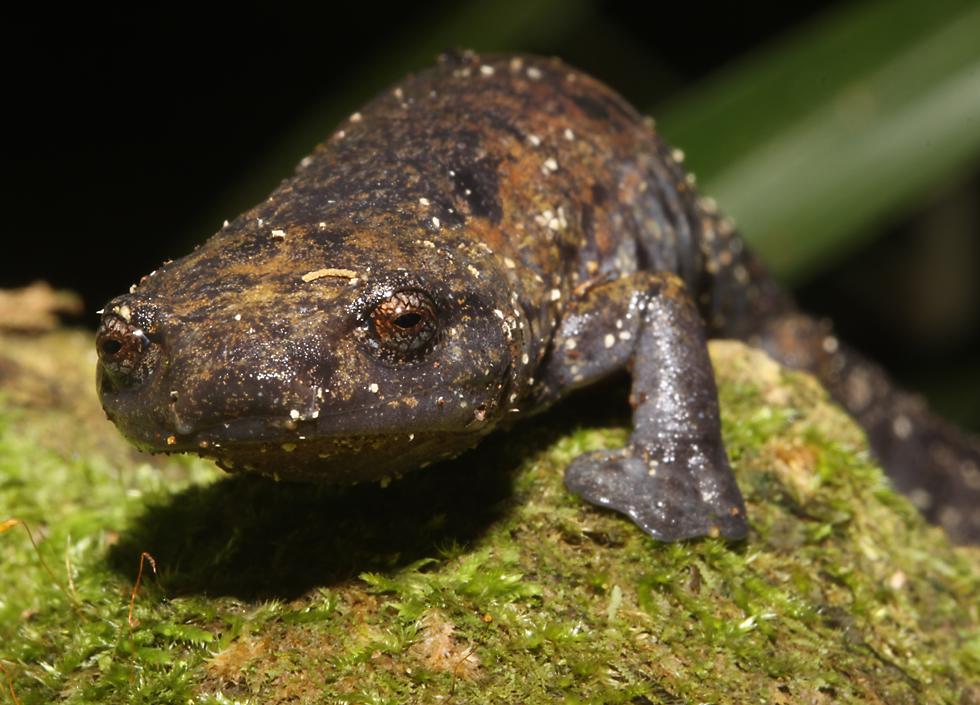
But wait, there's more! Rio Blanco turned out to be an excellent place for finding salamanders. Over two nights I found not just one, but four! This fairly large individual was even further from the river than the previous one. It's still got an awfully long way to go before it can compete with the Chinese giant salamander, which can reach 1.8 meters in length and weigh 65 kilograms - just a little less than I do! Salamanders are the only vertebrates which are able to regenerate limbs. In addition, like some lizards they can cause their tail to fall off if an enemy threatens; the tail continues to wiggle for some time, allowing the salamander to escape. It will later regenerate the tail. Even as adults some salamanders have gills, the ones I saw might have had internal lungs, but there did seem to be some indication of gill slits for internal gills. Some species hedge their bets by having both lungs and gills, while others have neither, respiring directly through the skin! |
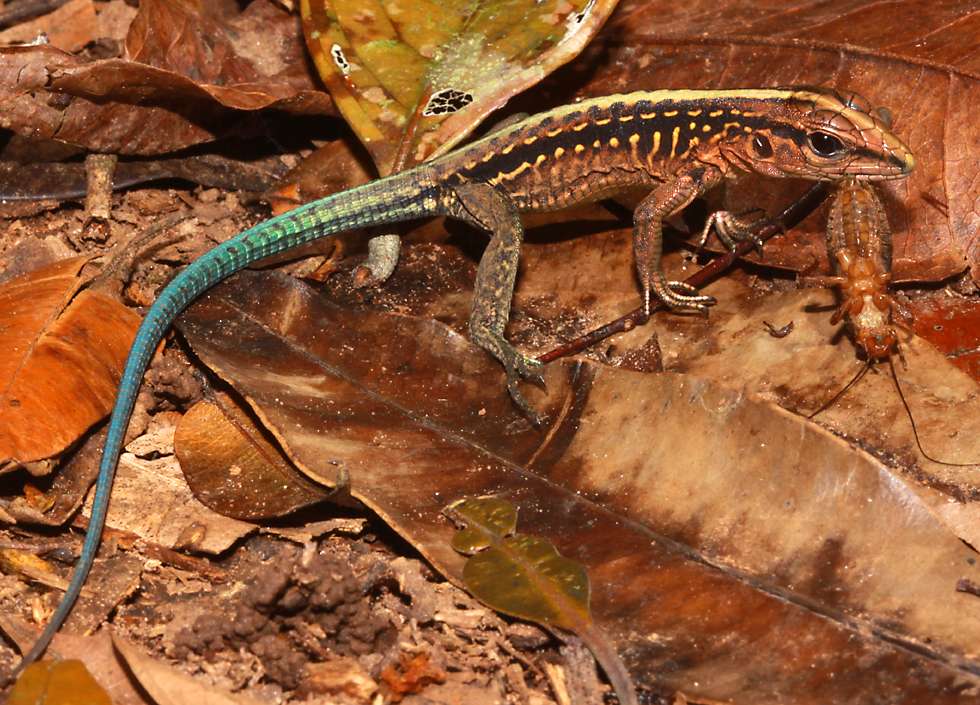
And now to an actual lizard. This is a Central American whiptailed lizard (Ameiva festiva), which I photographed in Cockscomb jaguar reserve. I was very fortunate to come across it just when it had caught a small cockroach in the leaf litter, and even more lucky that I reached it just before a group of people came down the trail in the opposite direction - I was able to stop them for one or two minutes so I could get some photos before the lizard was scared off. This species is a carnivore, eating both invertebrates and vertebrates, and being eaten by coatimundis, opposums and motmots. The metallic blue tail on this one indicates that it's probably a juvenile. |

This green iguana (Iguana iguana) next to the lagoon at Crooked Tree probably weighs a couple of hundred times what the whiptail weighs! This species of iguana can reach two meters in length and weigh nine kilograms. In spite of its size, green iguanas spend most of their time in trees, but they can also swim, which is what this individual decided to do when I approached too closely! If threatened an iguana like this will extend the dewlap under its throat and bob its head up and down in a threat display. If cornered it will use its tail as a whip to keep a predator at bay, and it also uses its tail to swim, letting its legs hang loosely in the water. They're often kept as pets but they're also eaten as "bush chicken". There's a similar-sized species in Central America called the black iguana or ctenosaur, which is often mistaken for a green iguana. They both belong to the Iguanidae family, but they're not the same species. The black iguana is mostly dark grey or sometimes has a blue wash, whereas green iguanas come in a wide variety of colors, including orange, pink and even green! |
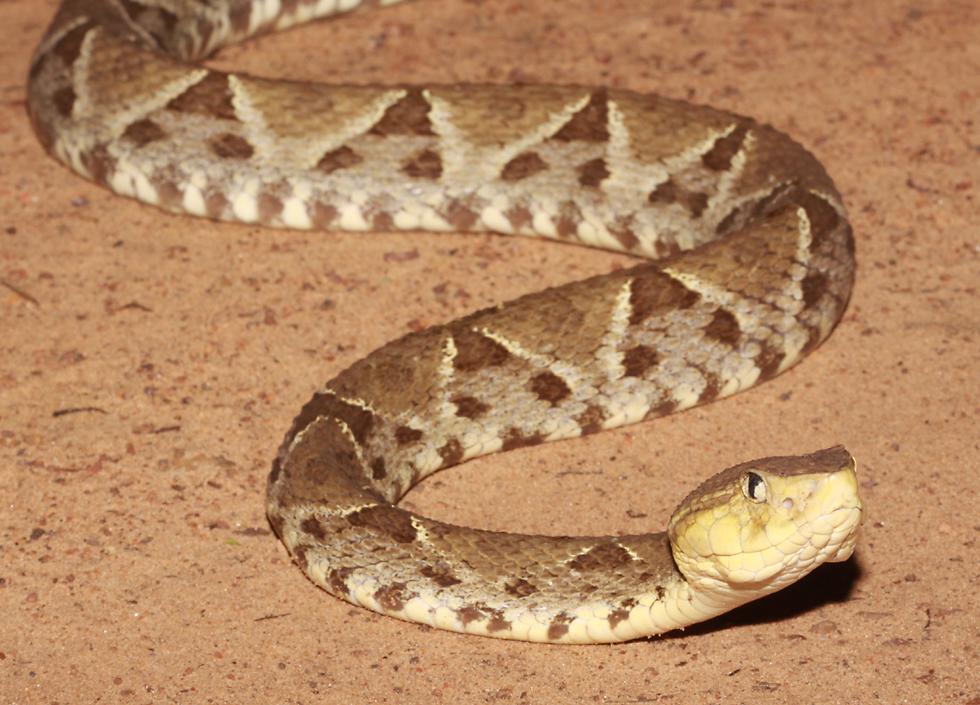
The fer-de-lance or terciopelo is the most feared snake in Central America, and with good reason - it's the cause of most serious snakebites in the areas where it lives. The name fer-de-lance isn't used in the countries where this snake lives, and there's a different snake called fer-de-lance in South America, so terciopelo is probably a more appropriate name. Terciopelo is Spanish for "velvet", literally meaning "third skin". In Belize it's also called the Tommygoff or yellowjaw. This is the snake I most wanted to see while I was in the country, and I got lucky coming back from dinner at Maya Landing to the park headquarters at the Cockscomb jaguar reserve. This beautiful six footer was stretched across the road, so I grabbed my camera and flash, jumped out of the van and approached it to get some photos. I was able to get five or six before it turned tail and headed back into the jungle. Luckily I didn't follow, because it has a reputation for initially fleeing and then turning around and attacking. Females of this species can reach two and a half meters in length and weigh six kilograms, making them one of the heaviest of all venomous snakes. The fangs can be an impressive 2.5 centimeters long. The terciopelo is said to be very unpredictable and very willing to defend itself by striking. However, most bites happen when one enters a house and strikes a person, or a person walks too close to one without realizing that it's there. For this reason I was ultra careful whenever I was walking around the forest in Belize, especially at night. Although the great majority of people recover from terciopelo bites, it's very common to have severe necrosis which requires fingers, toes or whole limbs to be amputated. |
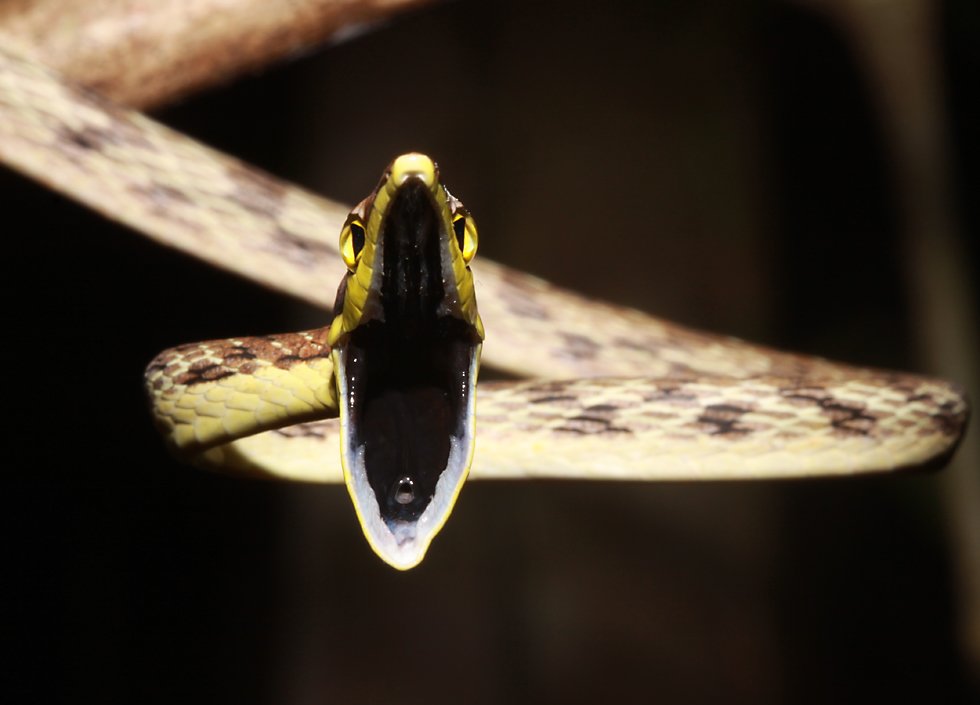
The Mexican vine snake does a very good job of imitating a branch or vine, at least until it realizes that it's been seen! This species reaches 5 feet in length and eats frogs, birds and lizards. It's slightly venomous, but not enough to be dangerous to people. In spite of its name, it's found all the way from Arizona down to South America. Most arboreal snakes are green and live in rainforests, but the Mexican vine snake is brown because it lives in drier forests, where its color matches the surroundings better. |
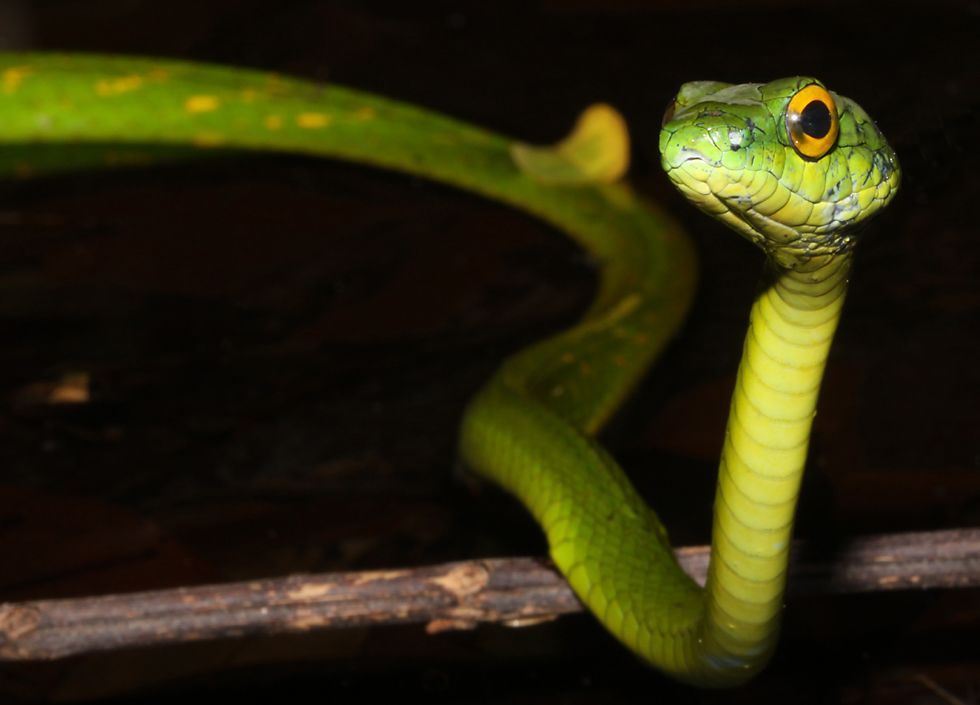
I saw two parrot snakes (Leptophis ahaetulla), one on a trail in the Cockscomb jaguar reserve, and this one leaning on a branch floating in a small pond next to Blue Creek. This species hunts frogs, lizards and birds during the daytime. It looks like this one is due to shed its skin, which is getting pretty tatty. It was very difficult to approach this one, there was only about a meter of space in front of it and then some coarse bushes I couldn't penetrate. I moved very slowly and eventually got right in front of it. They can do a very impressive threat display, opening their mouths and even flattening their throat a bit like a cobra, but I guess I was so slow that it never got around to doing this. Eventually it rushed off at high speed, just like the one at Cockscomb. |
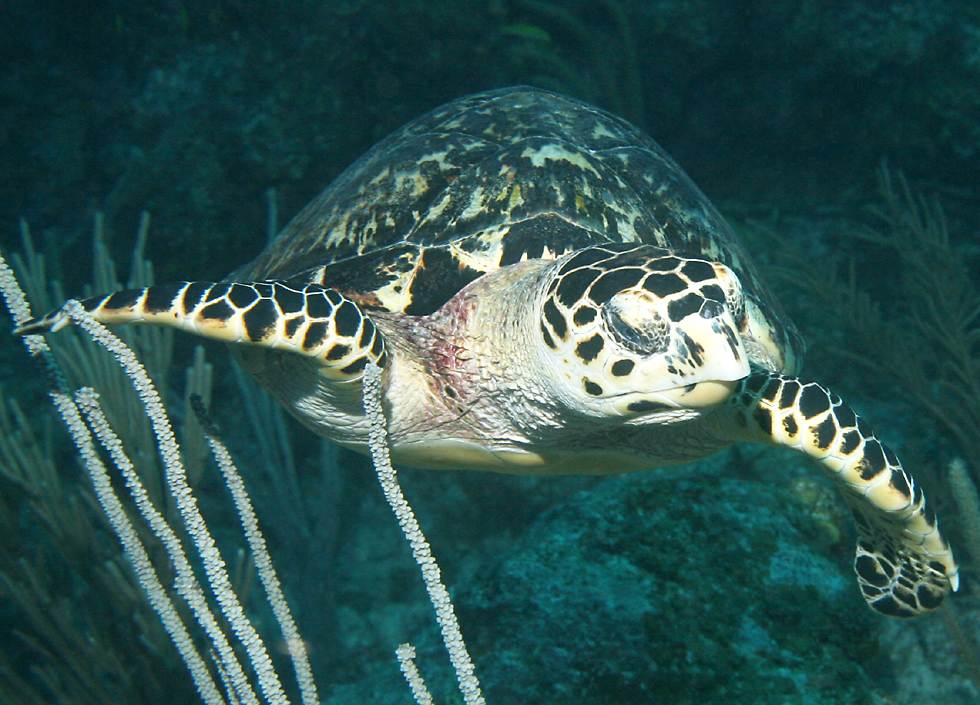
Not all the reptiles in Belize are on the land! I've done most of my diving in the Indo-Pacific Ocean, where green turtles are the most numerous species, so this was the first time I've ever seen a hawksbill turtle. They look very similar to green turtles, but they have four dark scales between their eyes, instead of just two. The English name comes from the shape of their beak. The first part of their Latin name Eretmochelys imbricata means "oar turtle" because of their front fins, and the second part of the Latin name means "overlapping", because the large scales at the rear of its shell overlap each other, giving a saw-like appearance to its edge. They can reach 3.5 feet in length and the heaviest one ever caught measured in at 280 pounds. Hawksbills mostly eat sponges, some of which are highly toxic but cause no harm to this species. Marine turtles are often very resistant to poisons, those like the hawksbill and loggerhead which eat jellyfish are entirely immune to their stings because of their thick shell and skin. The shell also protects them from most of their enemies, though sharks and large estuarine crocodiles will sometimes attack and eat them. Like other marine turtles, female hawksbill mate offshore from their selected nesting beach and then come onshore at night to lay their eggs. Hawksbills lay about 140 eggs the size of golfballs, which they bury in sand away from the water. About two months later the turtles hatch at night, dig their way to the surface and head towards the brightest source of light, which is usually the moon reflecting off the ocean. However if people are living nearby then the hatchlings often follow their lights and head inland where they die. Those that don't make it to the water by daybreak will usually be eaten by birds or crabs. |
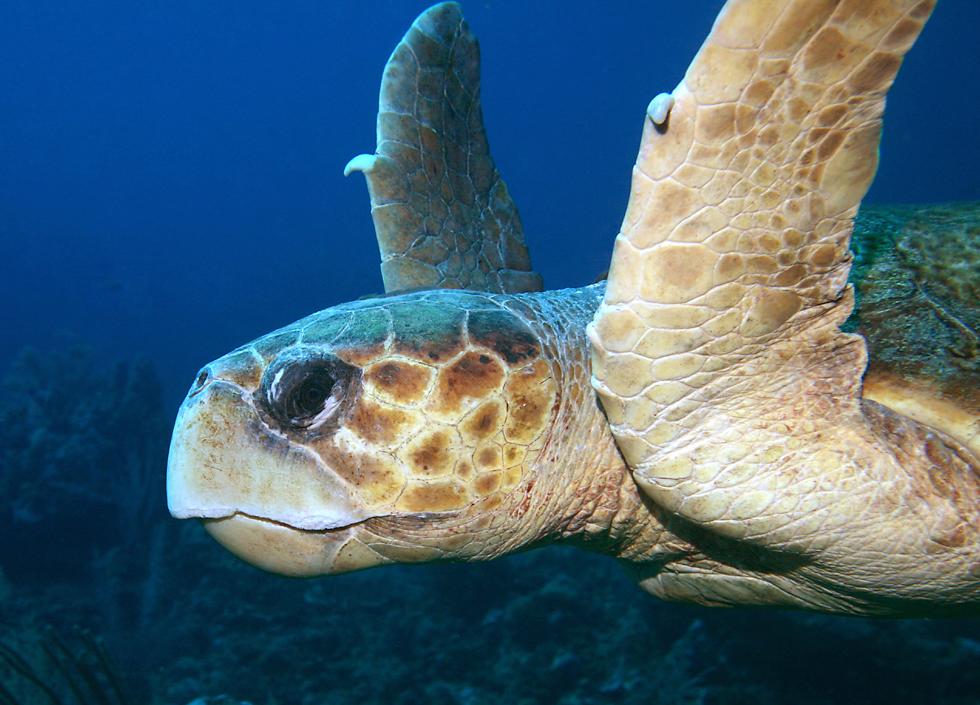
This was also the first time I've seen a loggerhead turtle, which gets its name because its head is much bigger in proportion to its body than other turtles. It's the most common turtle nesting in America, which is why it's also the state reptile of South Carolina. There are two sub-species, one of which lives in the Indo-Pacific Ocean, and the other which lives in the Atlantic and Mediterranean. This is an Atlantic loggerhead, so its full scientific name is Caretta caretta caretta. Since caretta is the Latin form of the French word caret, which means "turtle", the Latin name actually means "turtle, turtle, turtle"! They eat jellyfish, mollusks and crustaceans like crabs and Caribbean spiny lobsters. When the water gets cold they spend up to 7 hours at a time sleeping underwater, the longest dive of any air-breathing marine animal. |
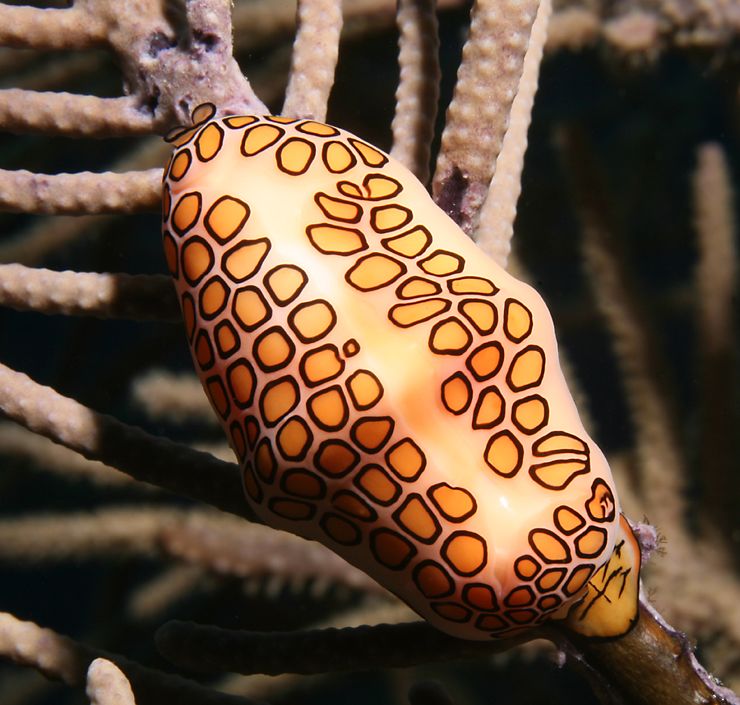
The flamingo tongue (Cyphoma gibbosum) is one of the so-called "false cowrie" snails, which are closely related to true cowries, a family which contains some of the most beautiful of all mollusk shells, making them very popular with collectors. The flamingo tongue is also often collected when it's still alive, which has led to a rapid decline in how many are still living in the wild. The flamingo tongue's shell is fairly boring - the beautiful patterns and colors you see here are not on the shell! Like many mollusks, the flamingo tongue has a skin-like layer called a mantle which it wraps around the shell when it's active. The mantle of the flamingo tongue has bold orange and black patterns on it, and that's what you see when it's moving around. In this photograph the mantle isn't entirely enveloping the shell, so you can still see the underlying dull orange color which covers the entire shell. The pattern on the mantle continues onto the snail's foot, which you can see poking out on the right-hand side, with black zig-zag lines on an orange background. This bright coloring warns predators that the snail tastes bad, and it's thought that it might even be toxic because of the poisons it consumes with its food. However, Caribbean spiny lobsters and some puffer fishes do eat them. The flamingo tongue is only about an inch long. It's one of the more common mollusks in the Caribbean Sea, and since it's active during the daytime it's one of the easiest ones to find. It's a carnivore, and this one is in the process of eating a gorgonian coral, stripping the living coral polyps from the hard branches that they've built. This kills individual polyps, but it doesn't kill the entire gorgonian "tree", which usually redevelops the areas which have been lost. Female flamingo tongues lay their eggs on the exposed gorgonian stems. |

The last time I was in Belize I was able to get some photos of Atlantic tarpon, but I was free-diving and using film gear, so I was able to get much better shots this time since I was scuba-diving and using a housed digital SLR camera. They can reach 8 feet in length and weigh 350 pounds. The name Megalops atlanticus means "Atlantic big eyes", and this species is also noted for its very large scales, measuring up to an inch across. Although they look like regular fish, tarpons are actually related to eels. They can move into fresh water and breathe air in oxygen-poor water, using their swim bladder to extract oxygen from it. Juvenile fish actually die if they don't gulp air, and even as adults they continue this behavior. When they're agitated they also use their swim bladder to make sound, perhaps to communicate with others of their kind. They live a long time, specimens 55 years old have been caught, and a large female can produce 12 million eggs at one time. Their newly hatched young look just like baby eels, which are called elvers. Tarpon are called The Silver King by fishermen and are greatly prized for their fighting abilities, frequently jumping out of the water as they try to escape. They're not much use for eating because they're very bony so they're mostly released after they're caught. There have been reports of recreational anglers being killed after catching a large tarpon and having it thrash around inside the boat. In spite of their size, adult tarpon are preyed upon by sharks, porpoises and alligators. They gather together in large schools of up to 200 individuals, and smaller groups often congregate in fairly shallow water, appearing in the same spot for years at a time. |
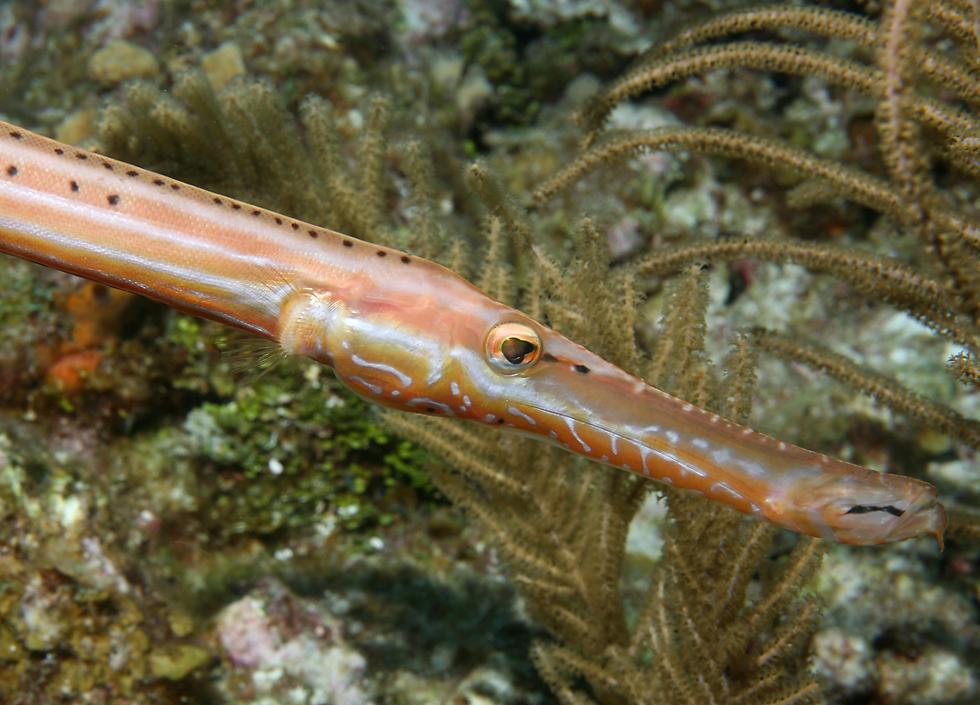
The Atlantic trumpetfish (Aulostomus maculatus) is related to cornetfishes and seahorses, the males carrying the eggs in the same way as seahorses. In spite of its English name, the genus name Aulostomus actually means "flute mouth". They get to about three feet long and like other members of their order they are ambush predators, spending most of their time hang vertically near branching coral or a sea fan, and then sucking up any small fish that gets too close. Their small mouths stretch wide to take in fish which might not be much smaller in diameter than the trumpetfish itself. They're able to change color rapidly, so they come in a variety of shades and patterns, including bright yellow, as well as blue or purple. They also use this ability to change color during their courtship display. |
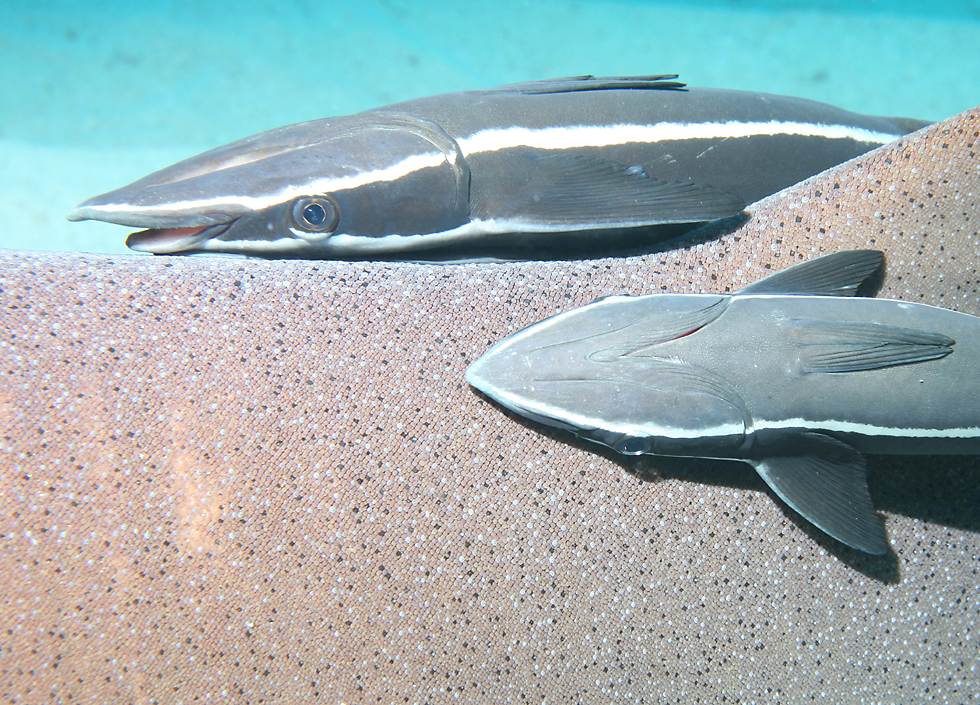
A pair of sharksuckers (Echeneis naucrates) hang onto a nurse shark. Nurse sharks spend a lot of time during the day sitting on the sea floor, so these sharksuckers have latched onto the shark's back, which means that they're both upside-down. There are eight different species of remoras and sharksuckers. In spite of the fact that they spend most of their time hitching rides on larger animals, they can actually swim fairly well on their own. This species can get quite large, sometimes over 3 feet in length. By attaching themselves to an animal like a shark the sharksucker saves energy and also benefits by eating scraps from the shark's hunting. This is an example of a commensal relationship, where the sharksucker gains a lot and the host doesn't gain but doesn't lose much, either. One benefit the host does get is that the sharksucker will sometimes eat parasites on its skin. Perhaps because of its proximity to a large predator, sharksuckers have no known enemies. Remoras and sharksuckers sometimes latch onto boats or even divers. When they do this, they can be easily removed by sliding them forwards. Some cultures have used remoras to catch turtles. A rope is tied around the remora, and when a turtle is spotted the remora is allowed to swim towards it. When the remora attaches itself to the turtle, the rope is pulled in and the turtle is either caught by hand or harpooned. Some ancient peoples like the Greeks thought sharksuckers had dangerous magical powers to affect ships; the scientific name reflects this, Echeneis being the Latinized form of a Greek word meaning "restraining a ship". The Latin word "remora" means "delay". |
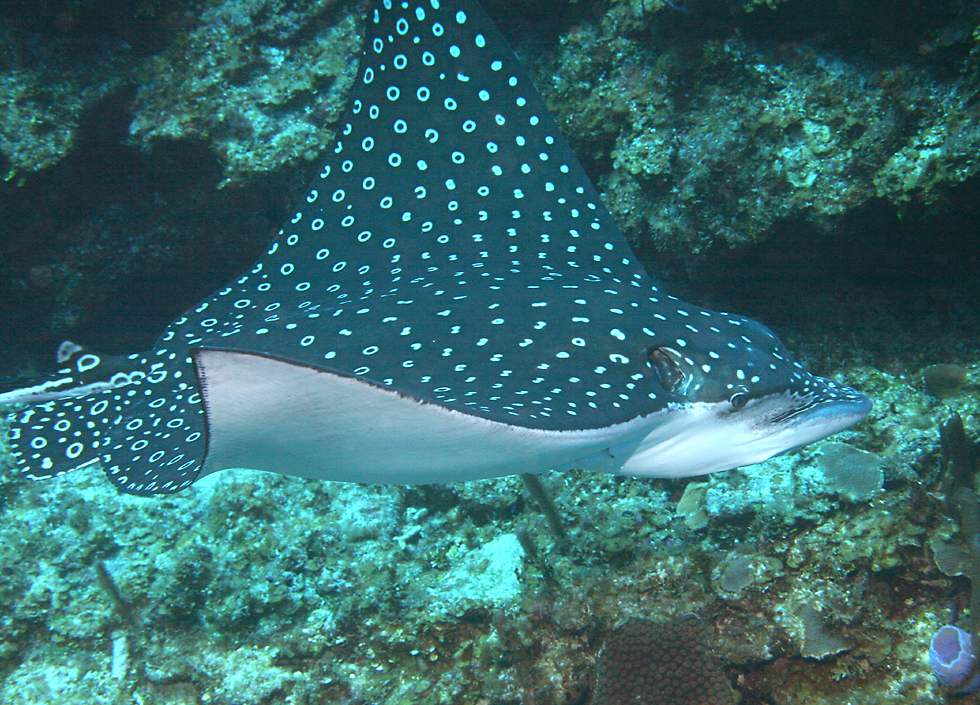
I photographed this spotted eagle ray while diving off Ambergris Caye; during that one dive we saw eighteen different spotted eagle rays! This species can be found in tropical oceans around the world. It has very distinctive markings, a bit like the markings on a whale shark. They use their duck-shaped snout to find mollusks and other food items. They can grow very large, with a wingspan of 10 feet, a total length including tail of 16 feet and a weight of 500 pounds. They're strong swimmers, gathering in large groups just below the surface of the ocean during mating season, and sometimes jumping right out of the water. Like many species of sharks and rays, the male chases the female when courting and bites her until she stops resisting and allows him to mate. |