
Underwater Highlights of Thailand
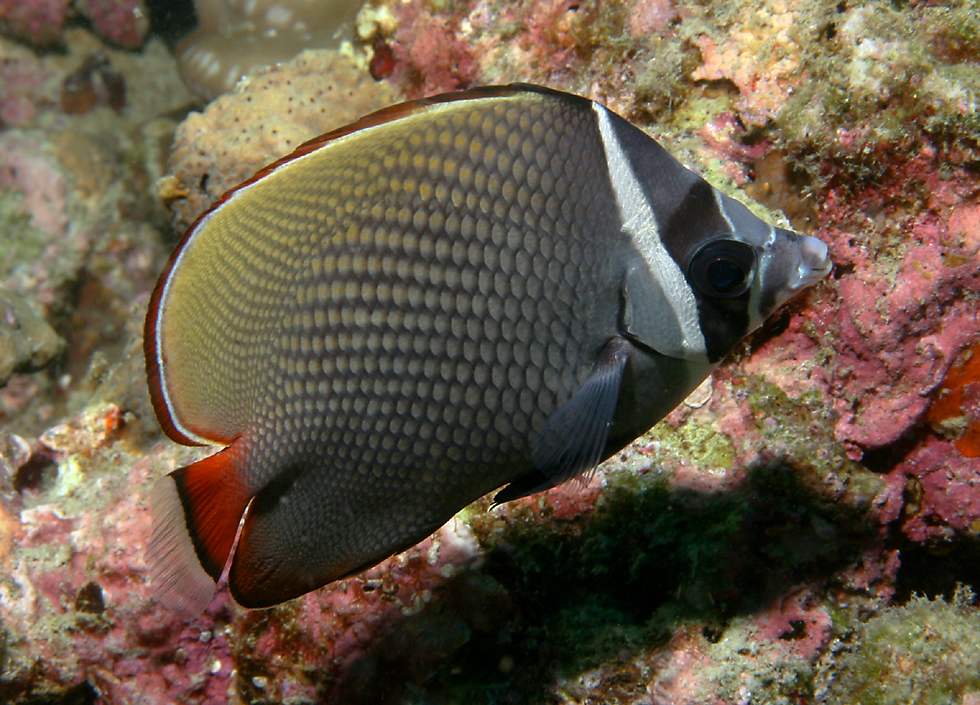
Without doubt, Thailand is one of the world's great travel destinations. As well as an interesting culture, Thailand has friendly people, fascinating ancient architecture and plenty of opportunities to view the local wildlife in the many national parks scattered around the country. In addition to all these attractions, Thailand also draws divers from around the world to sample the underwater delights of the country, like this beautiful white-collar butterflyfish, a member of a large family of engagingly colored and patterned fish which is scattered through the world's warmer seas. |
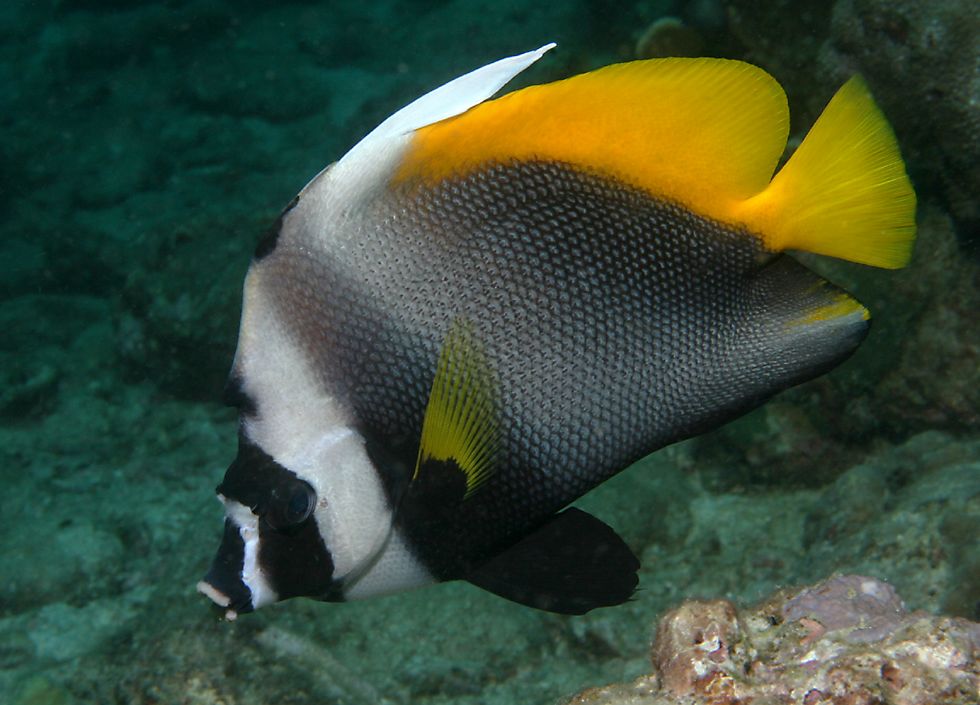
Bannerfish are another group of fish, though not as numerous as butterflyfish proper. Bannerfish are very similar in appearance in butterflyfish, so it's no surprise that scientifically they're grouped together, bannerfish being usually considered a "tribe" of the Chaetodontinae family. This is a singular bannerfish and like the white-collar butterflyfish it's a species I'd never seen before, which isn't surprising because it's fairly uncommon. Bannerfish are usually slightly larger than butterflyfish, the singular bannerfish reaching a length of about 25 centimeters, making it the largest of all its kin. |
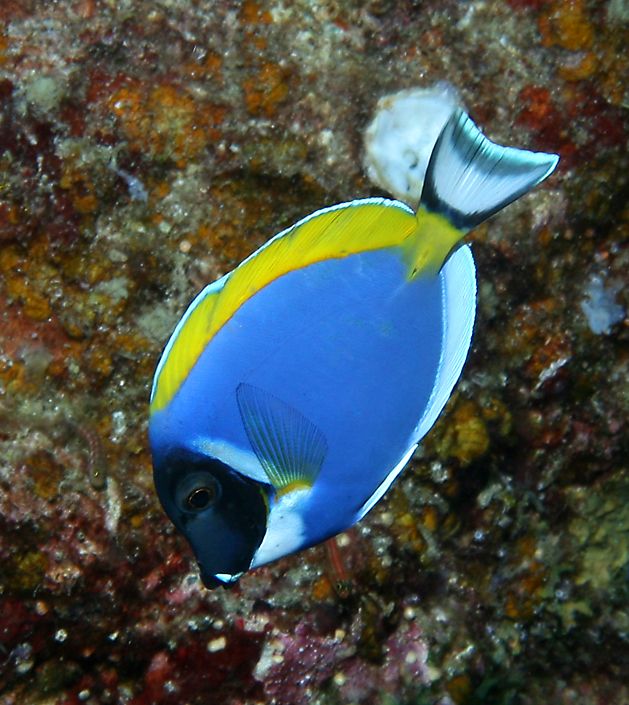
This powder blue surgeonfish is another new species for me, unfortunately I didn't get as close as I wanted, so I guess the "definitive" photo of a powder blue surgeonfish is still in my future. Surgeonfishes get their name from the sharp blade which usually lies recessed just before their tail, which you can see here as a slightly darker horizontal mark at the base of the tail. They can extend this for use as a defensive weapon or as a means of guarding territory from rivals. Powder blue surgeonfishes are certainly territorial, and their rivals include not just members of their own species, but also other types of fish which might try to graze on the algae which the surgeonfish eats. They're so aggressive that they can't be kept in aquariums with other fish. |
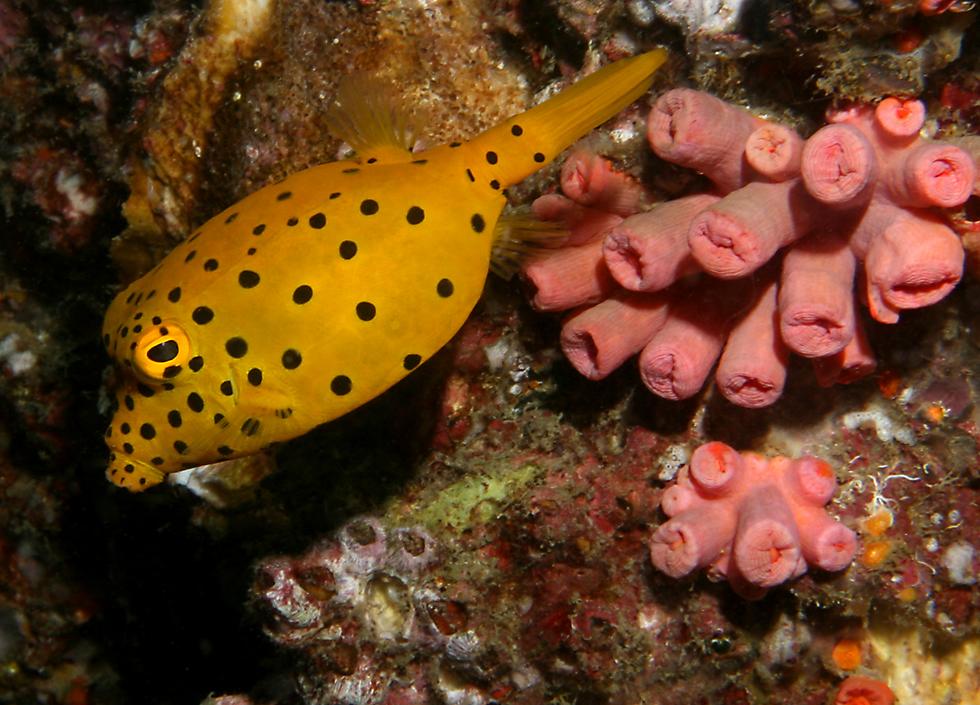
Yellow boxfish like this one are only yellow when they're juveniles, they then go through a couple of color variations as young adults and intermediate adults before ending up as rather dull looking adults with a faint purple color. They're difficult to keep in an aquarium because when they're stressed, perhaps by being harassed by the other fish, they emit a toxic slime which can kill everything else in the tank - call it the revenge of the nerd! They also grow too large to keep in average aquariums, eventually measuring in at 45 centimeters. |

Here's another juvenile, this time a member of the wrasse family called the yellow-tail coris. This juvenile is obviously very attractive, but so too is the adult - you can see a photo of an adult yelllow-tail coris in the Philippines. As you can see, they're both very good looking, but it would be next to impossible to know that they were even the same fish, apart from the obvious wrasse shape! |
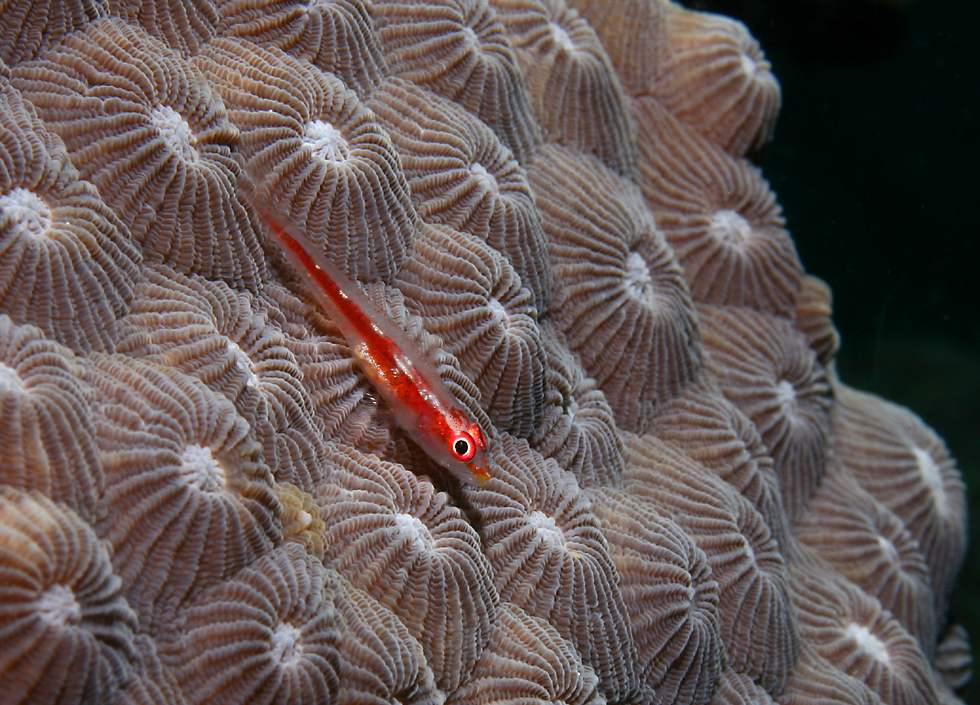
Gobies and blennies are mostly very small fish, blennies having a single long dorsal fin instead of the two dorsal fins of the gobies - though the triplefin blennies ruin it all by also having two fins! It makes no real difference, because I can't tell if this fish perched on brown coral has one or two fins, because I can't tell if the translucent area at the top is part of its back or a fin. |

This is the same type of coral but another fish, a much larger and more menacing variety called a reef lizardfish. They're an aggressive predator, grabbing other small to medium size fish with those needle sharp teeth and then opening that huge mouth wide to swallow them whole. |
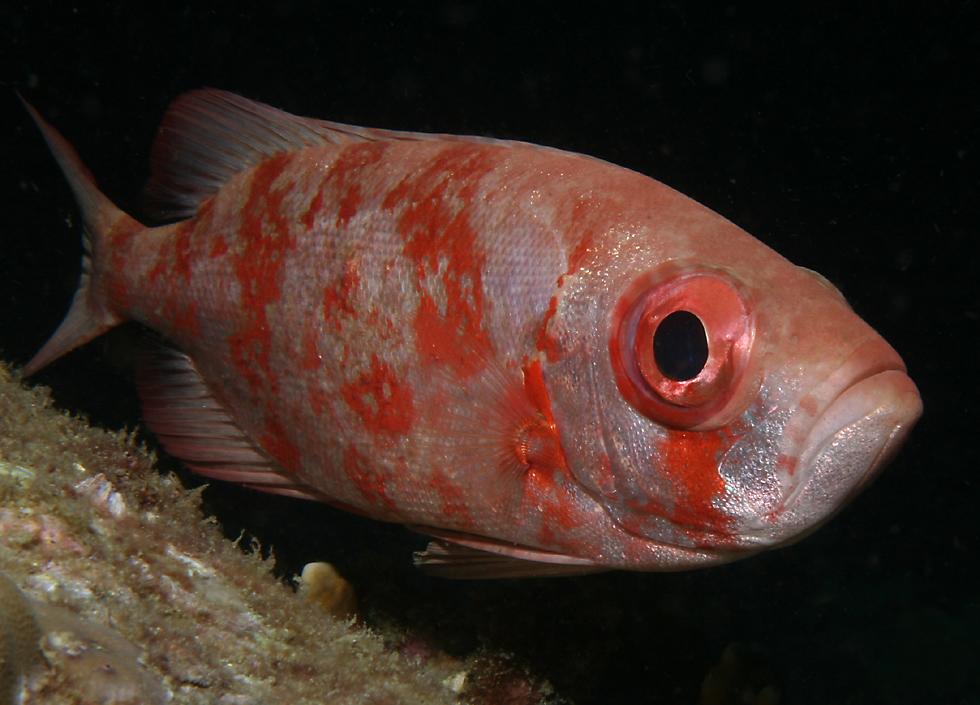
This fish looks rather morose, and so would you if you were called Bloch's Bigeye. They can change color fairly rapidly from completely red to silver with red on top, to this blotched phase, which could have earned the species the even more humiliating name Bloch's Blotched Bigeye! Those big eyes allow this family of fish to hunt smaller fish at night, which lets the bigeye have the last laugh after all. |
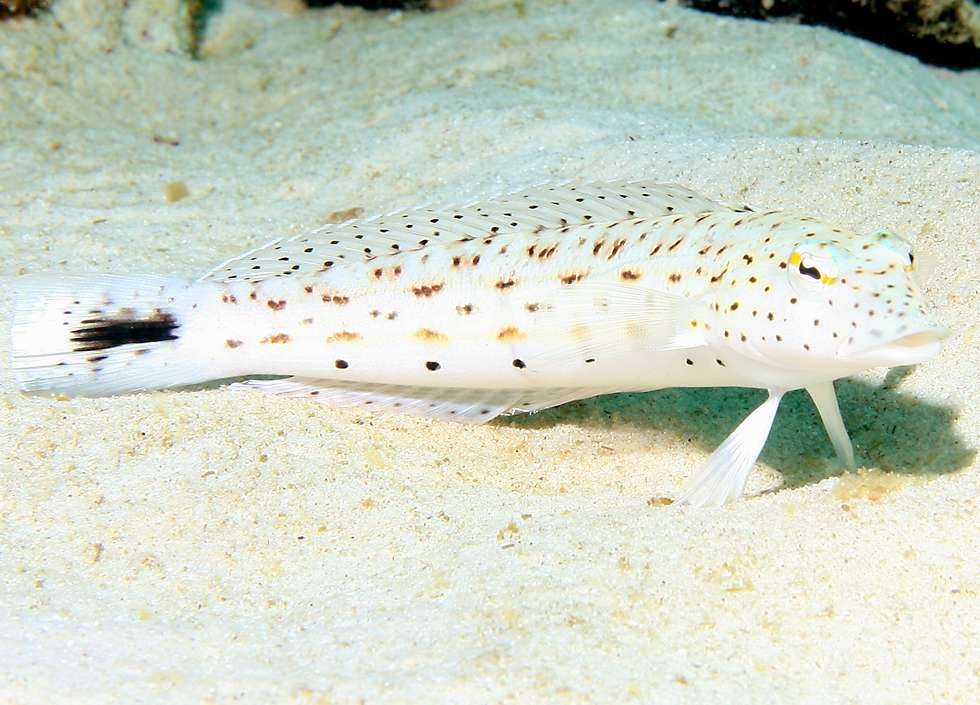
What are you lookin' at? As you might guess from its pose, this speckled sandperch is very territorial, perching on its two pectoral fins while it surveys its domain, a habit it shares with the other sixty or so members of this family. The speckled sandperch is probably the most commonly encountered member of the family, and it's also very widespread, all the way from South Africa to the Red Sea and across to Japan and the southern Great Barrier Reef in Australia. |

A black-spotted puffer drifts sluggishly around the reef. Instead of relying on speed, puffers protect themselves from predators by gulping down water and swelling themselves up to a size which hopefully makes them too much of a mouthful for the attacker. If that fails then it relies on a secondary defensive mechanism employed by many puffers, highly toxic flesh. It's better not to be bitten, but if that doesn't work then it's still better to have just one bite taken than many! This species comes in a wide variety of color schemes, some of which have very few black spots, however they can all be identified by the dark patch around the mouth. |
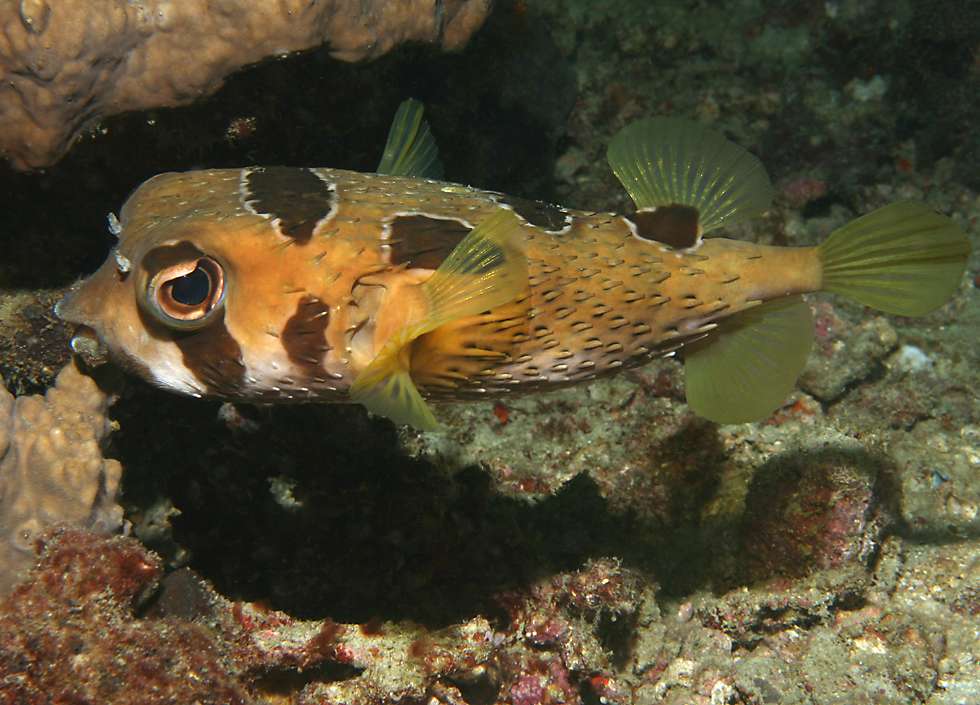
This black-blotched porcupinefish can pull all the tricks of a puffer, plus it has spines which stand erect when the porcupinefish is inflated, and it also has a reputation for inflicting nasty bites on any diver evil enough to provoke it for his or her own amusement! It's nocturnal, using that powerful bite to crush its preferred diet of crustaceans and shellfish. |

This spot-fin porcupinefish is much larger than the black-blotched porcupinefish, which probably helps it not be eaten but makes it prone to other nuisances, like the unwanted attention of this sharksucker which has decided to tag along for a ride. This species is circumtropical, which means that it's managed to establish itself in the tropical waters of both the Pacific and the Atlantic, which either involves surviving a trip through the cold waters at the bottom of South Africa, or being around long enough to have swum through the gap where Central America now is. Most scientists believe that it's the baby fishes, floating around with seaweed, which make the trip from one ocean to the other. |
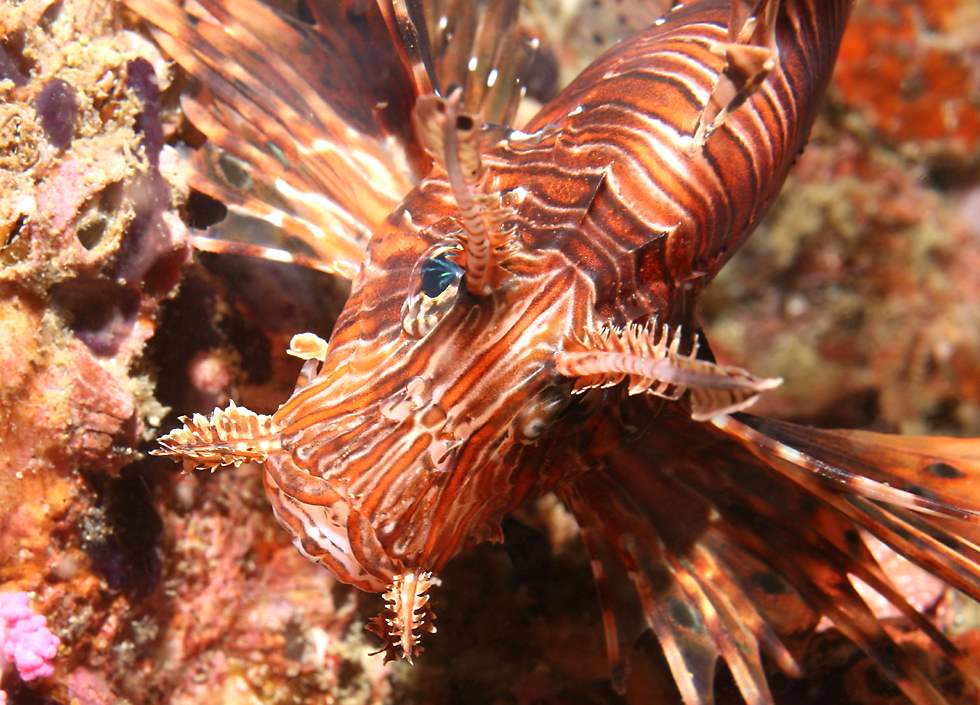
This lionfish is much more feared than the puffers and porcupinefishes, and for good reason - the spines on its back contain a very potent toxin, and you don't have to eat it to get a dose! Lionfish aren't just a menace for divers; I snorkelled with half a dozen of them in shallow water just off the most popular swimming beach in the Egyptian resort town of Dahab. I'm sure that those swimmers were unaware of the danger they were in. On the plus side, lionfish aren't at all aggressive, they're slow moving and would much rather swim away than use their formidable defensive powers. For these reasons, they're really not a huge threat either to divers or to swimming tourists. |
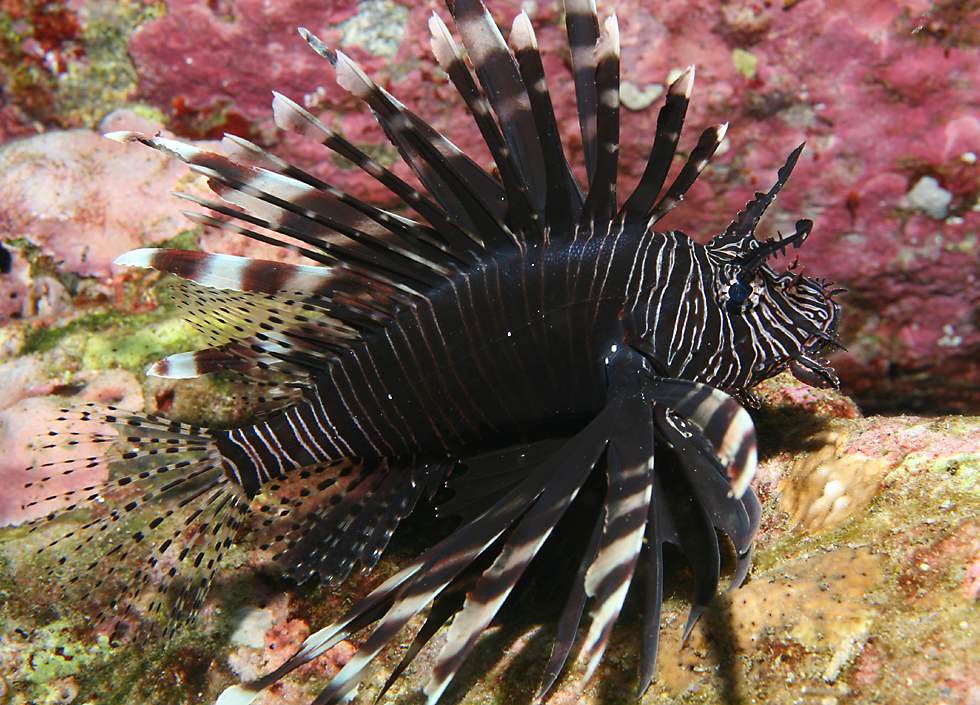
There are about a dozen species of lionfish, most are some combination of red and white stripes, however the dwarf lionfish does have a very nice yellow variation and some common lionfish individuals like this one are black and white. |
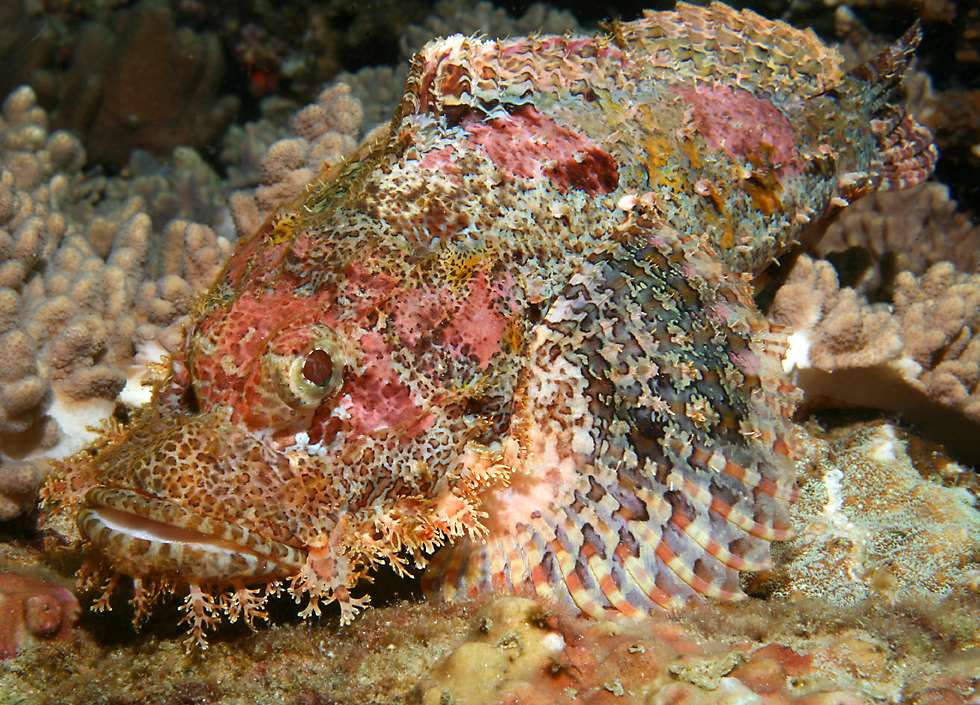
Scorpionfish like this tassled scorpionfish are very common through the Indo-Pacific region. Like the lionfish, their spines can deliver a very strong toxin, but unlike the lionfish they're often well camouflaged and therefore easier to accidentally contact. This particular individual has the most spectacular combination of patterns and colors that I've ever seen on a scorpionfish. |
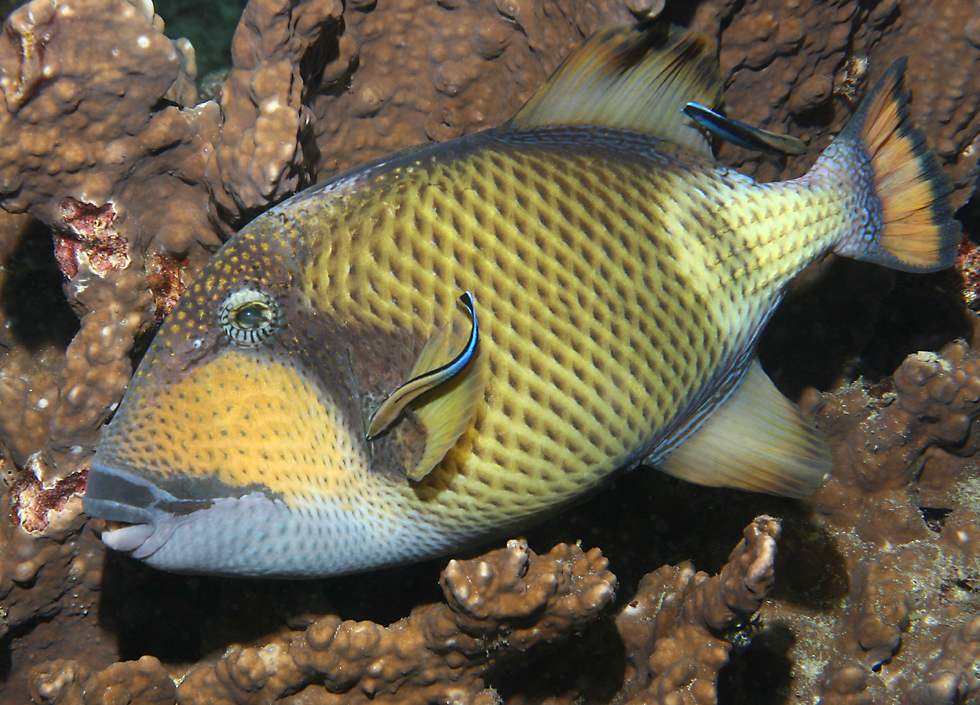
A titan triggerfish takes time out from its busy schedule for a spa treatment with a couple of cleaner wrasses. In this case, the busy schedule mostly consists of sinking its teeth into unwitting scuba divers, making it one of the most feared fish in the ocean, more so even than the lionfishes and scorpionfishes. You can get a better view of those teeth from this photo of a titan triggerfish in the Philippines. However this aggressive behavior is usually confined to those times when the triggerfish is guarding its nest of eggs, and even then facing it down (preferably with the help of some object like a camera housing) almost always keeps it at bay. |
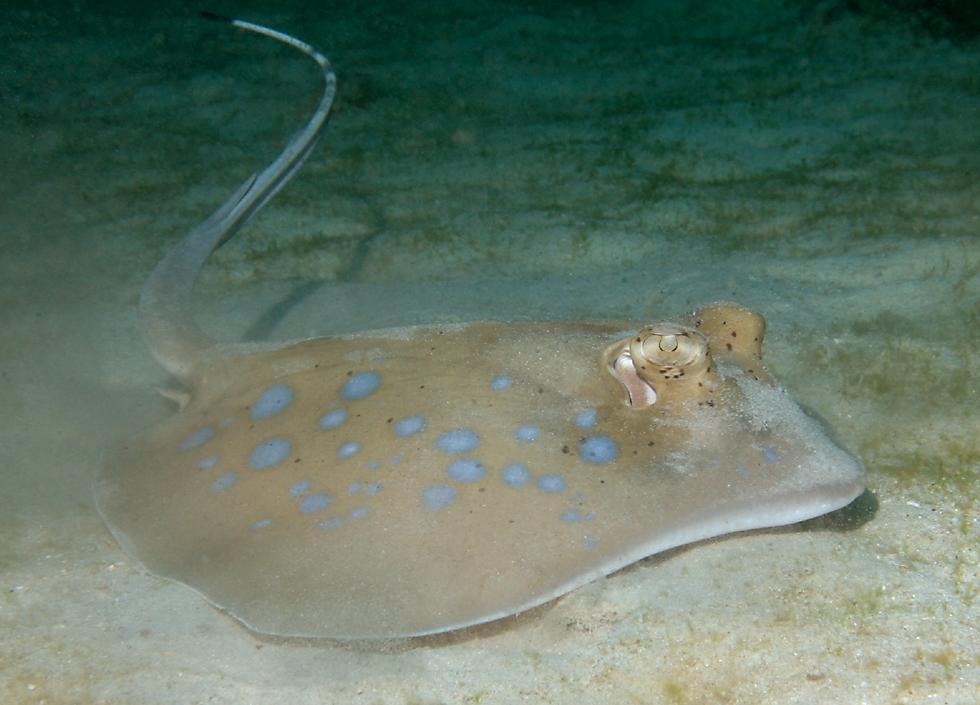
Stingrays like this blue-spotted ray have a fearsome reputation because of the venomous barb on their tail, but they're also totally non-aggressive. Most incidents occur when someone is wading through shallow water and accidentally steps on an unseen ray; for this reason it's advisable to shuffle your feet along the bottom to avoid the problem. Otherwise there are rare situations where the stingray puts its barb into a diver who is deliberately disturbing it. |
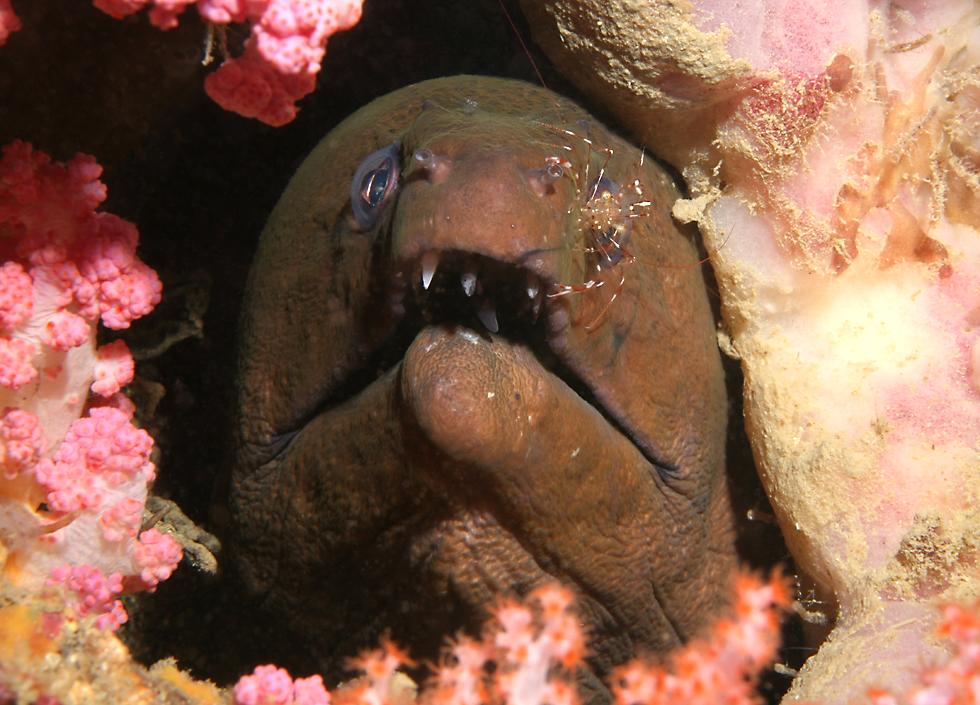
A giant moray (Gymnothorax javanicus) with a clear cleaner shrimp (Urocaridella antonbruunii). As its name suggests, the giant moray is the largest of the roughly 200 species of moray eel scattered around the world, reaching 10 feet long and weighing 80 pounds. The moray eel is another well-armed but unaggressive creature, and in its case attacks are almost entirely due to harassment, or the eel inadvertently and literally biting the hand that is feeding it. One reason moray eels look particularly menacing is that they usually breathe through their mouths, pump the water back to their gills. This exposes the long sharp teeth they use to catch fish, which often come in several rows, one or two on each side of the jaw and one or two more down the middle. Moray eels are unique because they have a second set of toothed jaws further down their throat, which comes forward and latches onto the prey and then drags it down the throat. This setup looks rather similar to the second set of jaws sported by the creatures in the "Alien" movies. This particular eel is benefiting from the services of a clear cleaner shrimp, though having the shrimp walk right over your eye does look uncomfortable! |
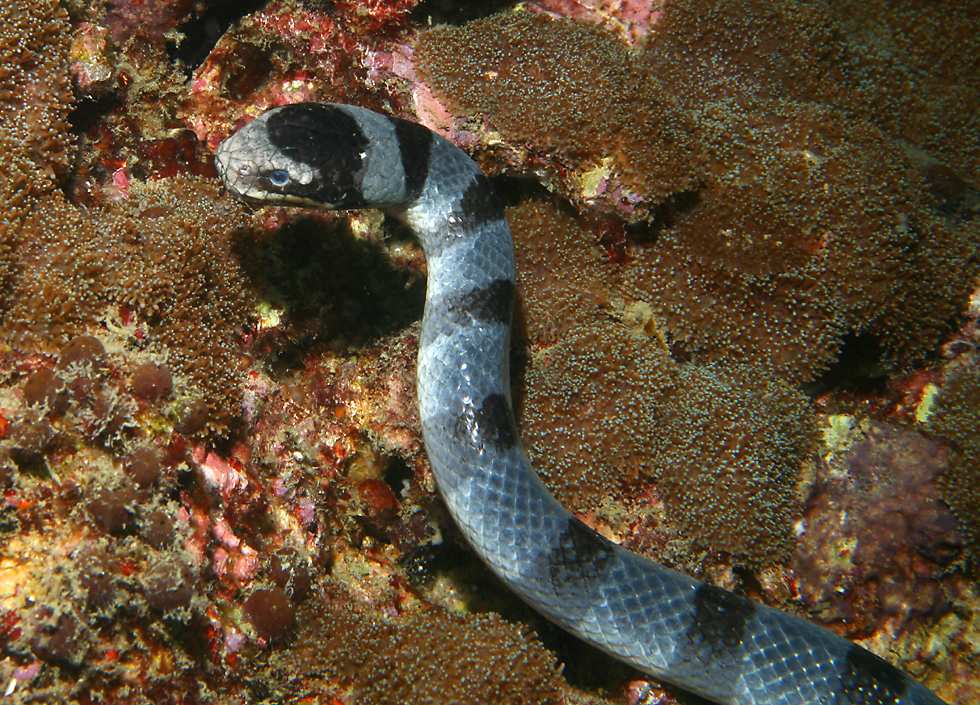
Here's the scariest critter of all, a banded sea snake! People don't like snakes on land, and certainly don't like encountering them in an alien environment like underwater, where you can't just go up to the surface whenever you want (unless you enjoy contracting the bends or rupturing your lungs by too rapid an ascent). Adding to the fear for many people is the knowledge that sea snakes are much more toxic than land snakes like a cobra, because they have to very quickly immobilize their prey before it can rush off into an inaccessible part of the reef. However, like the other critters on this page (apart from the titan triggerfish), almost all sea snakes are entirely non-aggressive, and most of them are docile enough to be handled, though that's not something I would ever attempt. However I was happy to follow this one around for a few minutes, and it completely ignored me even though I took about ten photos of it using a powerful flash at close range. I can't always promise to be so comfortable around a sea snake, though. There are some which are very curious, and will approach a diver in order to examine their own reflection in the diver's mask. There are even one or two species which do display aggression towards people, and unfortunately I wouldn't know how to recognize one of those. |
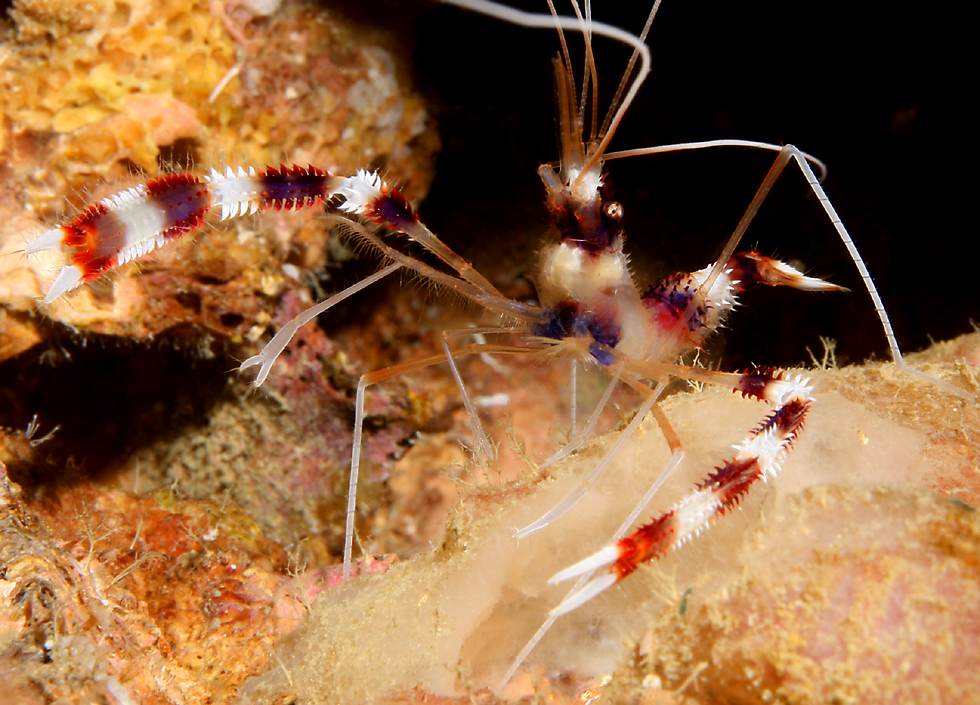
The moray eel and its shrimp friend were at the very small island of Koh Doc Mai, near Phuket, as was this banded boxer shrimp. Although it's called a shrimp, it actually belongs to a different family of crustaceans, but it performs the same cleaning services as the true cleaner shrimps. It's pretty much unconcerned about who it cleans, so if you slowly reach out your hand to it then it's quite likely that it will give you a quick beauty treatment, looking for parasites and bits of dead skin. They are found throughout the tropics, in both the Pacific and the Atlantic, and almost always come in pairs; this one's mate, a smaller male, was just out of shot on the right. |
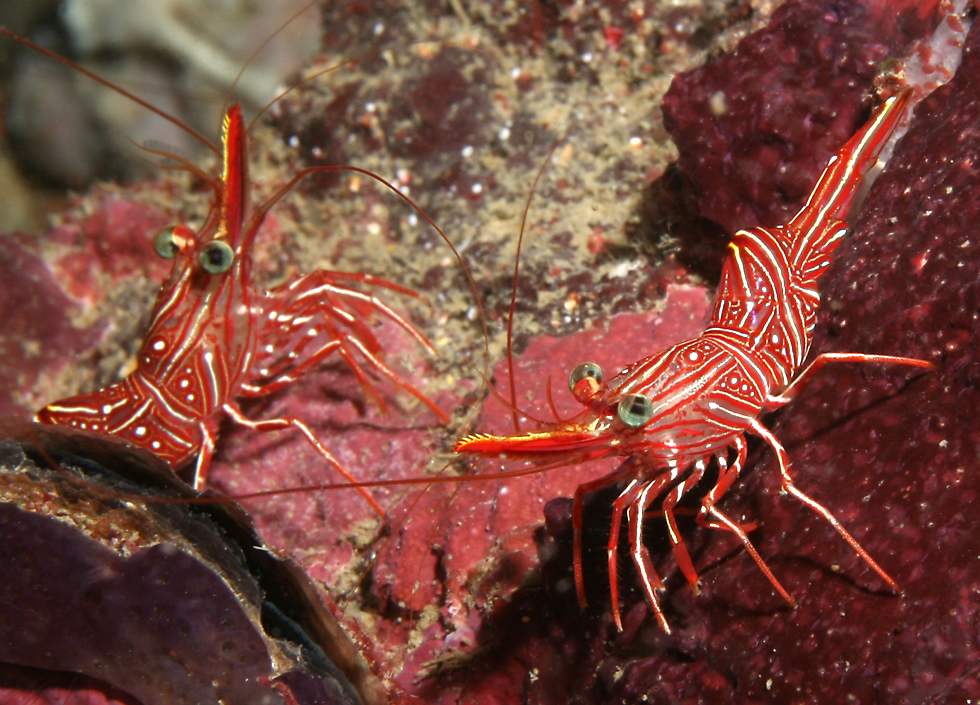
The name of these Durban hinge-beak shrimps might be a mouthful, but there's no denying that they've got looks and appeal, with those colors and stripes they pretty much epitomize the phrase "eye candy". These are the most common of all the hinge-beak shrimps, and sometimes they gather in large groups, making for great photo opportunities. |
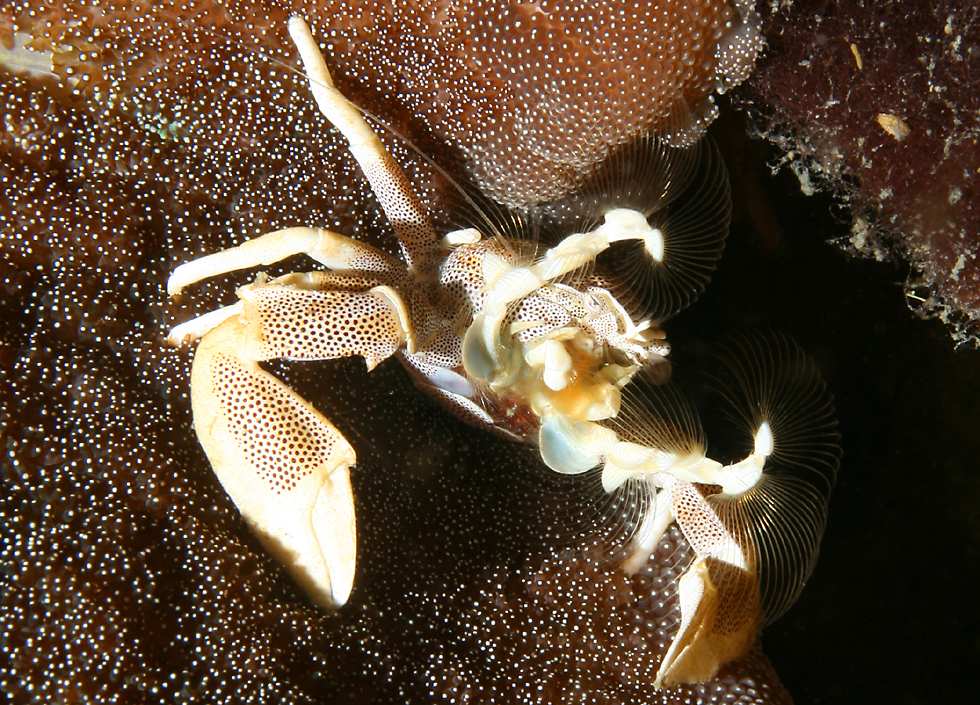
This spotted porcelain crab uses the feathery extensions on its maxillipeds to sweep the water for small crustaceans and other plankton. It's also called a porcelain anemone crab because of its habit of feeding while on an anemone, presumably to benefit from the protection offered by the anemone's stinging cells. In spite of its name and crab-like appearance, this species isn't a true crab, instead it's a type of squat lobster, the giveaways being its antennae and the three pairs of walking legs; true crabs have no antennae and four pairs of walking legs. There are a number of families of crustaceans which have evolved to look like true crabs, a process called carcinisation. |
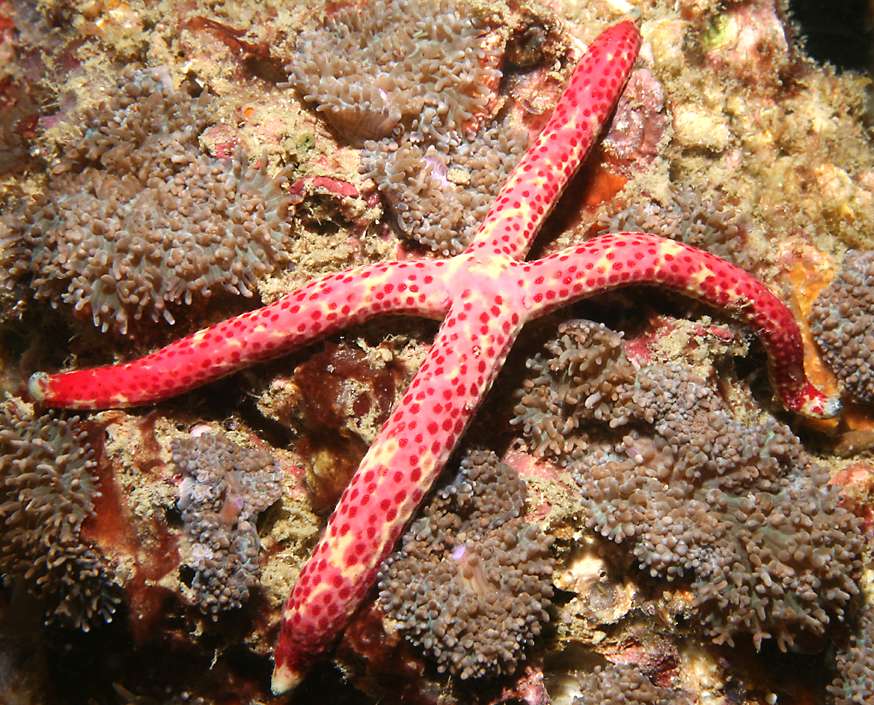
This poor Linckia multifora sea star was ridiculed all the way through school because of its funny name and because it had only four arms instead of five. Now it's condemned to wander friendless across the tractless wastes of the reef, alone and unaware of its nice patterns and pastel colors. Many starfishes come in a vast kaleidoscope of colors, one individual of the species being a totally different mixture of colors than other members of the same species. |
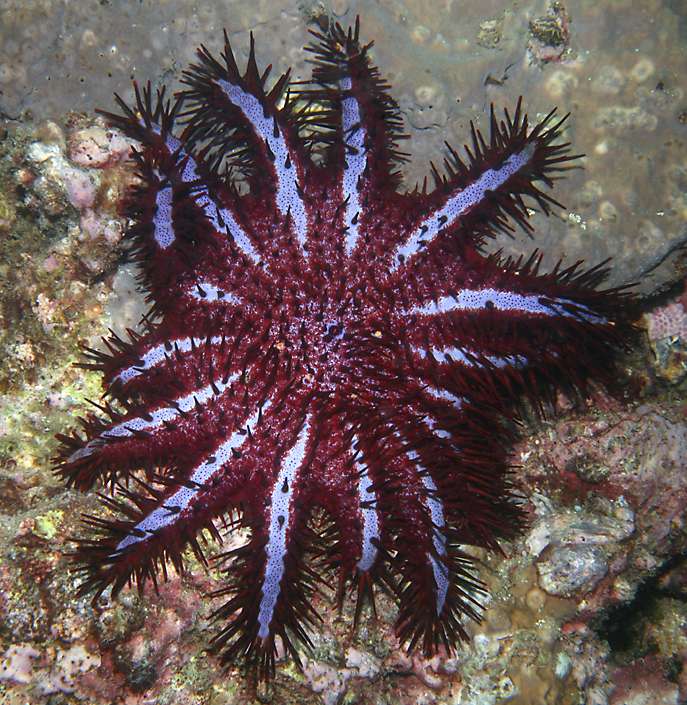
If the last sea star suffered from having too few arms, then this one definitely has a surplus, which has resulted in an arrogant monomania of horrific proportions. This is the much reviled crown of thorns starfish Acanthaster planci, which can strip coral heads bare by turning its stomach inside out and consuming the coral polyps. On their own they're quite bad, but sometimes they reach plague numbers and devastate large areas of reef. Like the other sea stars, this species is highly variable in coloration, I've also seen a dull colored one munching on a Fijian reef, but this vibrant purple and blue color scheme seems to be more common around Thailand. |
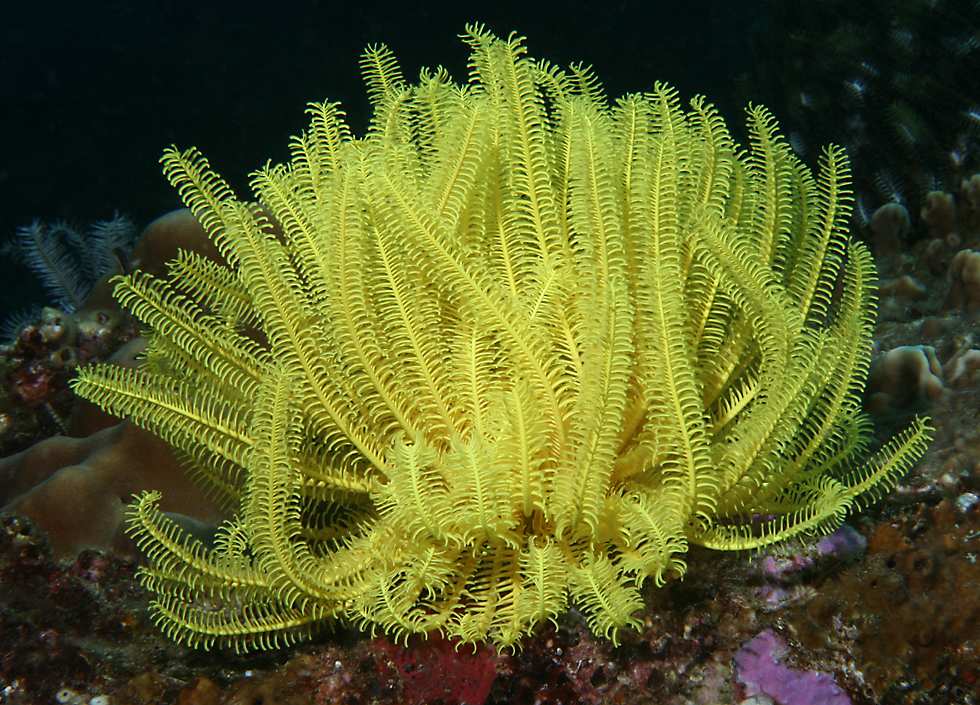
Talking about vibrant colors, here's a very nice crinoid called Comanthina nobilis. It belongs to a class of animals (yes, Virginia, this is an animal and not a plant) which are also called feather stars or sea lilies. The "feather star" name is a hint that crinoids belong to the same large group as the sea stars. Theoretically this means that they have five-fold symmetry, but as you can see they have a lot more than five arms, just as the two sea stars you've just seen don't conform to that "rule". The arms of the crinoid capture food particles from the water and pass them down to the mouth, which is at the top and center of the creature. Crinoids first appeared around 450 billion years ago. Some of the modern species have a stem which anchors them to the rock while others are completely mobile and can even swim. However it appears that even the species with stems can move from place to place if the mood comes over them. |
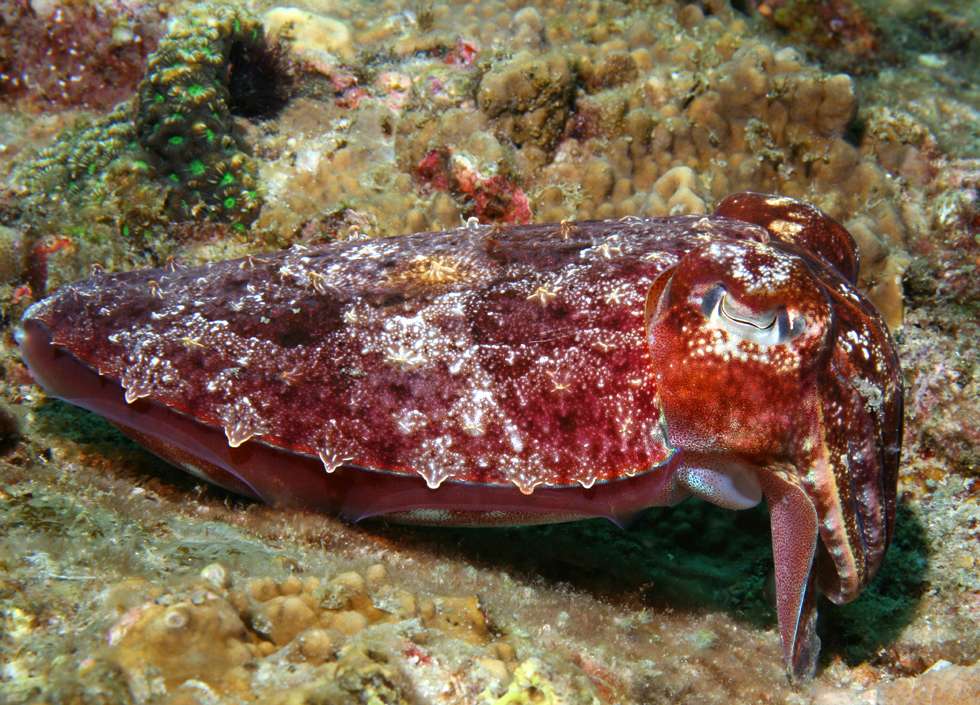
Having a fixed color is so uninteresting, and cuttlefishes like this one are masters of change. When I first saw this individual it was mostly white, with speckled brown, but within thirty seconds it had changed to this rich shade of burgundy. Ironically, although they have very highly developed eyesight, they're actually color blind, so they can't see the color of the background that they try to blend to. Like their cousins the octopuses, cuttlefishes can also change their texture, you can see the raised spikes that this one has formed on its back. Cuttlefish are actually molluscs just like clams and scallops, but without the external shell; instead they have an internal "cuttlebone", a porous, chalky structure which is best known as the treat given to caged birds to keep their beaks in good shape. They only live for a year or two, but cuttlefish are considered one of the most intelligent invertebrates, they can solve mazes and unlike octopuses they're highly sociable and have a wide range of communication displays. |
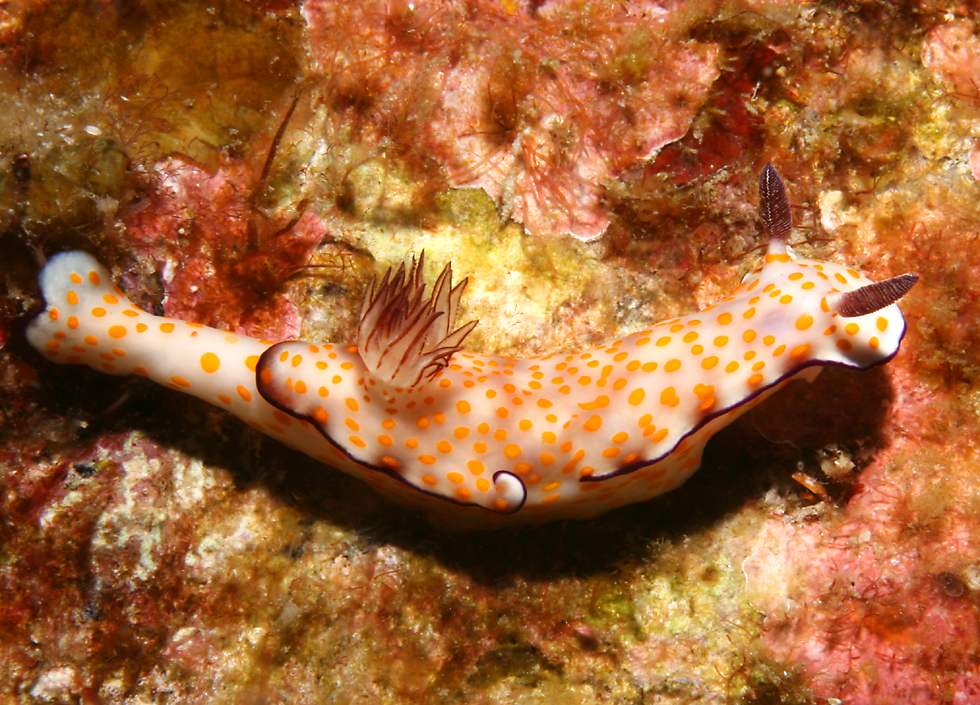
I don't think anyone would ever accuse a sea slug like this Risbecia pulchella of being intelligent, but there's no doubt that it's interesting and beautiful, in fact it's common name is the "beautiful risbecia". It's quite common to find members of this species trailing one after another, perhaps a prelude to mating. |

Here's Glossodoris rufomarginata, which is commonly called the white-margined glossodoris; however the Latin "rufus" means red, so I'll stick with the less commonly used name red-margined glossodoris, because it seems more appropriate. Like many other sea slugs it eats sponges - not the chocolate type with frosting, but the clean yourself in the bath type. |
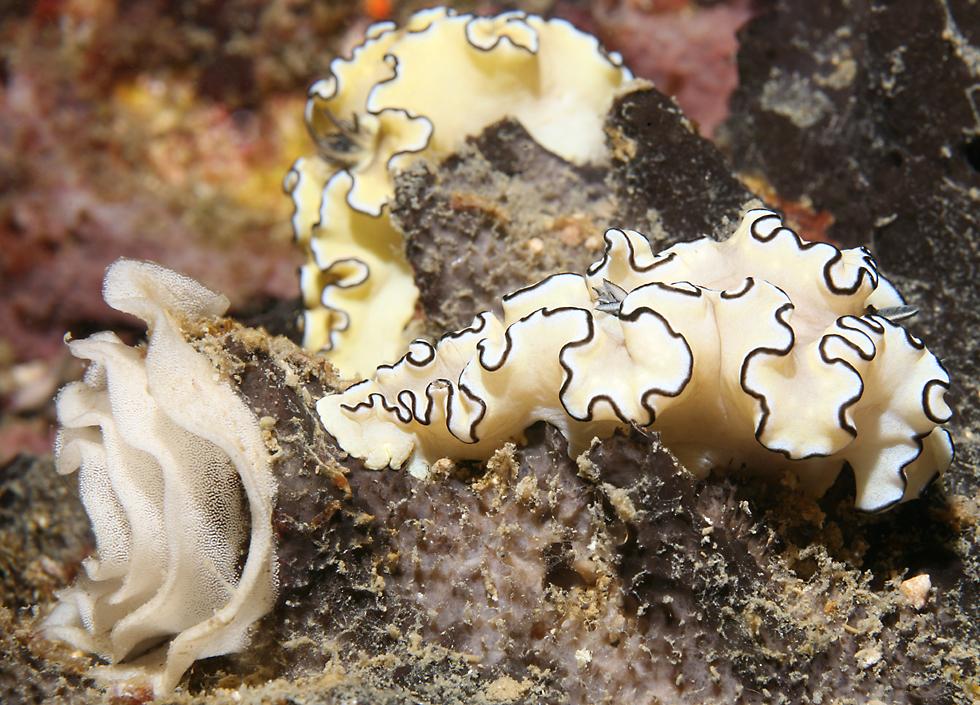
This sea slug with the very frilly edge is Glossodoris atromarginata, the fittingly named black-margined glossodoris, which also eats sponges. Actually there are two black-margined glossodorises in this photo, and the strange white spiral on the left of the photo is a ribbon of sea slug eggs. The eggs laid by this variety of slug certainly have the same shape and color as these, so there's quite a good chance that they were laid by one of these two. Sea slugs are hermaphrodites, each individual is both male and female, so when they mate both pass sperm to the other and then both go off to lay eggs. |
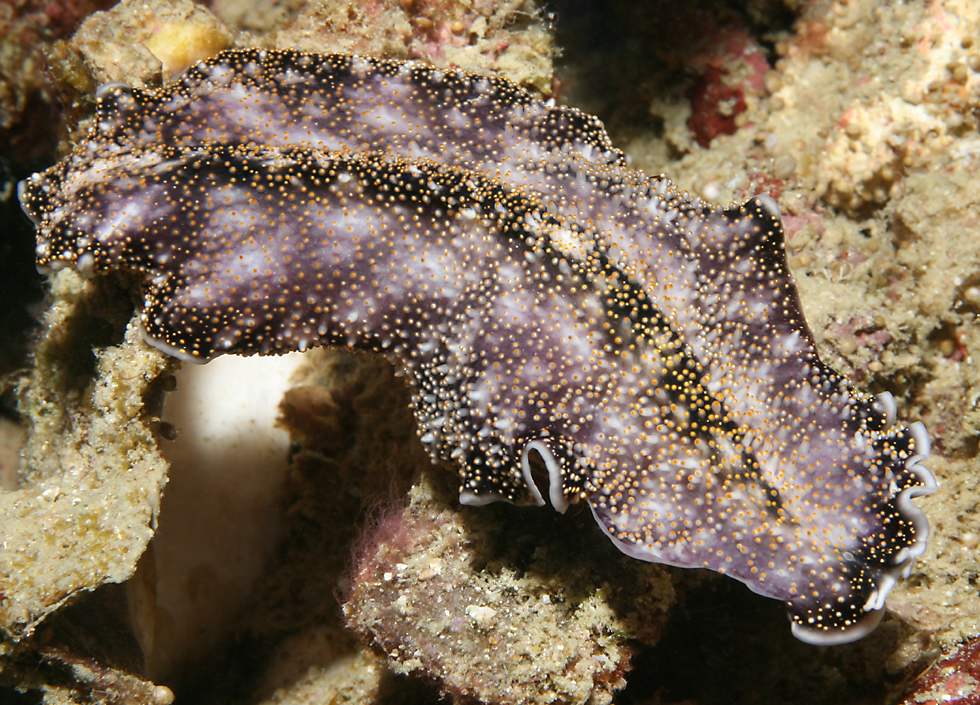
This strange looking thing isn't a sea slug, it lacks the "naked gills" on its back which gives them their technical name "nudibranch". Unbelievably, this is a worm, more specifically an Acanthozoon or Thysanozoon flatworm, which is commonly called a "yellow-spotted polyclad flatworm". It's difficult to track down exactly what species it is because several of them look similar; most are scientifically undescribed and known only from photographs. If you're German then you'd call it a Strudelwurm, even though they're probably far less tasty than a nice apple strudel! Whatever species it is, it was certainly moving rapidly, which makes sense because these flatworms are carnivorous. Although they usually slide along the bottom, they can also swim by undulating the edges of their mantles. |