| For
many people this is the very image of paradise, Fiji-style.
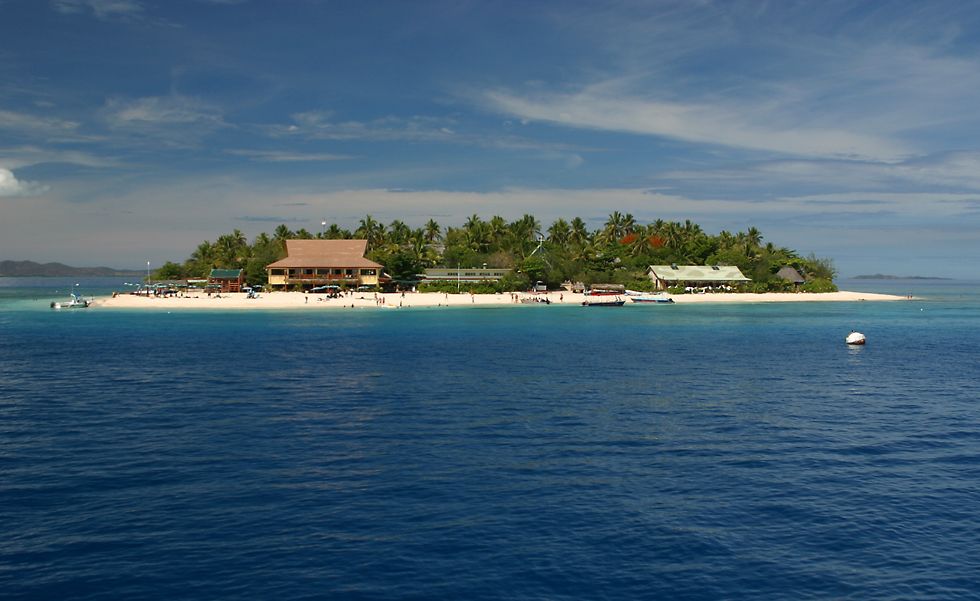
Beachcomber Island is a self-proclaimed "party island" in the Mamanuca
island group north of the main entry point to Fiji, Nadi. The
coconut palms and coral reefs might be exotic, but everything else is comfortingly
familiar, though with a slight twist. The local people speak
very good English, but thanks to the early missionaries and their lexographical
ideas, Fijian spelling is unusual, which explains why Mamanuca is pronounced
Mamanutha,
and Nadi is pronounced Nandi. |
 |
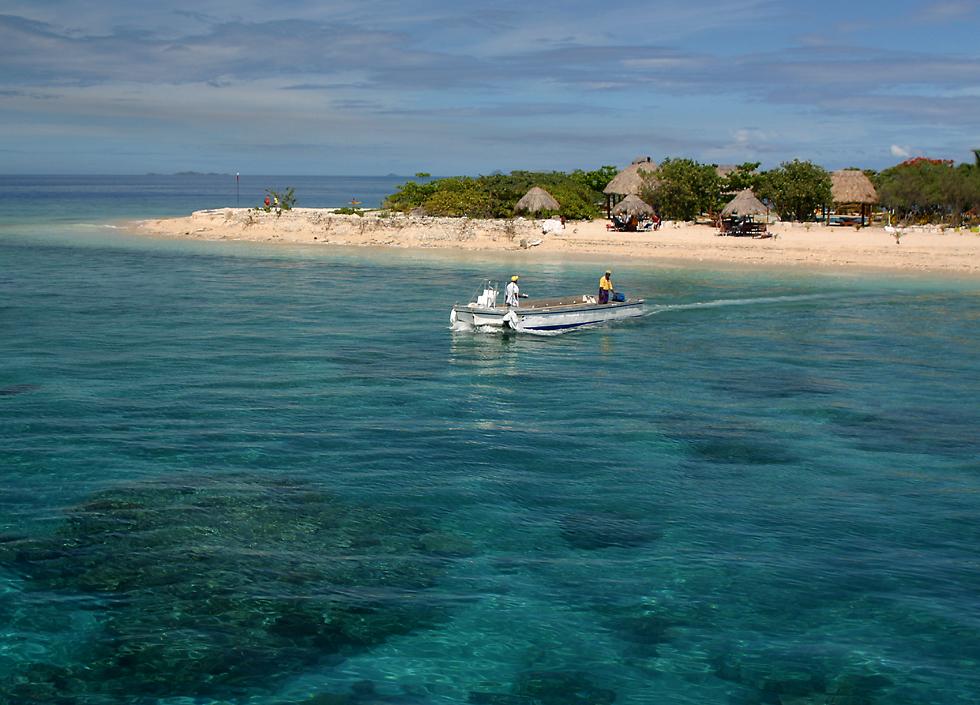
| Navini
is another resort island in the Mamanuca group, but smaller and quieter,
offering relaxation in contrast to the frenetic activity of Beachcomber.
And relaxation is about all you can do on an island whose resort proudly
proclaims "You can and will stroll around the island in 10 minutes".
I applaud those people who can enjoy such an environment, but a type A
personality like myself needs a little more action and variety. |
 |
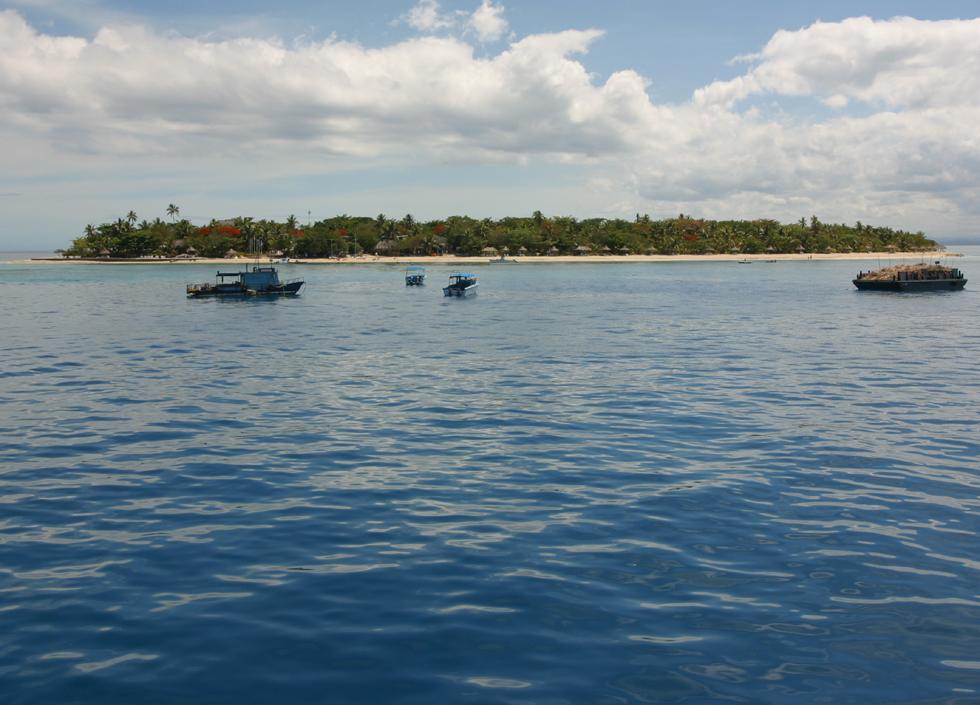
| Treasure
Island has more watersports but in a more adult atmosphere than Beachcomber,
with canned culture in the form of a kava ceremony and "Polynesian" hula
dancing and fire dancing - a slightly odd idea, since Fiji is really a
Melanesian country. In a bid to grab as many "eco-dollars"
as possible, the resort has introduced various native animals such as crested
iguanas and banded rails to the island, and operates its own captive breeding
programme for green turtles. |
 |
| Just
in case it isn't already apparent to you, I decided I wasn't the "Mamanuca"
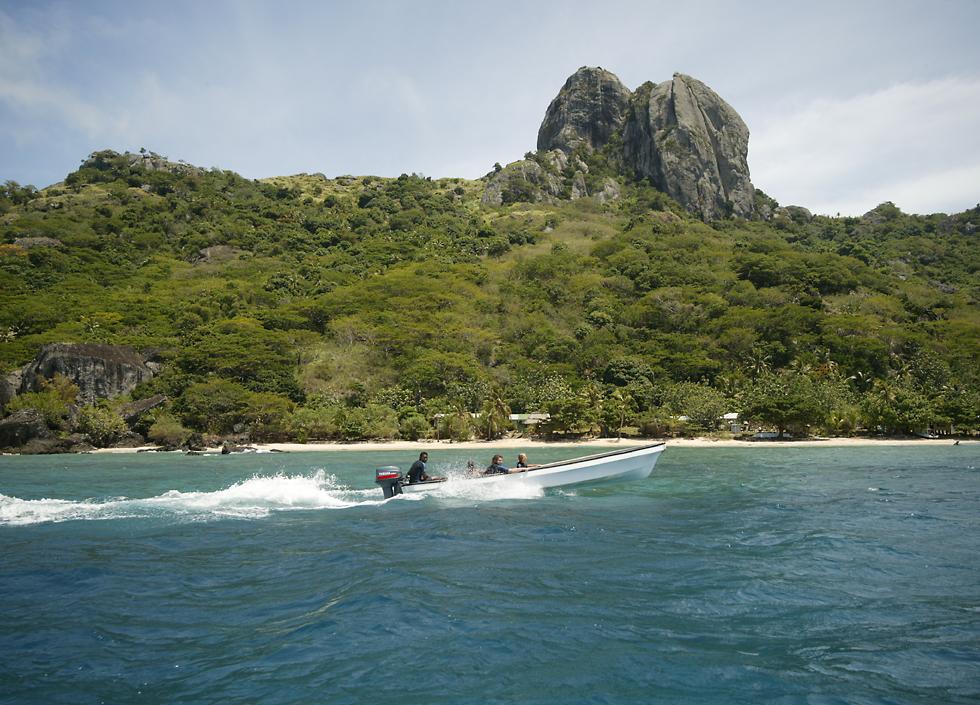
type. Instead, I took the ferry further north to Wayalailai,
one of the nearest islands in the Yasawa group. The Wayalailai
Resort has much less of a packaged feel than those further south, since
it's operated by the local Fijian village you see on the shoreline here.
There's no disco, banana boat or paragliding, but there's a nice dining
area, with traditional feast done weekly, snorkelling on the reefs and
hikes around the island. |
 |
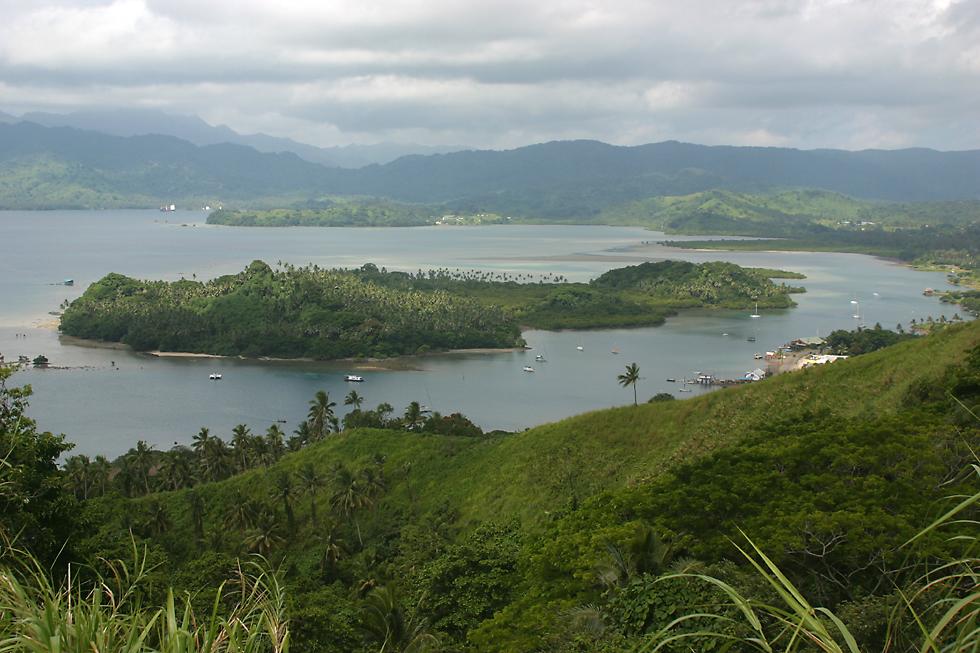
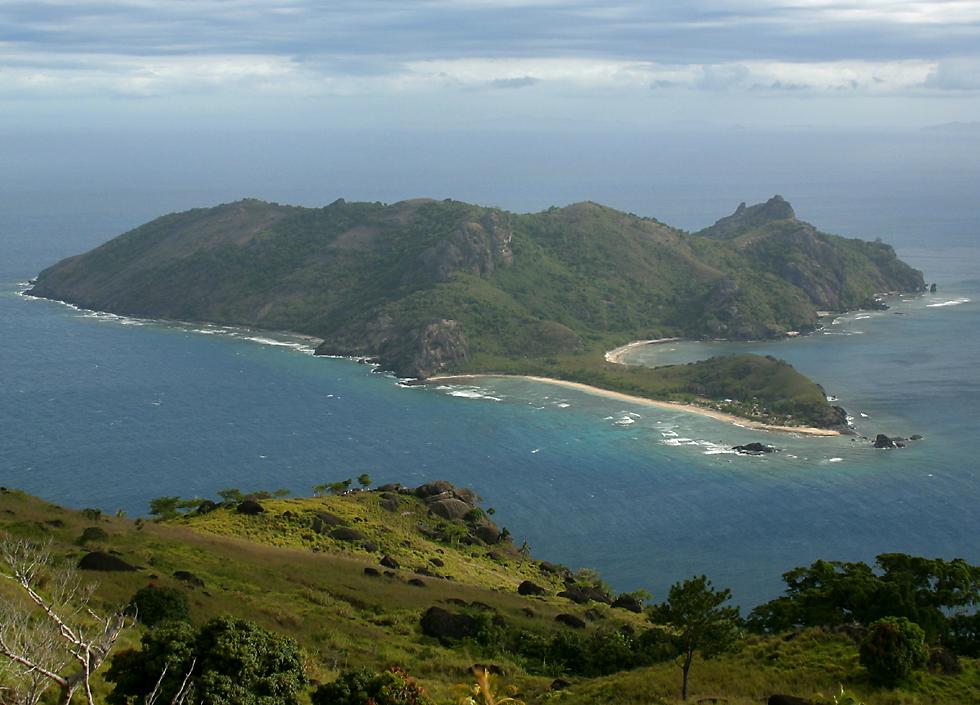
| Here's
a view from the top of the hill, with Kuata island across the channel,
and the mainland just visible on the horizon. Kuata is one
of the best places to go snorkelling around here, with sheltered areas
no matter what direction the wind is coming from. |
 |
| Wayalailai
is a much better place to have real interactions with native Fijians than
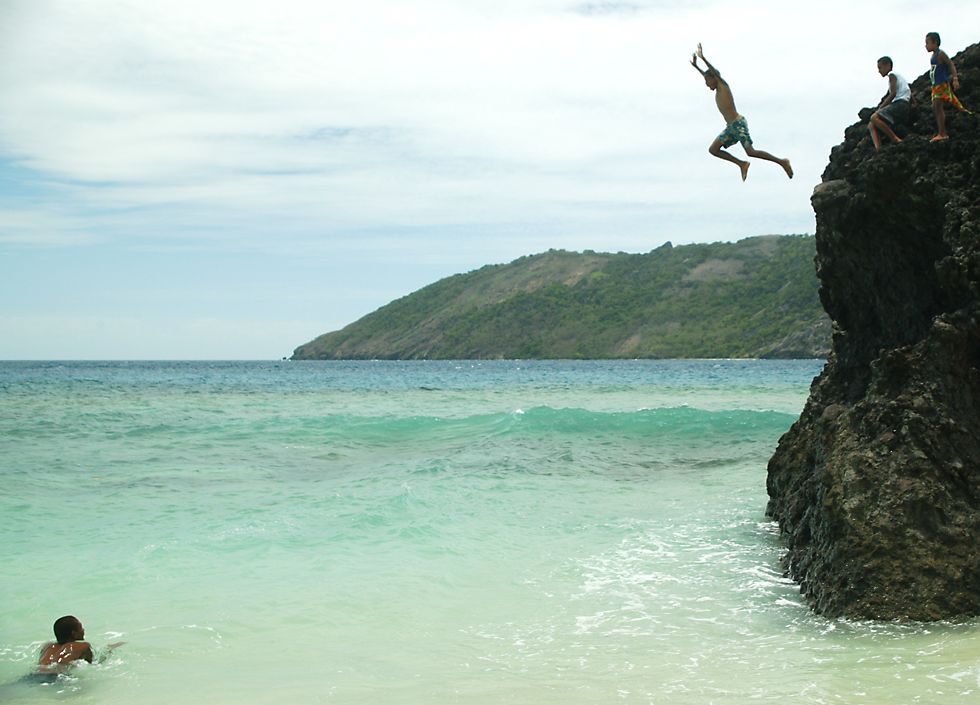
the sanitized resorts further south. Here are some of the local
kids enjoying themselves on the beach in front of the resort, which draws
a mostly backpacker clientele. I joined a couple of locals
on a night snorkelling trip, at first I was surprised by one of them speaking
very fast and very loud in Fijian as soon as we got in the water, then
I realized he was praying! Not too comforting when you consider
how famous Fiji is for sharks, and when both of them were spear-fishing.
At the end of the trip I realized that the boat which dropped us off had
departed to another village, together with my clothes! One
of the Fijians lent me a pair of his shorts to wear, and I spent the rest
of the evening and that night in the village, before walking the short
distance back to the resort in the morning. |
 |
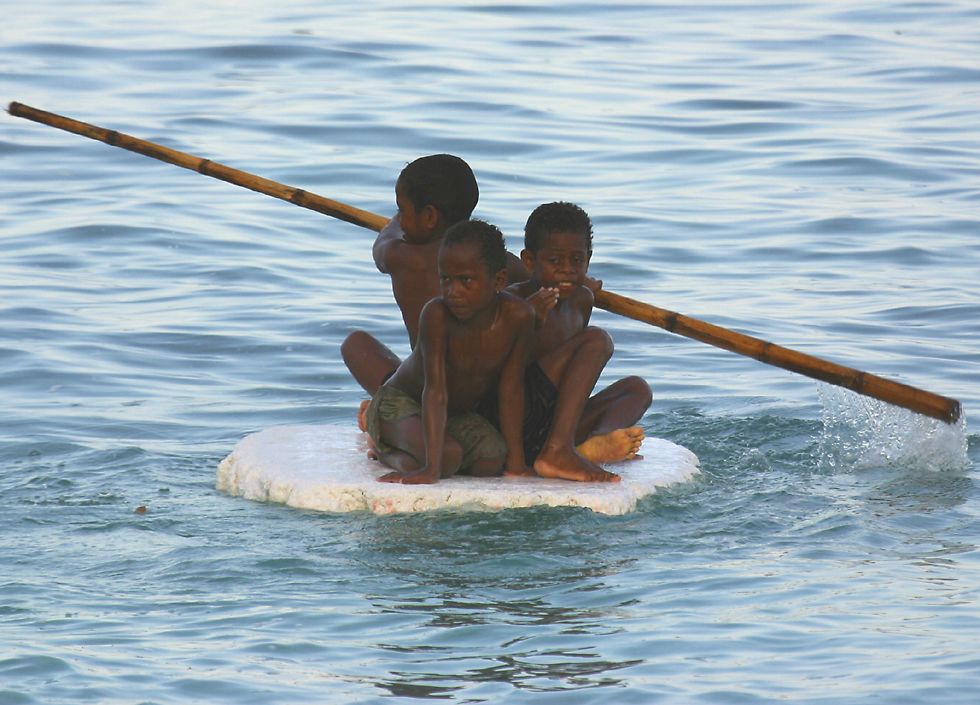
| With
so much water in Fiji, it's no surprise that much of the play time for
these kids involves swimming and diving; the ones above have learned to
expertly time their jumps to coincide with the incoming waves, and this
group below looks like an intrepid band of explorers! Fiji
is a slower-paced and simpler place than western countries are now, so
the kids amuse themselves, often out of sight of parents, and use whatever
is around for their enjoyment. |
 |

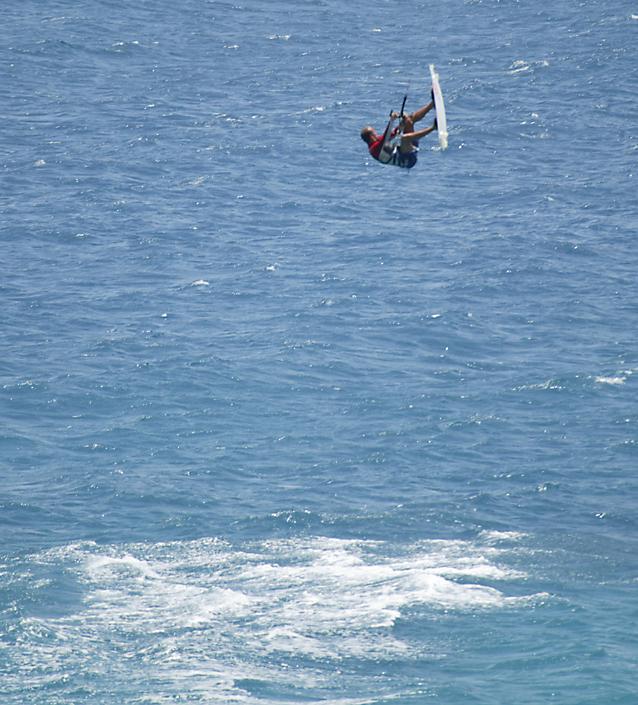
It's not just the young or native-born who enjoy playing in the water!
This French backpacker brought along an entire kiteboarding kit with him,
and he made good use of the windy conditions, jumping high into the air,
and even jumping over several boats full of surprised locals who happened
to pass by. |
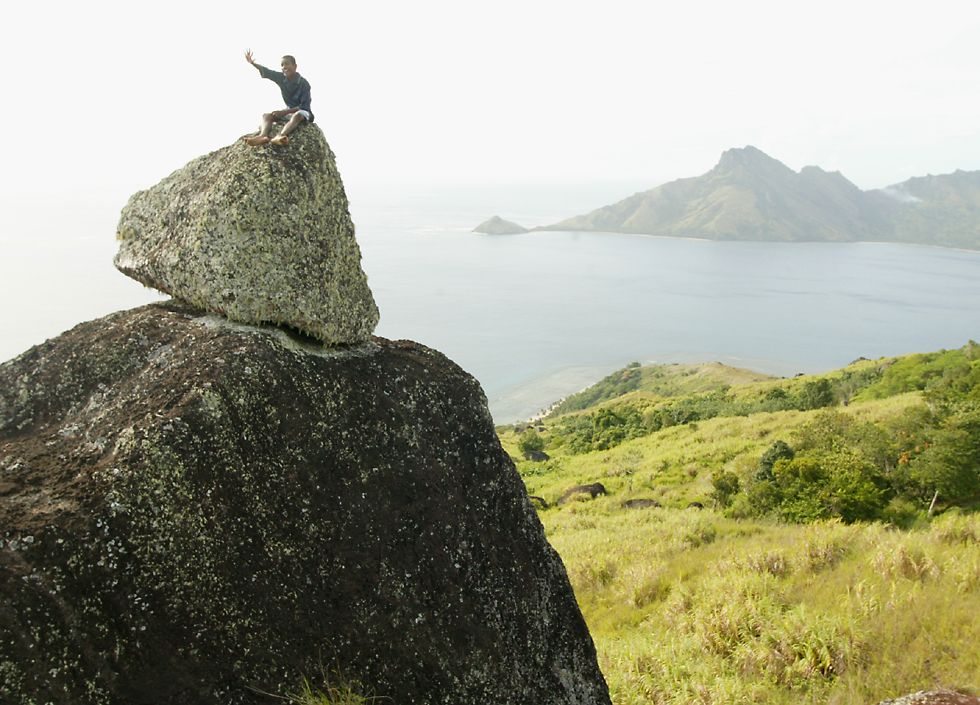
| I
trekked across the island with a couple of kids from the village as guides.
I didn't see as much wildlife as I hoped, but it was still a great walk,
with excellent views including Waya, the next island north.
The name Wayalailai actually means "little Waya", but Wayalailai also goes
by the name Wayasewa. |
 |
| Namara
village is on the opposite side of the island from the backpackers' resort,
and those who were interested were taken around by boat for a cultural
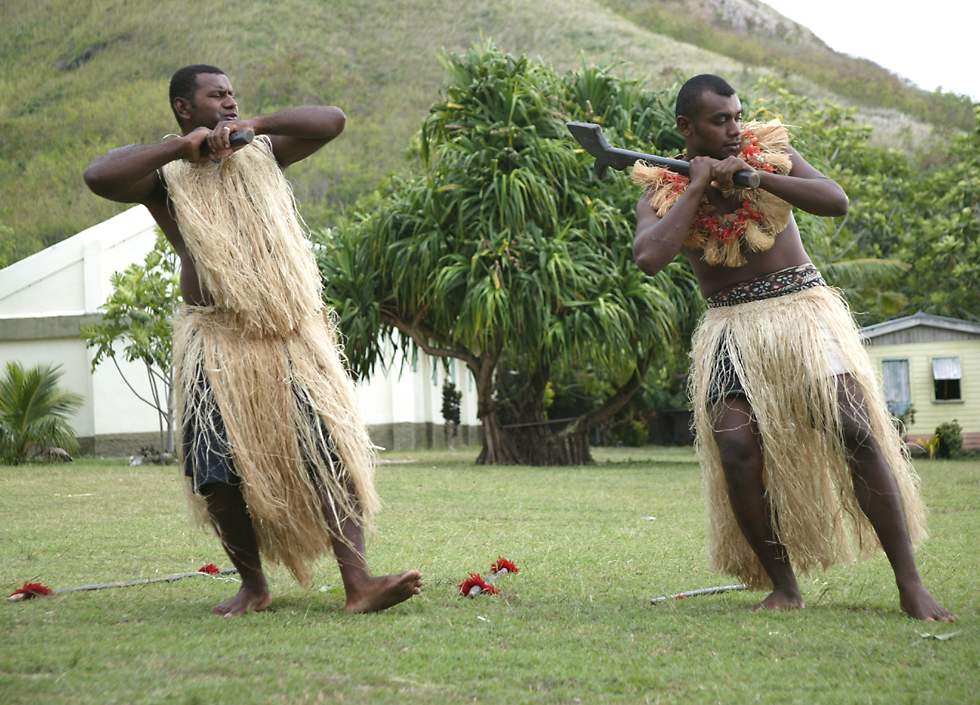
display which everyone seemed to enjoy. The display was also
a reminder of how the Fijian people, now so friendly, were once very warlike.
Like almost all Pacific Ocean peoples, they were cannabilistic, and European
visitors steered well clear for 150 years. Even Captain Bligh
of "mutiny on the Bounty" fame had to make a dash past Fiji with several
local canoes in hot pursuit after he'd been cast adrift with 18 other men. |
 |

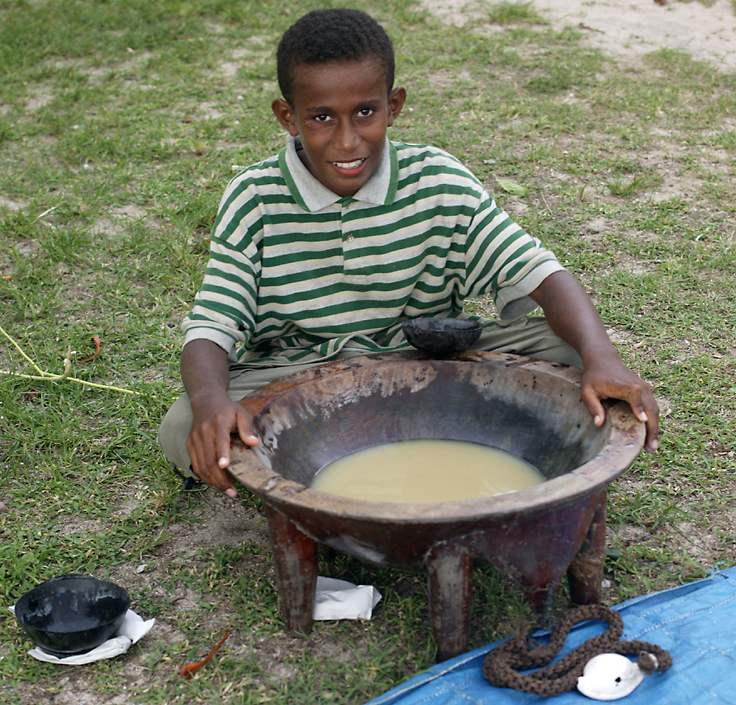
The visit to the village included a kava or "Yaqonga" ceremony.
Kava is a traditional root crop in the Pacific; a member of the pepper
family, it's valued because of its mild narcotic qualities.
The taste isn't much to write home about, it tastes about as muddy as it
looks, but it's said to create a euphoric feeling of well-being.
It's not addictive, there are no unpleasant after-effects, and unlike alcohol,
kava doesn't cause belligerent behaviour. There's even a theory
that it can help against some forms of cancer! |
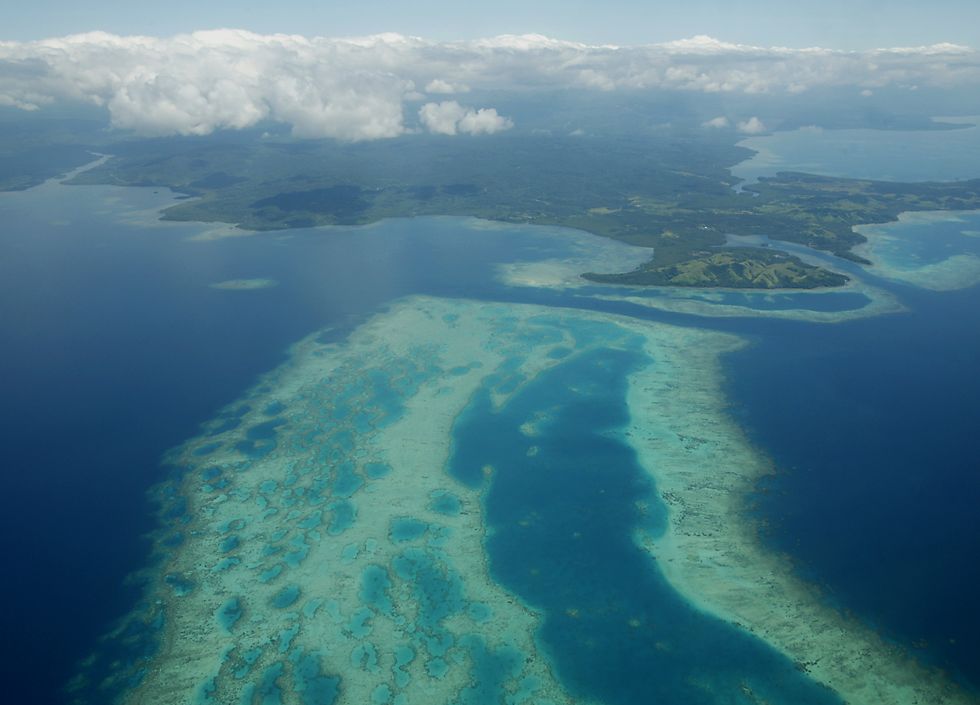
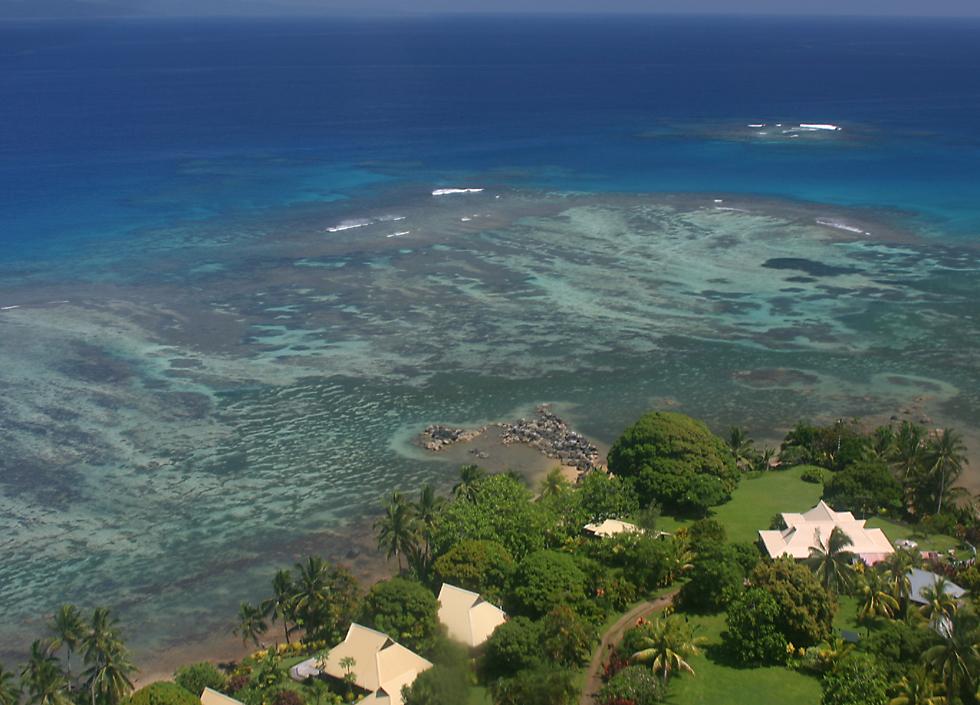
| Fiji
has a lot of islands and a lot to offer. Here's a photo taken
from a "puddle jumper" from the main island Viti Levu to the next largest
island Vanua Levu. When I lived in New Zealand I knew a Fijian
guy called Villiame Lomaloma who had been piloting one of these small inter-island
aircraft for several years, but didn't know how to drive a car! |
 |
| Here
is Savusavu, the second largest town on Vanua Levu! I'd been
trying unsuccessfully to contact Silktail Lodge on the Tunuloa Peninsula
for some time and when I got there I found out why it was so hard - there
was no email, no telephone and no mains power. By a sheer stroke
of luck, though, I met the son of the family at the airport and got to
the place that way. I stayed a few nights and got several of
the wildlife photos you will see later. |
 |
| My
island hopping didn't stop with Vanua Levu. This is the shoreline
of Taveuni, third largest island in Fiji, which forms the south-eastern
side of the Somosomo Strait, whose fast flowing currents are world famous
as a great place for divers to see sharks and soft corals. |
 |

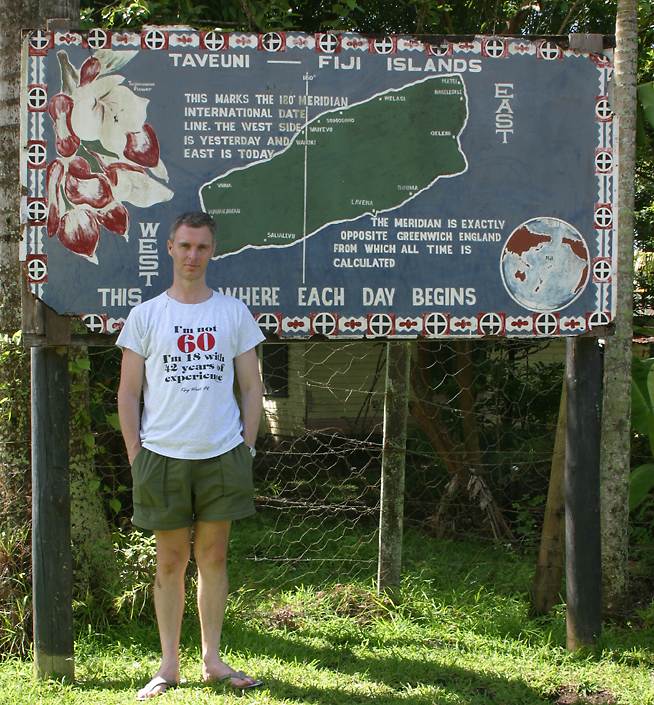
For me, this sign and its bragging rights are just one of the reasons to
visit Taveuni.
The eastern tip of Vanua Levu, the island of Rabi (pronounced Rambi)
and Taveuni all straddle the 180th meridian. As the sign says,
that means that this is "where each day begins" and theoretically if you
stand with one foot on the left of the line and one on the right then you're
both in yesterday and today or, if you prefer, today and tomorrow.
Of course no mere mortal can be allowed to enjoy such a mind-boggling concept,
so the official keepers of time decreed that the international date line
should do a giant dog-leg to the east of Fiji, so that the whole country
is in one day at any one time.
Those Who Must Be Obeyed also decreed that New Zealand's Chatham Islands
is the spot in the world which first sees the light of each new day.
When the new millenium dawned on January 1st, 2000 (Yeah, yeah, I know
that "officially" it happened on January 1st, 2001 - don't bother sending
me your emails!) it was therefore New
Zealand which got the honours, in spite of the efforts of a few Pacific
island countries to unilaterally modify their timekeeping.
Now I'm a New Zealander, but even to me it feels like Fiji has much more
claim to this prize than we did. And given the choice, I'd
far rather be drinking kava on both sides of the Taveuni dateline than
freezing my butt off standing on some windswept hill on the barren and
windswept Chatham Islands.
Unfortunately, in the end I wasn't able to indulge in either of those pleasures,
since I was too busy freezing
my butt off on December 31st, 1999 in New York's Time Square! |
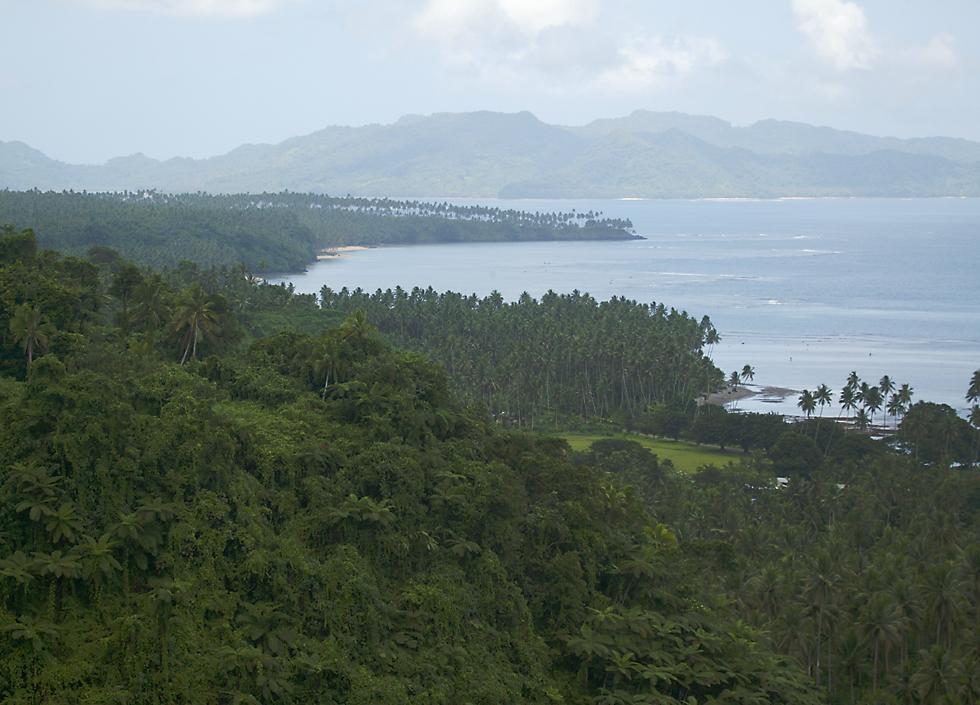
| Taveuni
has a lot more on show than a novelty billboard. As well as
the diving I mentioned, it's a good place to see the local culture and
it has several good spots to find wildlife, including Bouma national park,
which is where I took this photo. |
 |
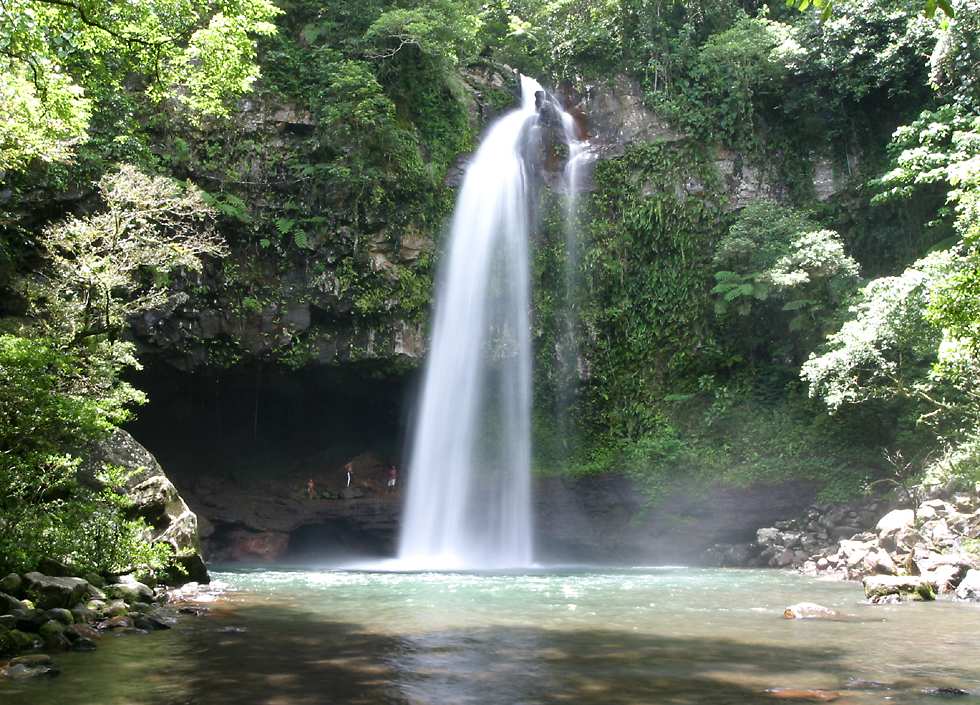
| Bouma
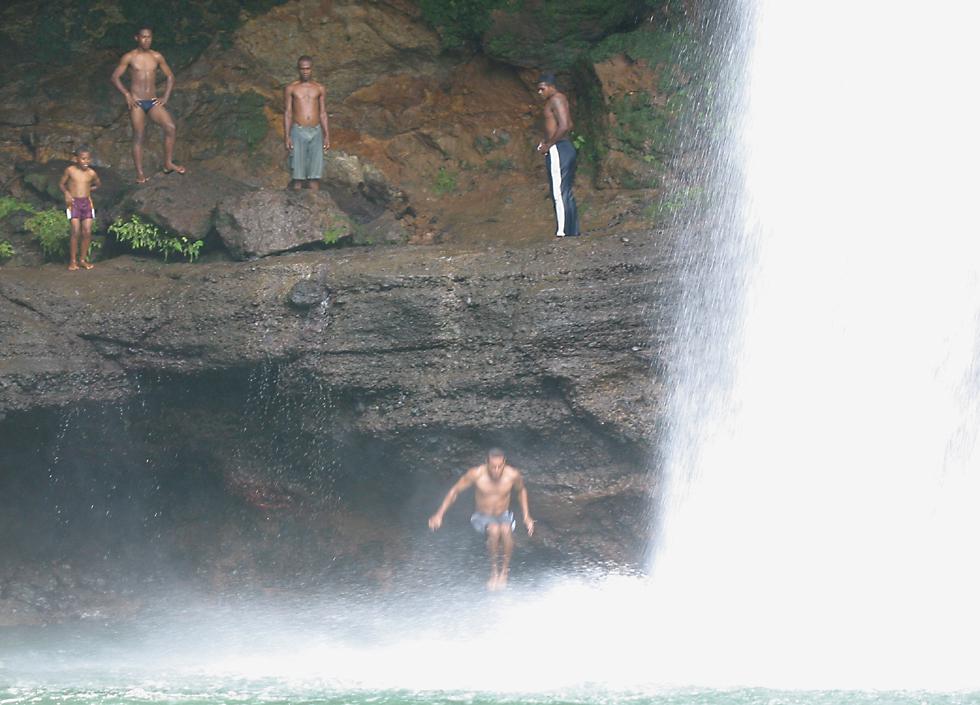
is also a good place for scenery, including a series of three waterfalls.
This one is the lower Bouma falls and in case you're in any doubt about
how high they are, just see how small the people are standing next to it! |
 |
| Again
it was the local kids performing dare-devil feats in the water.
There were also a few families having picnics near the waterfalls. |
 |
| Here's
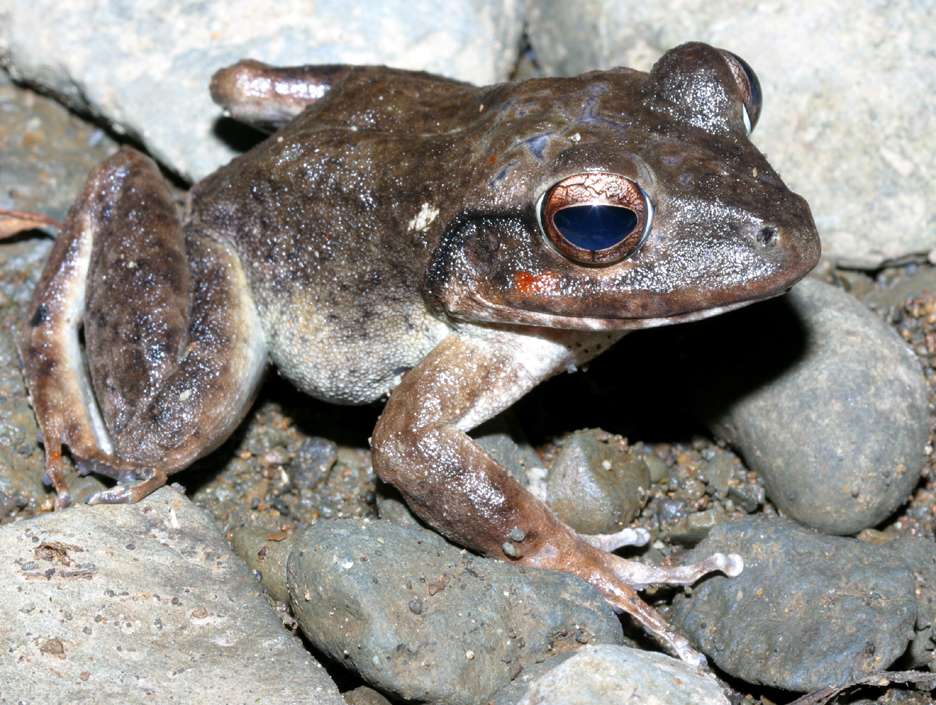
one of the first animals I found at Bouma, right at the lower falls.
It's a rare Fijian ground frog, one of only two frog species in the country,
the other being a tree frog. You might think that Fiji with
its forests and high rainfall would have lots of frogs, but in fact it's
so far away from other large land masses that only a few species have been
able to colonise. And now the ground frog is in serious trouble
because of ignorant westerners introducing rats, mongooses and the very
large and voracious South American "cane toad", which likes nothing better
than to eat the native wildlife of Fiji, Australia and other places where
sugar cane farmers took it. |
 |
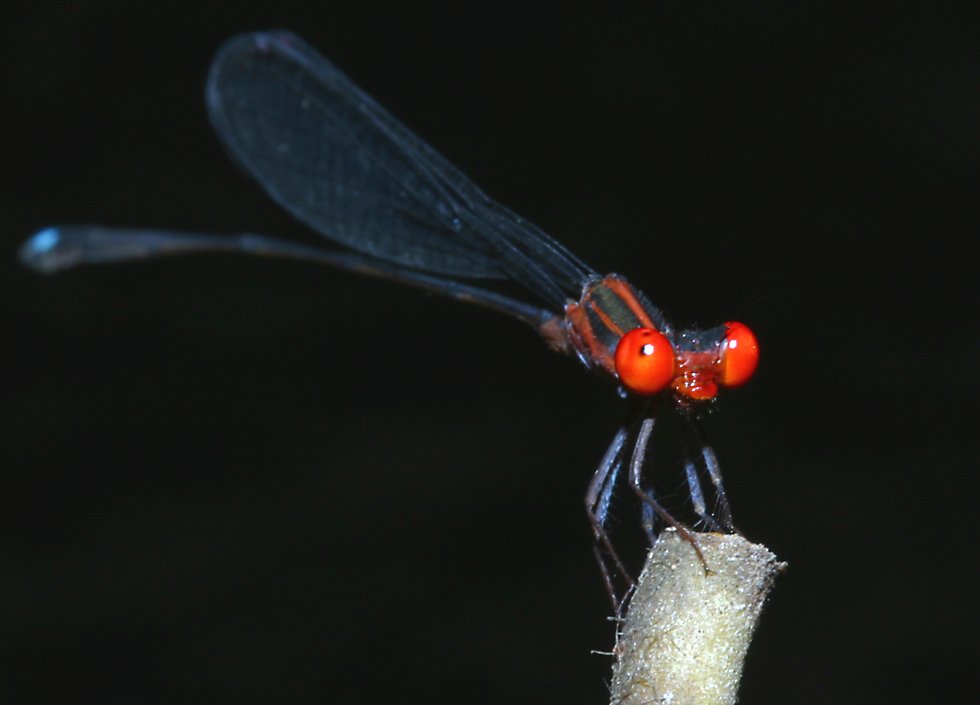
| Here's
another local, a variety of damselfly which doesn't have a common name,
so it has to go by its scientific name Nesobasis erythrops.
I saw several different types during my two week stay, including some
mating pairs. The one shown here has a very unusual combination
of colors with its orange body and eyes, and a blue tip to its tail. |
 |

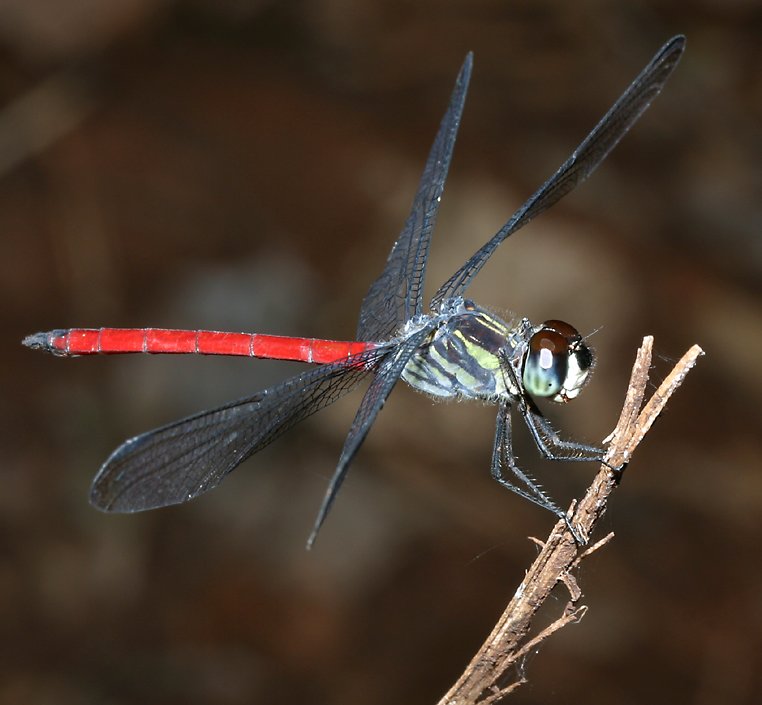
Here's one of the damselfly's close relatives, a dragonfly which goes by
the Latin moniker Agrionoptera insignis or, to its English-speaking
friends, the red swampdragon.
This critter also has an unusual combination of colors. You'll
find many dragonflies which are red and many which are green, but this
is the first red and green one which I had ever seen. I only
saw one red swampdragon in Fiji, on the island of Vanua Levu, but it was
kind enough to let me get several photos from different angles.
Large animals have trouble crossing the vast stretches of ocean between
Fiji and other countries, but a number of insects like dragonflies have
made the journey, probably carried from island to island by storms until
they get here. That's why the red swampdragon can be
found not only here, but also throughout Asia and down into Australia.
I found several types of dragonfly on Vanua Levu, but by far the best spot
I came across for these attractive insects was the Koroyanitu National
Heritage Park on Viti Levu. I was able to put together a
whole page of Fijian dragonflies and damselflies, and three of these
photos were later used as models for a set of Fijian postage stamps! |
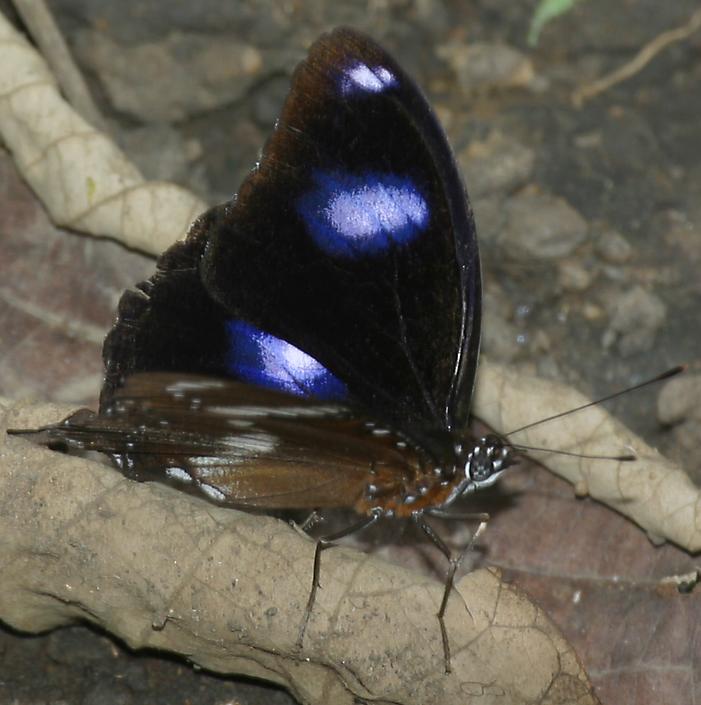
Fiji doesn't have as many butterflies as other countries, but this male
"blue moon" is one very attractive inhabitant.
This is another insect which is found in Asia and also in other parts of
the Pacific, where it's usually known as the "common eggfly" or "great
eggfly". Personally I much prefer the name "blue moon".
All male blue moons look much like this one, but the females look quite
different, and they even differ markedly from each other. This
happens because females in different parts of the world, all the way from
Madagascar to Japan and New Zealand, mimic various different butterfly
species which are toxic and therefore taste bad to predators like birds.
As is common with quite a few butterfly species, the male is territorial
and will guard an area of ground against intruders. However
the blue moon females are unusual in that they apparently also guard the
sites where they've laid eggs, a rare example of maternal care in the world
of butterflies. |
| Where
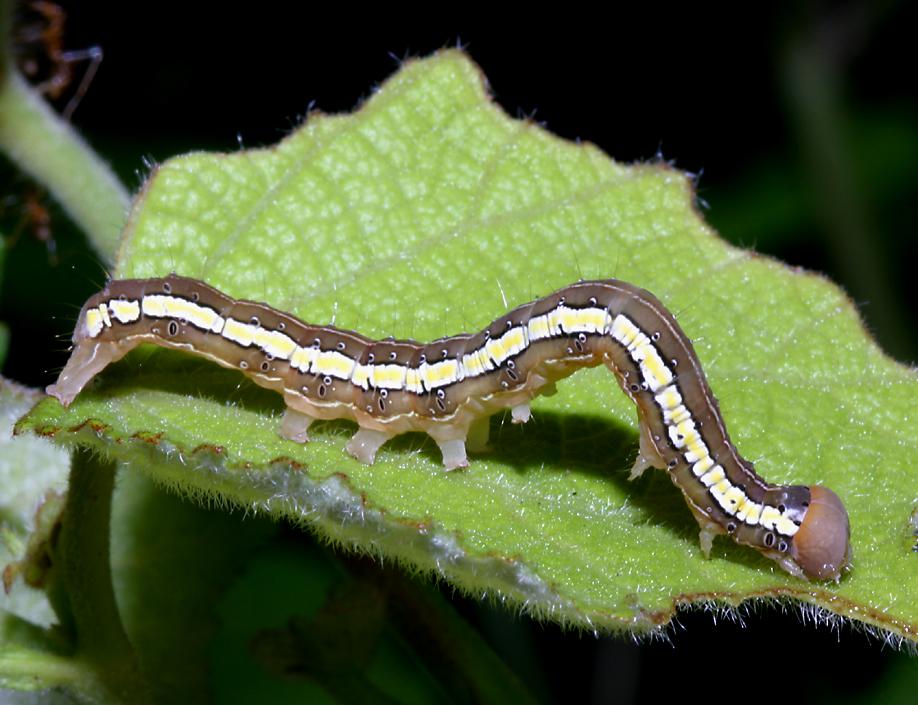
there are butterflies and moths there must also be caterpillars.
This attractive specimen is a variety of looper or inchworm, which means
that it belongs to the very large family Geometridae, also known as "geometer"
moths. In keeping with the inchworm name, the Greek term geometer
means "earth measurer". |
 |

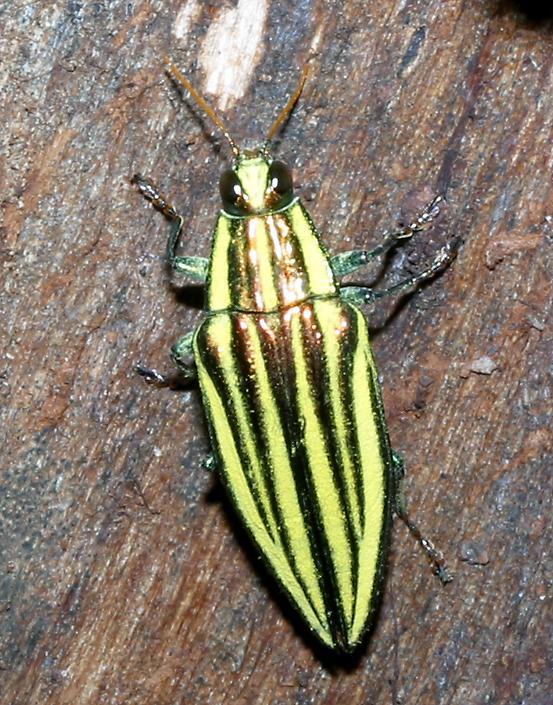
Beetles are the most common type of insect on the planet, but I photographed
very few during my stay.
This one is by far the most interesting, a jewel beetle called Paracupta
sulcata. Fiji has a variety of interesting jewel beetles,
but it's very hard to find any information on them. Since this
is the first and only jewel beetle I've ever seen, I was pleased just to
come across it while I was staying on Taveuni, but I was disappointed when
it didn't stay long enough for me to get more than a few photos. |
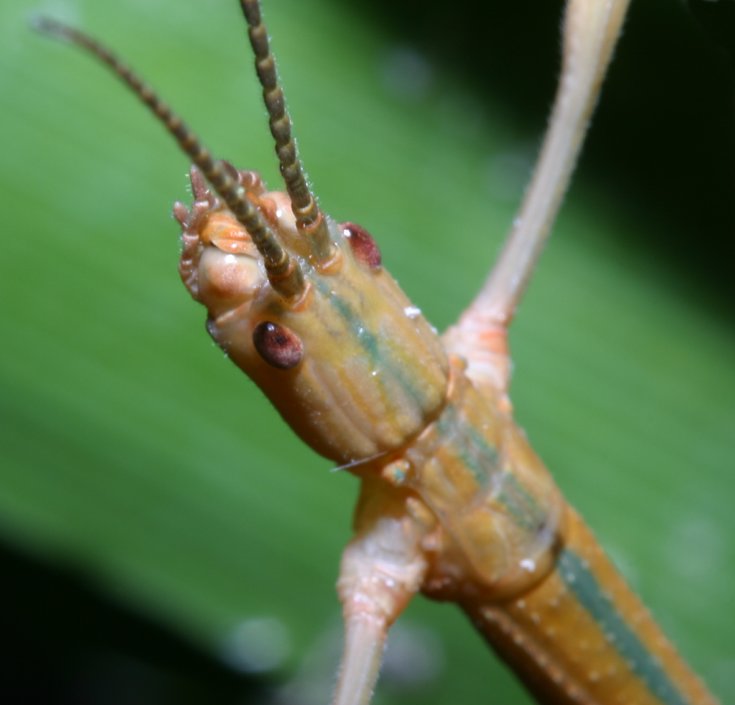
This stick insect (in America the term "walking stick" is used) was on
Wayalailai. |
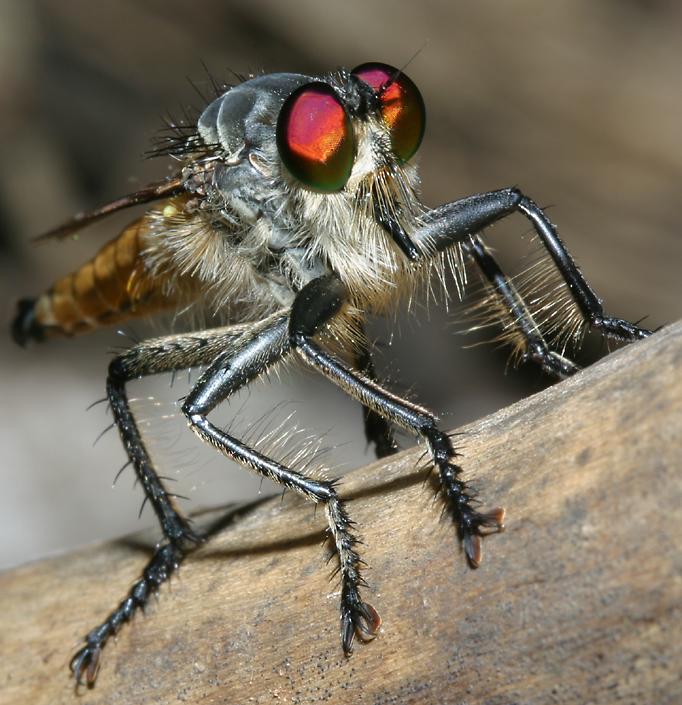
This extraordinary little monster is a type of robber fly, a family found
around the world whose members sit on a perch and dart rapidly out to catch
other flying insects.
The robber fly jabs its strong pointed beak into the insect it catches
and sucks the juices out.
Robber flies are very recognizable with their strong, spiny legs and thick
moustache and beard. |
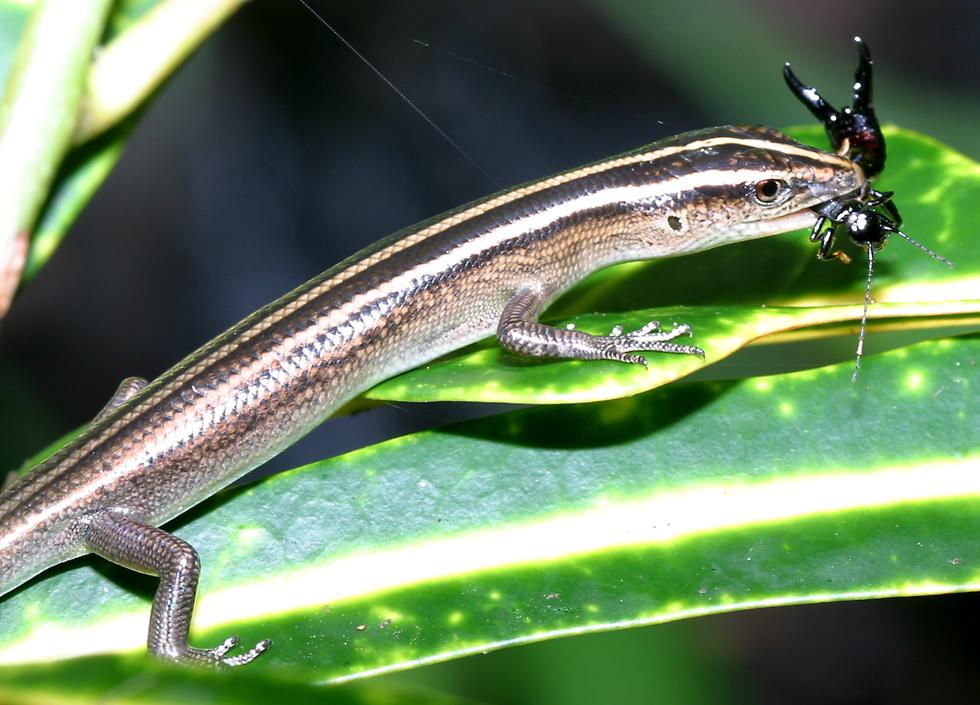
| The
robber fly was in Bouma national park, as was this mighty hunter, a small
skink which has caught an earwig. The earwig's pincers were
obviously of no use against such a formidable foe! |
 |
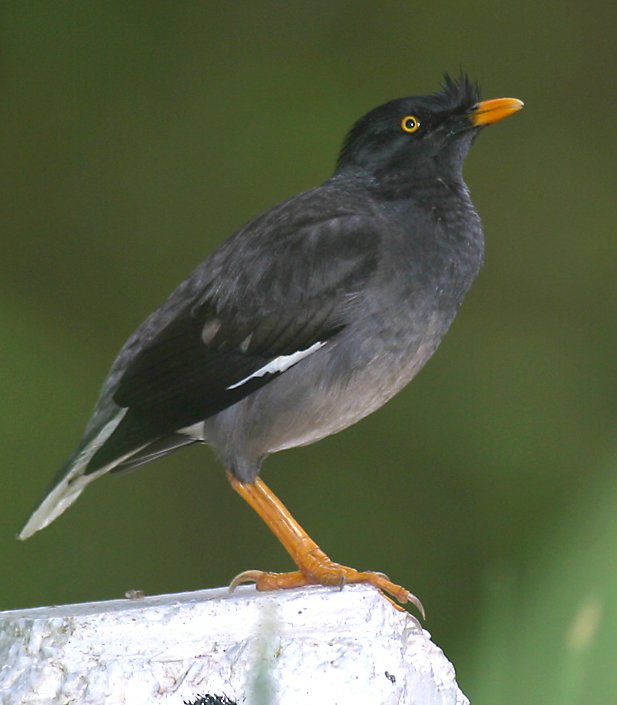
I ended up photographing about fifteen types of bird, including this jungle
myna, a member of the starling family.
The forest myna and its better known cousin the common myna were introduced
from India, along with about 30 other birds from different parts of the
world. About 15 of these species became established.
There's a lot of ethnic tension between native Fijians and the indentured
workers the British brought over from South Asia, who now make up almost
half of the population. Somewhat unkindly, the native people
refer to these human immigrants as being like the mynas - loud, greedy,
acquisitive, and damaging to the original inhabitants. |
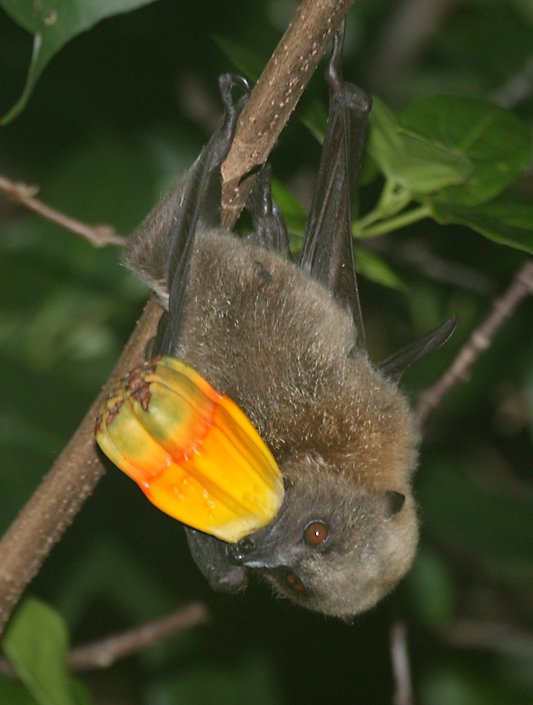
A winged animal of another type, this time a Samoan flying fox, which is
a type of fruit bat.
These were a common sight on Vanua Levu, flying around in the late afternoon
and evening.
I was lucky enough to see this one flying past holding a pandanus fruit,
and then land out of sight a short distance away. I followed
it and took several photos, but it didn't seem quite sure what to do with
the cumbersome fruit, so in one shot the fruit is hanging incongruously
in mid-air right next to the flying fox's head.
The fruit had of course slipped out of its grasp, and the next few shots
feature a flying fox with a somewhat reproachful look on its face as it
stares pointedly straight at me. |
| This
Fiji trip was my first with a digital underwater camera, but there was
quite a steep learning curve and I didn't have as many opportunities to
free-dive as I wanted. Quite a few photos were ruined by condensation
on the inside of the housing, I figured out later that it pays to keep
some silica gel inside in order to soak up excess moisture before hitting
the relative cold of the water. However I did get a few nice
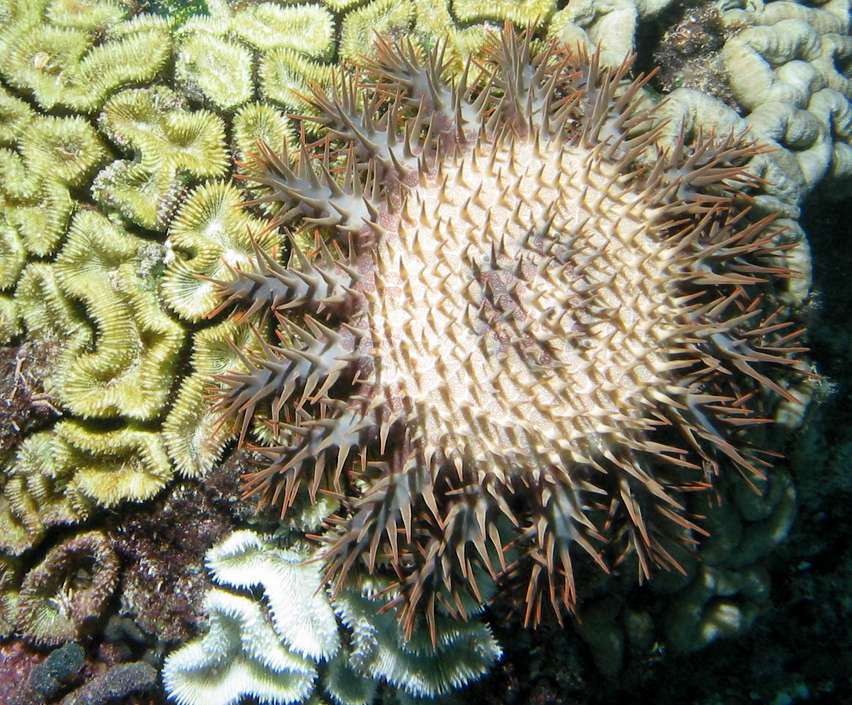
shots, including this crown of thorns starfish trashing coral on the reef
around Kuata, leaving nothing but white skeletons in its wake. |
 |
 |