| Nellis
AFB Threat Training Facility Aircraft |
| This
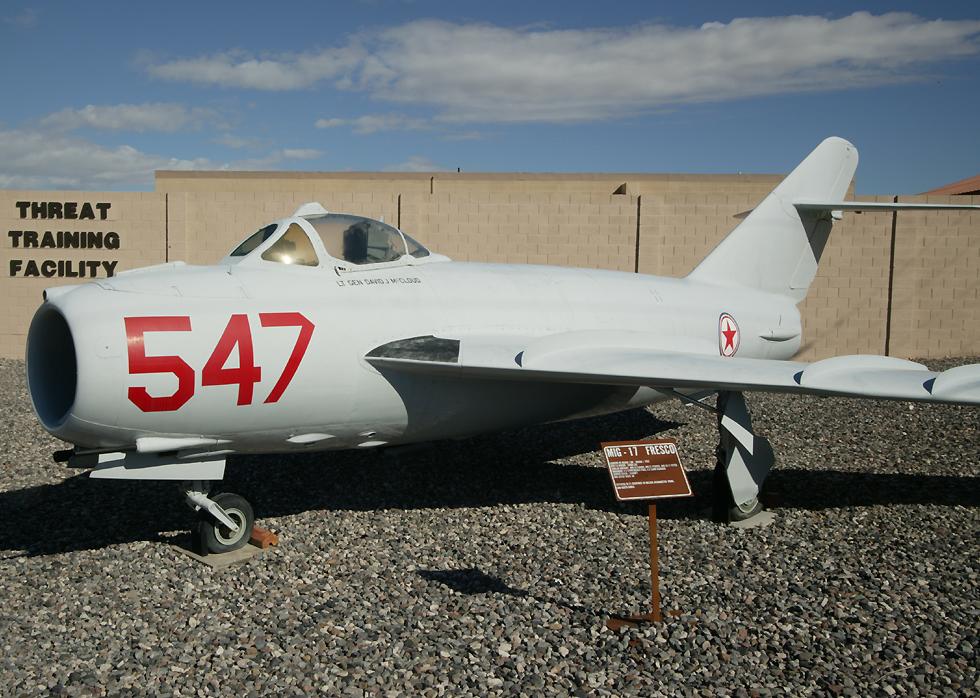
MiG-17 "Fresco" is the oldest design of fixed wing aircraft at the Threat
Training Facility, a slightly larger refinement of the MiG-15 "Fagot".
This one is in North Korean markings and, as you can see, it was flight
tested by Lt Gen David J McCloud. |
 |
| This
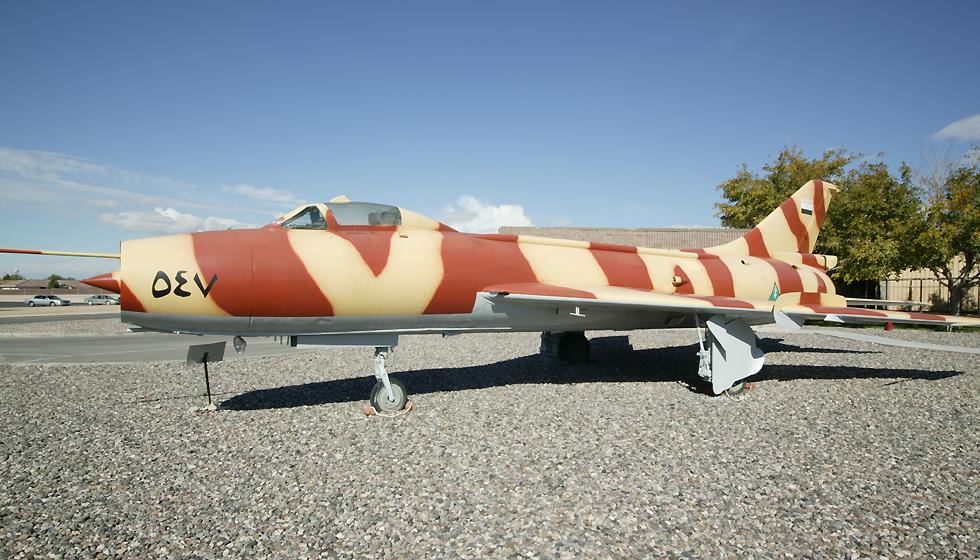
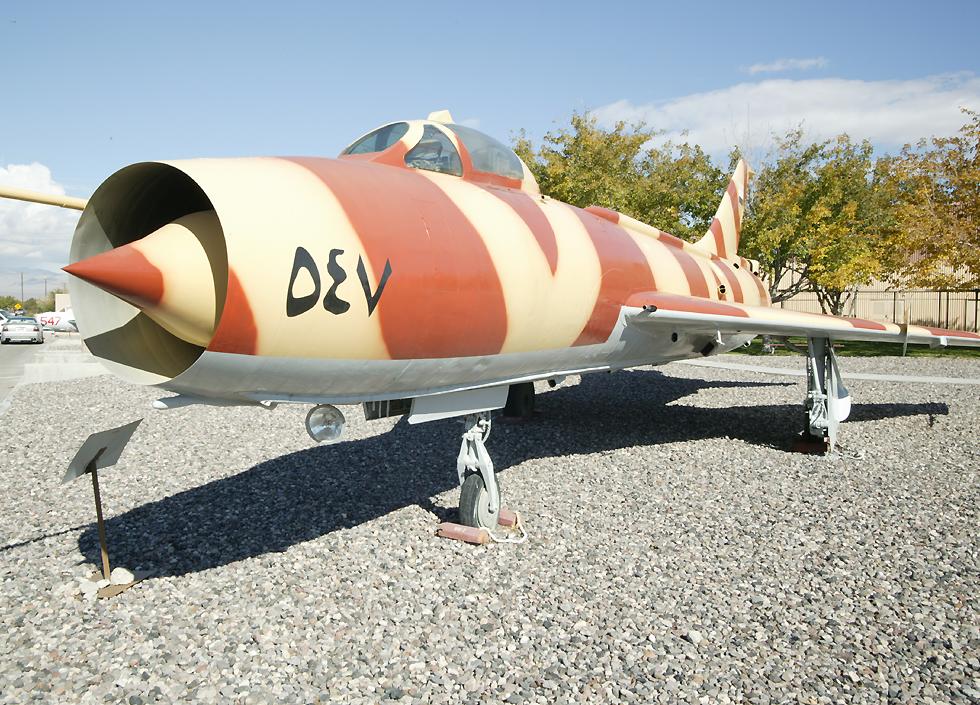
Sukhoi Su-7 fighter has the NATO reporting name "Fitter". Since
the official names of Russian aircraft were classified, NATO came up with
a system of naming in which arbitrary names were assigned, the first letter
of the name signifying whether the aircraft was a fighter (like the "Fitter"),
a bomber (like the "Bear"), a helicopter (like the "Hind") or a cargo plane
(like the appropriate named "Crate"!). |
 |
| The Su 7 was really
a second generation jet fighter/ground attack aircraft, capable of Mach
1.6 and armed with two 30mm cannons, one of which you can see here in the
wing root. |
 |
| The
Threat Training Facility also has a MiG-21 "Fishbed" jet fighter parked
across the road which I didn't photograph because of a lack of time - however
fans of this type can enjoy this page of Vietnamese
Air Force MiG-21s in Action from a visit I made to Danang airport in
2004. Here's something I made sure not to miss out on - the
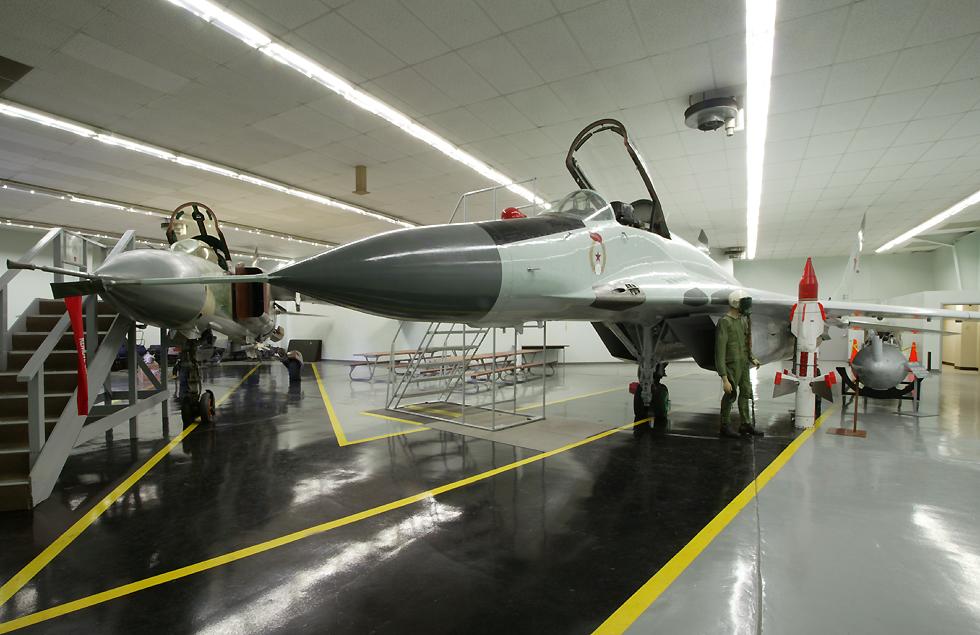
MiG-23 "Flogger" and MiG-29 "Fulcrum" which are the pride and joy of the
collection. |
 |
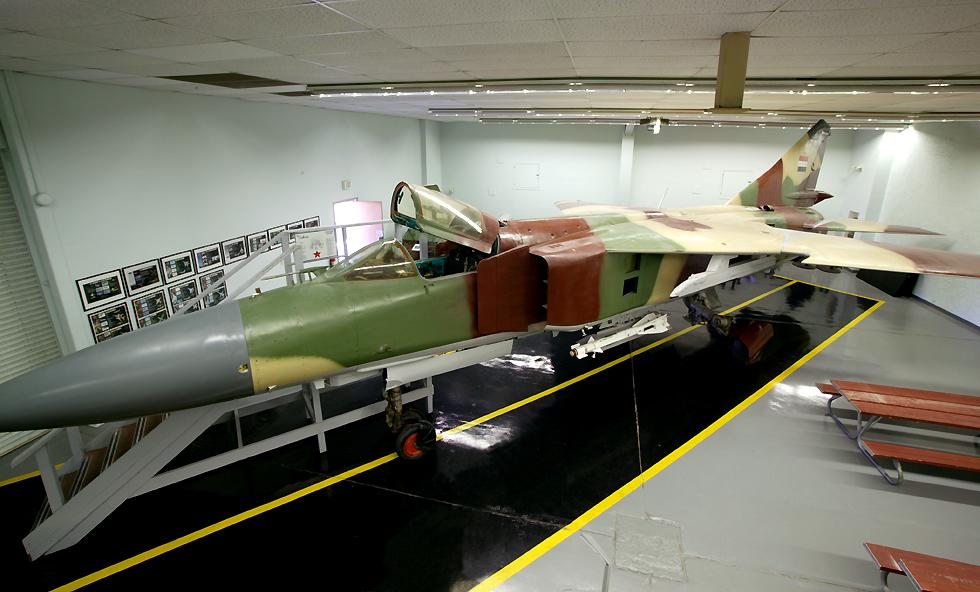
| The
MiG-23 is a large improvement on the MiG-21 which it replaced from the
early 1970s. Capable of Mach 2.35, it has variable sweep wings
which can be set to 16 degrees of sweep during takeoff and landing, 72
degrees for high speed flight, and 45 degrees for mid-range operation;
the dogtooth you can see in the outer wing section fits in to the inner
wing section when in the 16 degree position. The MiG-23s acquired
by the US military are designated YF-113s (MiG-21s are YF-110s); this particular
one is a MiG-23ML, the last production version, though aerodynamic and
other changes continued for a few years after production ended in 1981.
The MiG-23 is still operated by a long list of countries, so it's of obvious
interest to American military planners. |
 |
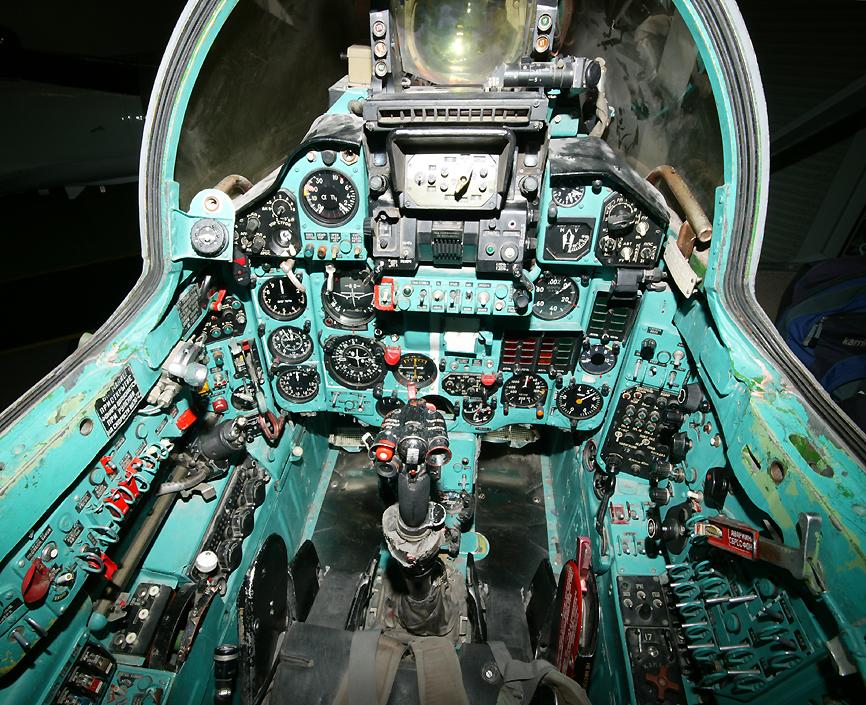
| Here's
the somewhat cramped cockpit of the MiG-23. Seeing all of those
gauges and controls makes you respect the capabilities of those fighter
jocks. The Russian designers have a well-deserved reputation
for being less technologically sophisticated than their western counterparts,
but you can see that the Flogger has a heads-up display, and it also has
fairly fancy missile and IFF (identification - friend or foe) systems. |
 |
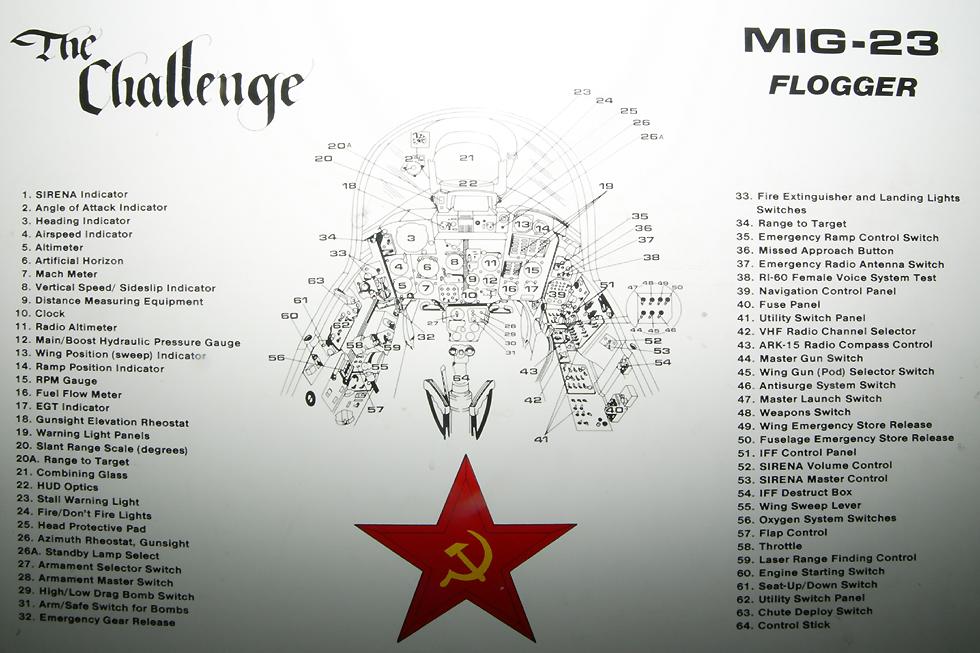
| And
here's the sign describing what all of those knobs and switches do.
I particularly like item 38 "RI-60 Female Voice System Test", though I'm
not sure if the female voice is that of the pilot's mother or an attractive
SIRENA (items 1, 52 and 53 - actually the name of the radar system).
You can also see that item 54 is the self-destruct button for that IFF
system, to prevent it falling into enemy hands (a bit late now, of course). |
 |
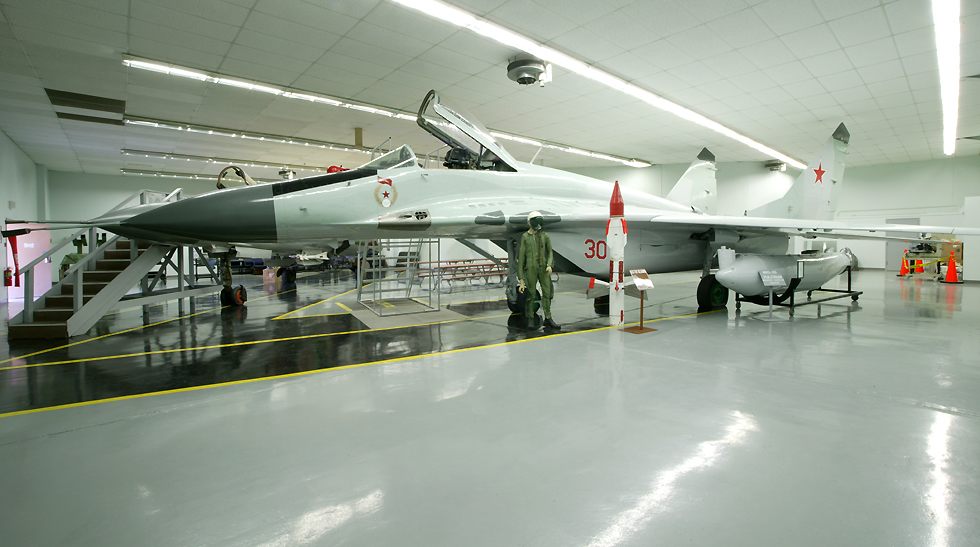
This MiG-29S "Fulcrum-C" was one of 21 bought from the cash-strapped republic
of Moldova for $1 million each. The United States was eager
to buy these because Iran, which already has the MiG-29 "Fulcrum-A", was
also interested in buying this batch of aircraft, which consisted of six
A models, one B and fourteen Cs. It was considered especially
urgent to buy these aircraft, since they're capable of delivering nuclear
weapons.
The MiG-29 first flew in 1977 and was intended as a lightweight advanced
tactical fighter to counter the American F-15 Eagle. It was
a replacement for the MiG-23 and, although they share a similar top speed,
the MiG-29 is considerably more capable. The MiG-29 can perform
the unusual "Cobra" maneuver, and has excellent missile systems, but it
cannot be refuelled in flight and has shorter range and loiter ability
than western fighters. Nevertheless many people feel that the
MiG is superior to the F-15 at close range because of the MiG's excellent
maneuverability and a helmet mounted weapons sight that responds to the
direction in which the pilot is looking. Since it is a relatively
small and lightweight aircraft, and also has the safety margin that comes
with having two engines, the MiG-29K was also developed as a carrier-borne
fighter. One unusual feature is that the main engine intakes
have covers which close when taxying, to prevent stones and other debris
from being sucked into the engines; when this is done, air for the engines
is taken in through vents on the top of the wing. These covers can
even be activated in flight, up to speeds of 800 km/h.
The MiG-29 was exported to many countries, and when the Soviet Union collapsed
many of the former republics, such as Moldova, ended up with them.
With the reunification of West Germany and East Germany, a number ended
up in the combined German Air Force, so the MiG-29 has the distinction
of being the only Russian designed aircraft to serve with members of NATO! |
 |
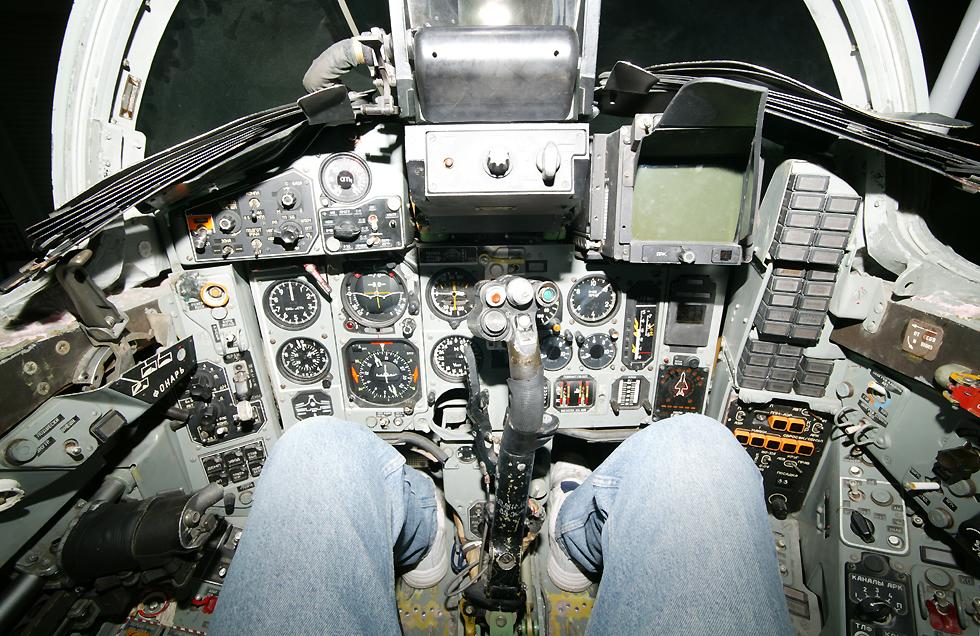
| Here's
the cockpit of the MiG-29, which immediately appears more spacious and
modern than the MiG-23 cockpit; it also has much better all-round visibility
than previous MiGs. I don't have an identification chart for
this cockpit, so you'll have to rely on my limited knowledge of military
avionics for a description. OK, let's begin. That thing
between my legs must be the joystick, and as you can clearly see there's
a TV screen on the right hand side for in-flight movies on long trips,
and venetian blinds at the front of the canopy if the pilot gets tired
and wants to sleep for a while! I'd better stop there, in case
I get any of the details wrong. |
 |
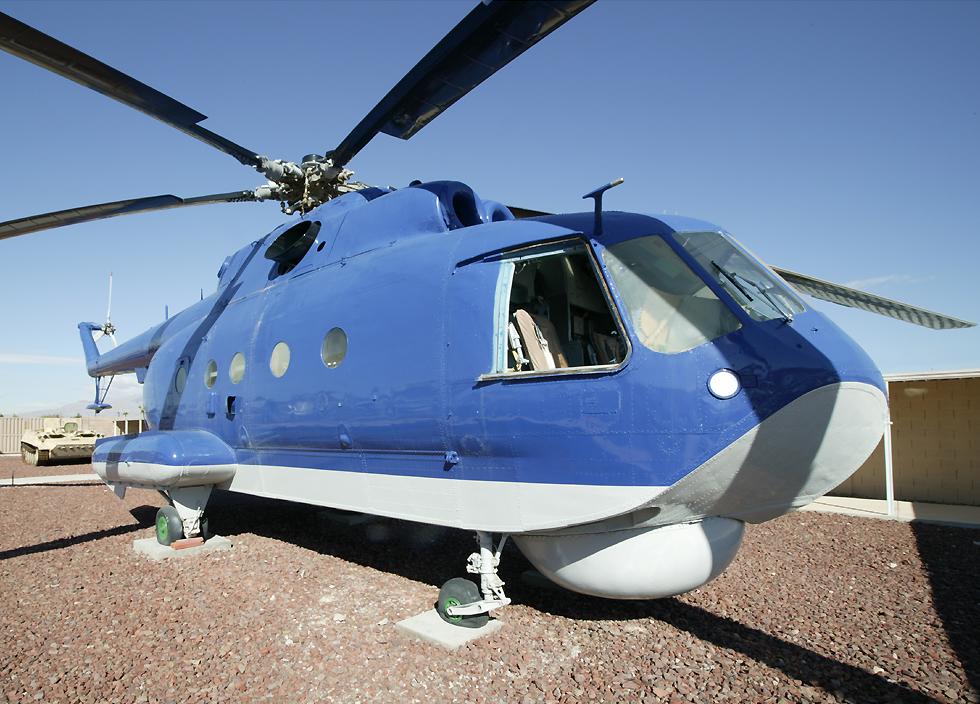
| As
well as Russian jets, the Threat Training Facility also has a number of
Russian helicopters. They're hoping to acquire an Mi-8 "Hip",
but until that time visitors will have to make do with this Mi-14 "Haze",
which is a naval variant of the "Hip", with a large radar dome under the
nose for anti-submarine warfare, together with a boat-like fuselage and
pontoons to allow operation from water. |
 |
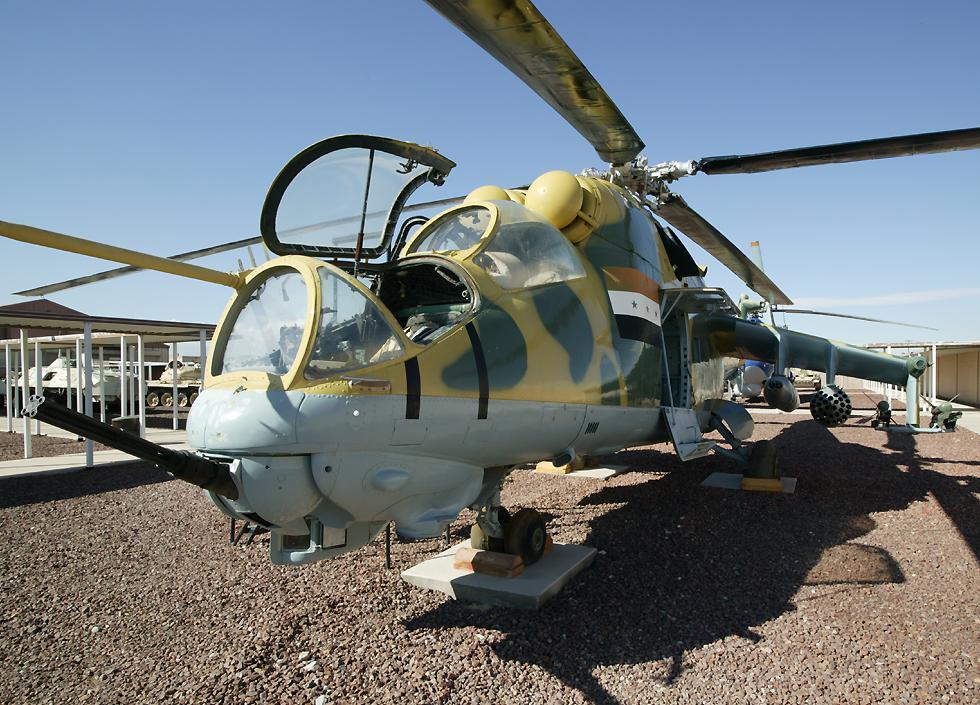
| This
Mi-24 "Hind-D" gunship was captured during the first Gulf War, and is still
shown with Iraqi markings. The somewhat strange looking bubble
canopies of this helicopter became familiar to the western public because
of its use by Soviet forces in Afghanistan. Unlike American
helicopter gunships like the venerable AH-1 Cobra and Super Cobra, or the
more modern AH-64 Apache, the Hind is also capable of carrying up to 8
combat troops, in the compartment visible on the right-hand side of this
photo. The stub wings are used to carry cannons, rocket pods
and anti-tank rockets, and also provide between 20 and 30 percent of the
lift when in forward flight. |
 |
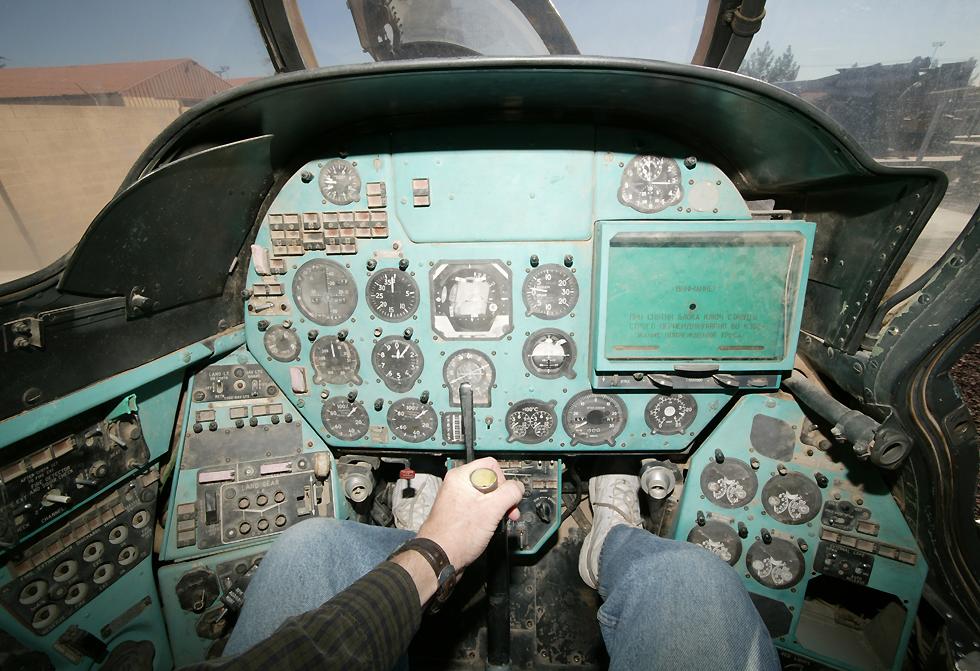
| Here's
the pilot's cockpit, which is behind the gunner's cockpit; both are armored
and can withstand hits by 20mm cannon shells. Several Hinds
are operated by the US military, though they're not often seen.
I presume that this example was also flown after its arrival in the country,
since many of the gauges are marked in English. |
 |
You
can see more Soviet helicopters at the
Vietnamese Air Force Museum in Hanoi, both fixed wing aircraft and
helicopters at the
Russian Air Force Museum in Monino, a
MiG-29 in action at MAKS 2005 and some modern
Soviet helicopters in action at MAKS 2005.
 |