| The
Vietnamese Air Force in Operation |
| When
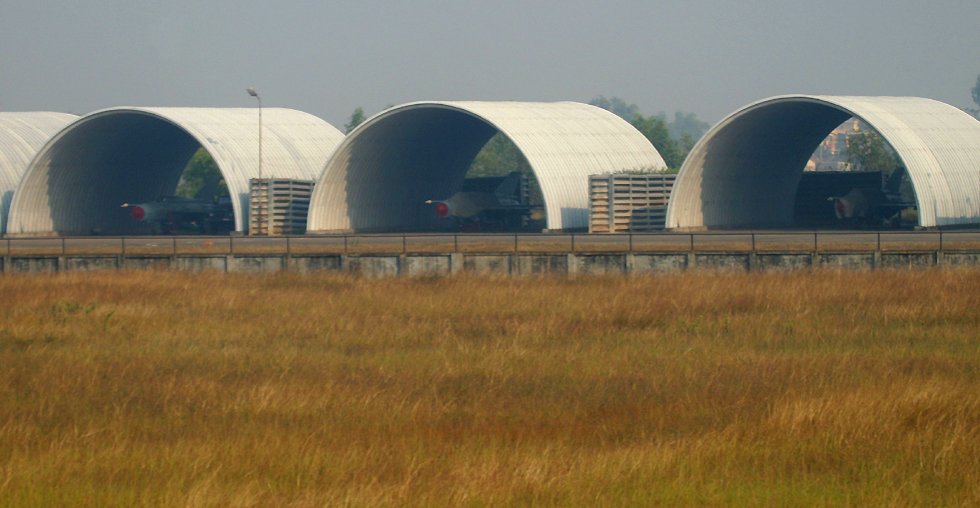
I flew into Hanoi in December of 2004, I noticed that there were covered
revetments on the left-hand side as we landed. So when I came
back to the airport a few days later to take an internal flight, I asked
for a window seat on the left, hoping that the prevailing winds would make
us take off in the same way that I'd landed earlier. I was right,
and managed to get a few shots of these MiG 21s as we were on our takeoff
run. I saw similar revetments at the airport in Danang, which
might have been built originally by the American military, but American
forces never operated out of Hanoi, so these ones must have been built
either by the French (which started receiving American military aid in
Vietnam in the 1950s) or by the communist forces. |
 |
| From
Hanoi I flew down to Danang, then made my way a little north to Hue before
heading back south through Bach Ma national park to the very picturesque
town of Hoi An. While I was in Hoi An I heard jets passing overhead
a few times and although I didn't see them I guessed that they were probably
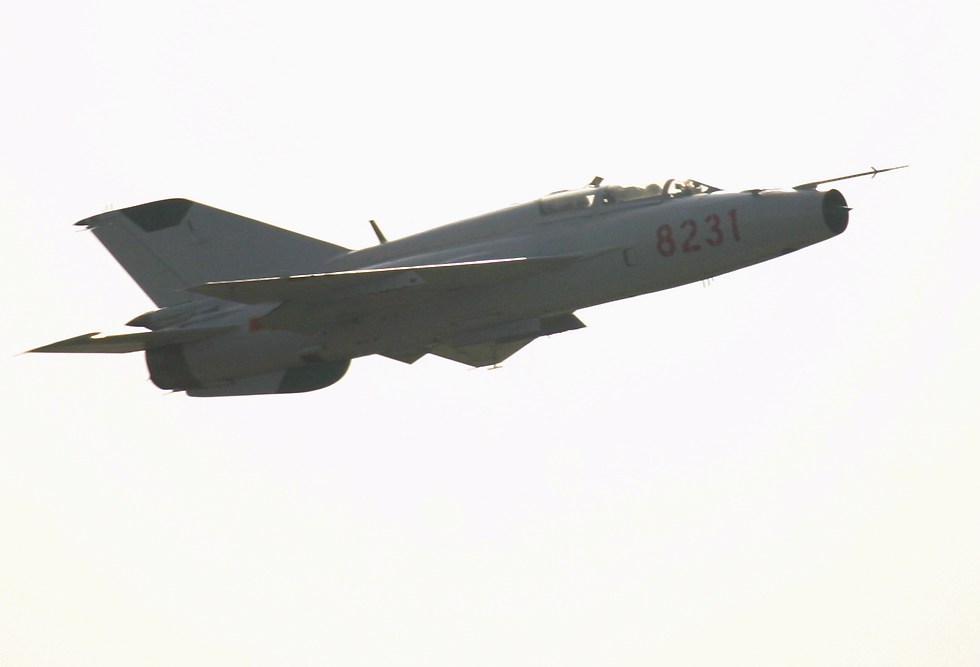
Vietnamese Air Force fighters. Sure enough, as I drove in to Danang
airport for another short flight down to Cam Ranh, a MiG 21 "fishbed" jet
was taking off using its afterburner. So when I went into the
waiting area for my flight, I took out my camera and long lens, hoping
not to be arrested as a spy! Unfortunately I was behind a thick sheet
of tinted glass and the lighting conditions were horrible, everything was
strongly backlit because the sun was directly in front of me.
Nevertheless, I did manage to get this shot of another MiG 21 taking off;
as you can see, it's a two seat trainer version. |
 |
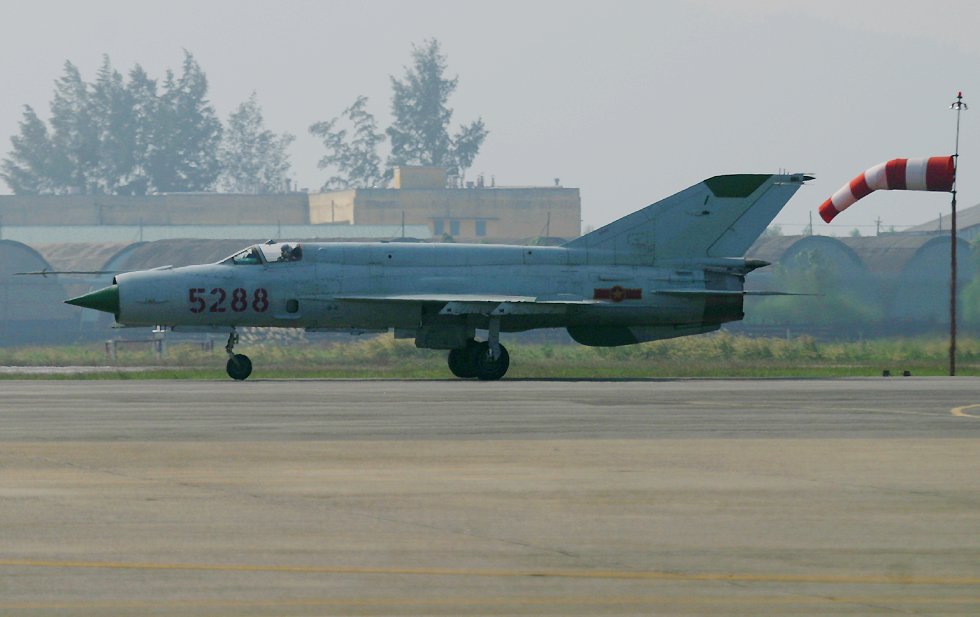
| After
ten minutes another MiG passed by. I'm not sure whether it
was taxying to the end of the runway for takeoff or whether it was just
going back to its hangar, but it's certainly an interesting shot because
you can see the armament racks under the wings, and also the conformal
fuel tank on its back between the cockpit and the tail. Most
models of MiG fighter suffered from short range, and the original MiG 21
was no exception, so this fuel tank was added to alleviate the problem.
However it turns out that the weight of the fuel in the tank made the plane
unstable, so it had to be reduced in size by a third. The tank
also forced the removal of the rear cockpit panels and made the pilot's
rearward view even worse than it had previously been. One interesting
feature of all versions of the MiG 21 is the large wheels, which were designed
to allow the plane to operate from fairly unprepared fields.
Like most Russian military equipment, it was designed to be simple and
robust so that it could be maintained by relatively unsophisticated support
personnel. The Vietnamese Air Force operates the MiG 21PFMA
model, which has the NATO reporting name "Fishbed-J". |
 |
| By
this time my flight was boarding, which involved being bussed out to the
tarmac so we could board the plane up a set of stairs. An older guy
in a military type of uniform was standing near the tail where we were
boarding and I still had my camera in my hand, but I figured I'd risk official
disapproval and act ignorant if I was challenged. I stayed
at the back of the line and after a while the official-looking guy left.
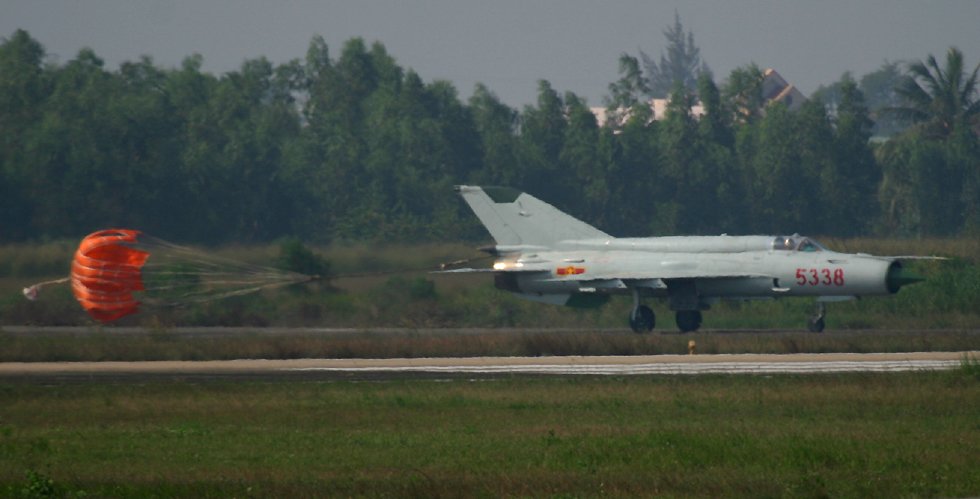
Shortly after that yet another MiG landed and deployed his drogue chute
to slow down. Unfortunately there was high grass between me
and it and by the time the plane got near the end of the runway where the
grass was shorter, the heat and haze joined together to wreck the photo. |
 |
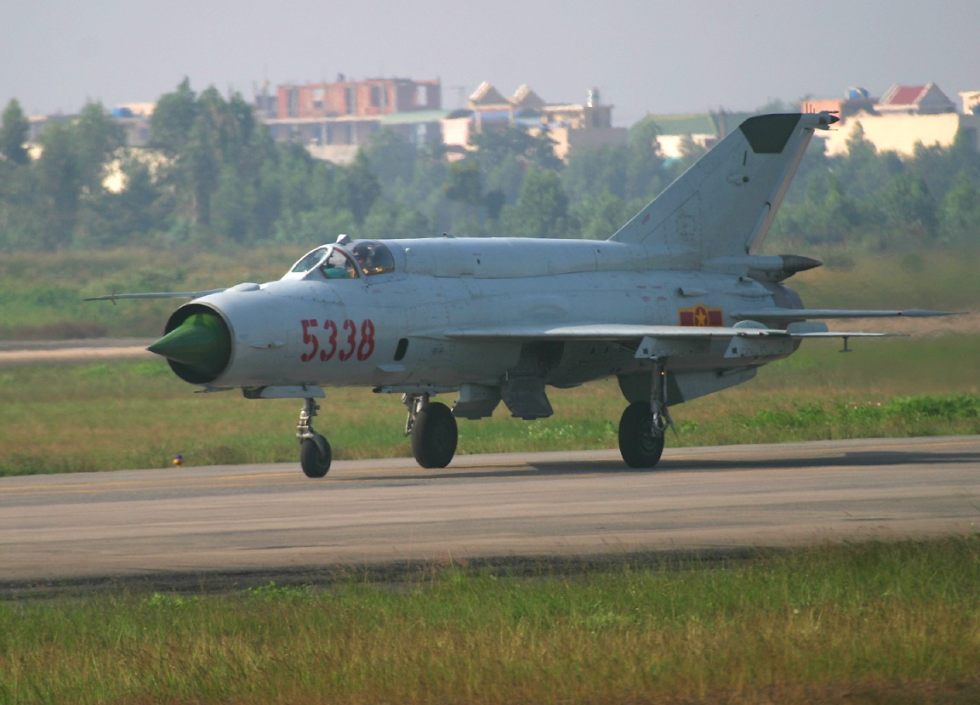
| By
the time it started back along the taxiway everyone was on board except
for me, so I climbed up the stairs, stood at the top and took a few last
photos. As I was doing this, an airline employee at the bottom
of the stairs looked back over his shoulder to see what I was photographing
and then looked back at me with a big grin on his face! |
 |
 |
Once again I'd asked
for a window seat, but unfortunately this time I ended up in an ATR-72
turboprop, directly opposite the propellers. This meant that
the window was heavily pitted and obscured and made it very hard to get
any decent shots.
However, I did get
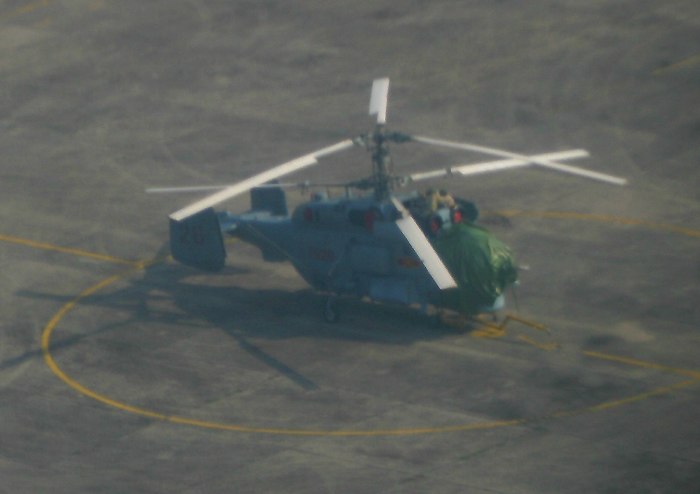
one photo of this strange looking Kamov Ka-28 "Helix" anti-submarine helicopter.
This was the successor to the similar looking Ka-25 "Hormone" which you
can see on the page describing Russian
helicopters at the Vietnamese Air Force museum in Hanoi. |
 |