
Teotihuacan
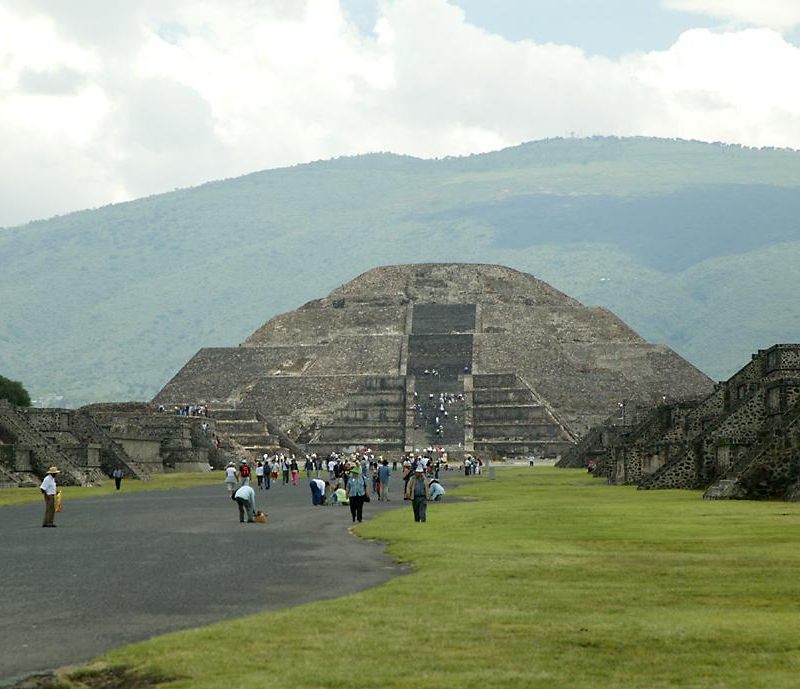
The ancient city of Teotihuacan is located just 50 kilometers north-east of the center of Mexico city and is well worth at least one or two days of exploration. There are many restored buildings to explore, artwork and artifacts recovered from the site, as well as the two enormous structures for which the city is best known, the Pyramid of the Moon, shown here, and the even larger Pyramid of the Sun. Unlike the pyramids of Egypt, the pyramids at Teotihuacan aren't build of solid stone, instead they consist of stone and brick rubble covered with layers of cut stone, however they're still an extraordinary achievement, especially since all this was done without the benefit of pack animals, metal tools or the wheel. |
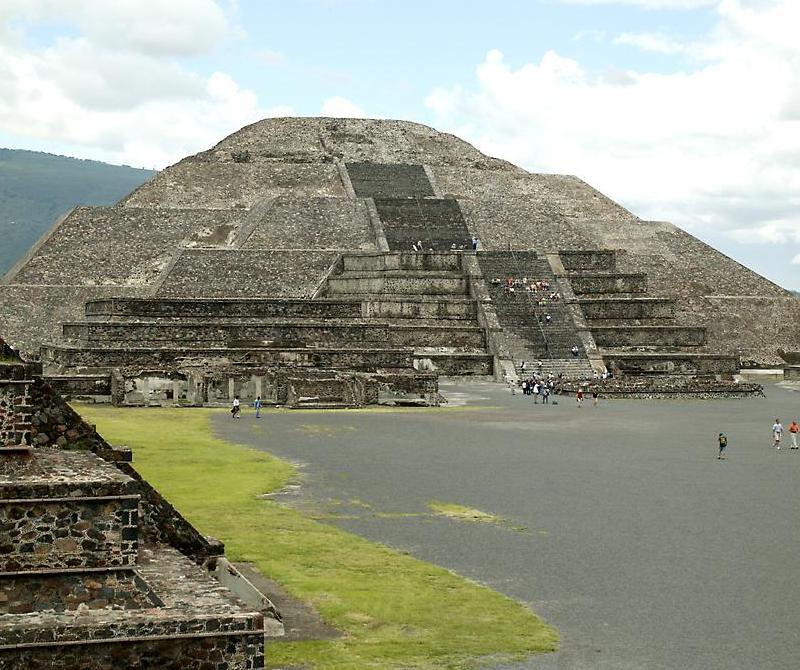
Here you see the Pyramid of the Moon from across the Plaza of the Moon, which is surrounded by 12 temple platforms. Surprisingly, no-one knows who built Teotihuacan; the name itself is from the Aztec Nahuatl language and is thought to mean the "city of the gods". The Aztecs, who founded Mexico city, came on the scene much later and considered the ruins they found at Teotihuacan to be sacred, making their own religious pilgrimages there. Archaeological study has determined that the main construction period started around 300BC, and continued for hundreds of years until the city's violent destruction in the 7th century. |

This is the Pyramid of the Moon, photographed from the top of the Pyramid of the Sun. The stairs on both pyramids begin on a stone structure which is attached to the pyramid, but many people consider the Pyramid of the Moon to be more graceful than the earlier Pyramid of the Sun. The large stone altar in the middle of the Plaza of the Moon is thought to have been used for ceremonial dancing. Around the outside of the plaza you can get a good idea of how the city must have looked to the first Europeans, with most of the buildings, including the pyramids, completely overgrown by a layer of vegetation. |
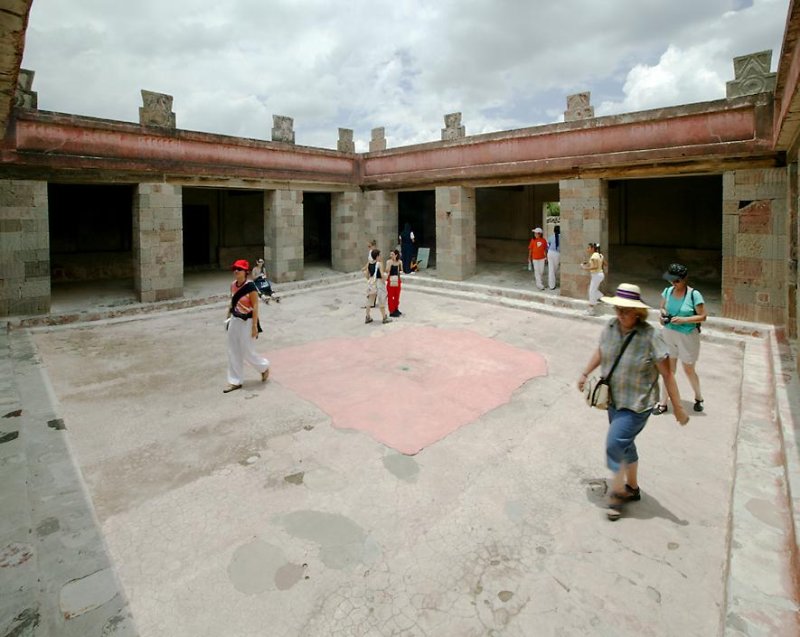
The Palace of Quetzalpapalotl is located a short distance to the south-west of the Pyramid of the Moon. This is thought to be the place where the high priest lived, and is one of a number of former residences of the nobility which have been restored and made open to visitors. |
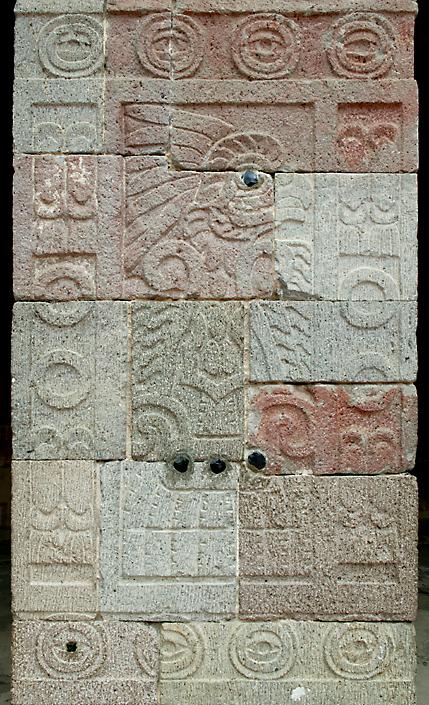
The name Quetzalpapalotl is Nahuatl for the "Quetzal butterfly" and it was applied to this building because of carved images like this one which appear on the columns surrounding the courtyard shown above. Some of these images are thought to represent the quetzal bird, which was revered by pre-European peoples living throughout central America. Other images show a creature which is a combination of the quetzal and a butterfly, hence the name. The black volcanic glass called obsidian forms the eyes of the birds. It seems rather odd that the pieces of stone used to make the pillars are cut into irregularly sized and shaped blocks, and also vary in texture and color from each other. I'm not sure if some of the blocks are reconstructions, but even if they are there's still a lot of irregularity in the construction of the pillar. |

These are the lintels and roof ornaments surrounding the courtyard. There are many painted and carved designs of abstract geometric figures in this palace; like other ancient American peoples, the builders of Teotihuacan were extraordinarily skilled at observing and predicting astronomical events and accurately recording the passage of time. This is one of the very few buildings in the entire city whose roof line is still intact. |
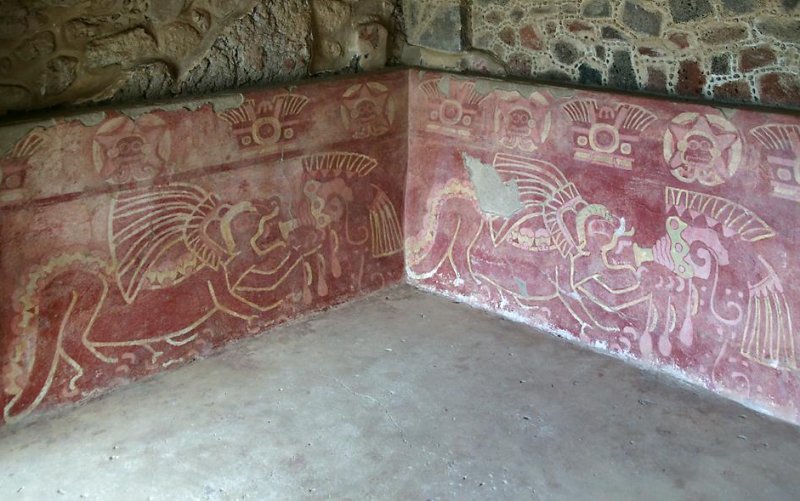
There are several other structures in the same small area as the Palace of Quetzalpapalotl. This mural showing pumas with feathered head-dresses is in the appropriately named Palace of the Jaguars. The figure in the five-pointed stars above the pumas is the rain and maize god Tlaloc, probably the most powerful god in ancient central America. From this palace you can enter the subterranean Temple of the Plumed Conch Shells which has murals of shells, perhaps outfitted as musical instruments, together with birds spouting water, painted in green, blue, yellow and red. |
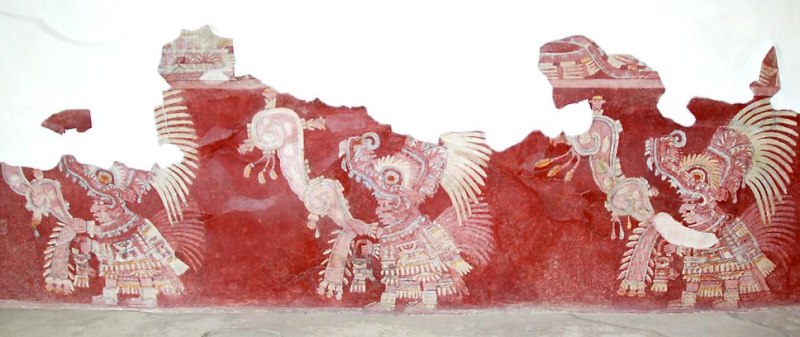
In the last photo of the Pyramid of the Moon you can see a path which leads to the south-east of the pyramid, which takes you to the Palace of Tepantitla, which was also thought to be the residence of a priest. There are an enormous number of murals scattered around the buildings at Teotihuacan; several particularly valuable ones were discovered in this palace in 1942, including this procession of priests in full ceremonial costume. |
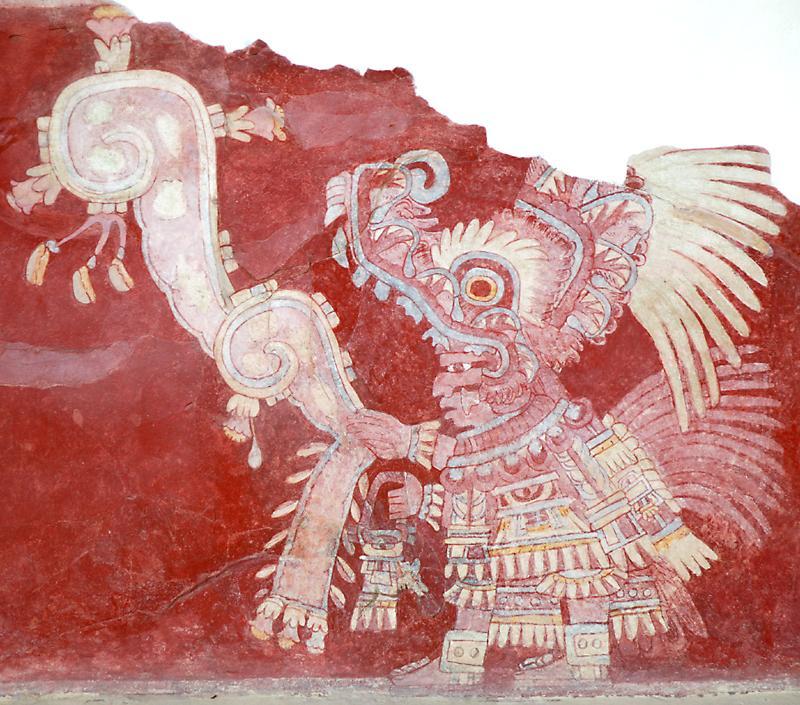
Here's a closeup from the previous mural. As well as paintings of gods and animals like pumas, there are also many frescoes showing people, like the priests in this mural wearing elaborate head-dresses. The strange looking curved shapes in front of this person are actually speech bubbles which signify that he is talking or chanting, though there's no indication of what he is saying - unlike the Maya, the inhabitants of Teotihuacan left no traces of a writing system. |
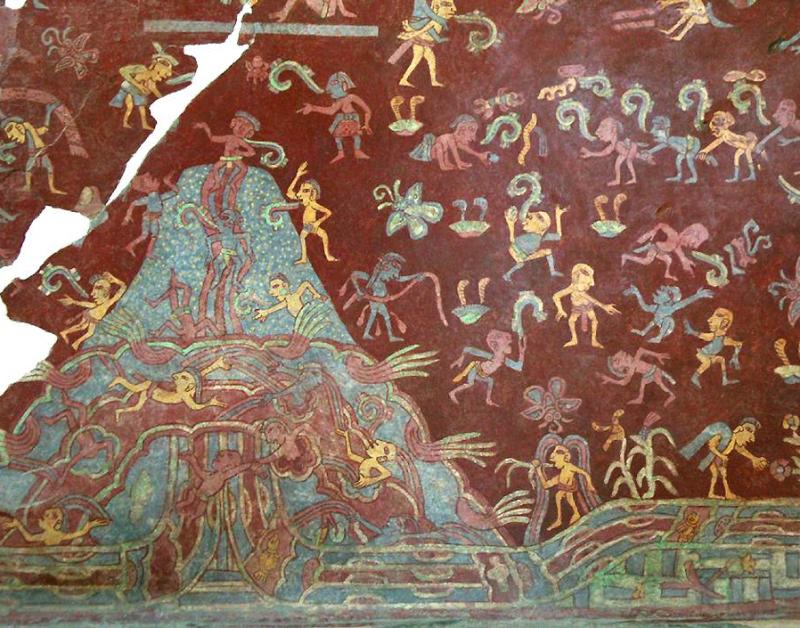
The most famous painting in this palace is called The Paradise of Tlaloc. The god Tlaloc is shown several times in frescoes, and in the one which depicts his "paradise" many people are shown in the middle of a variety of acts - diving and swimming in a river with fish, talking to each other, eating, picking flowers and, near the top right-hand corner of this photograph, holding hands between their legs! As you can see, there's an abundance of speech bubbles, as well as various butterflies and other insects. |
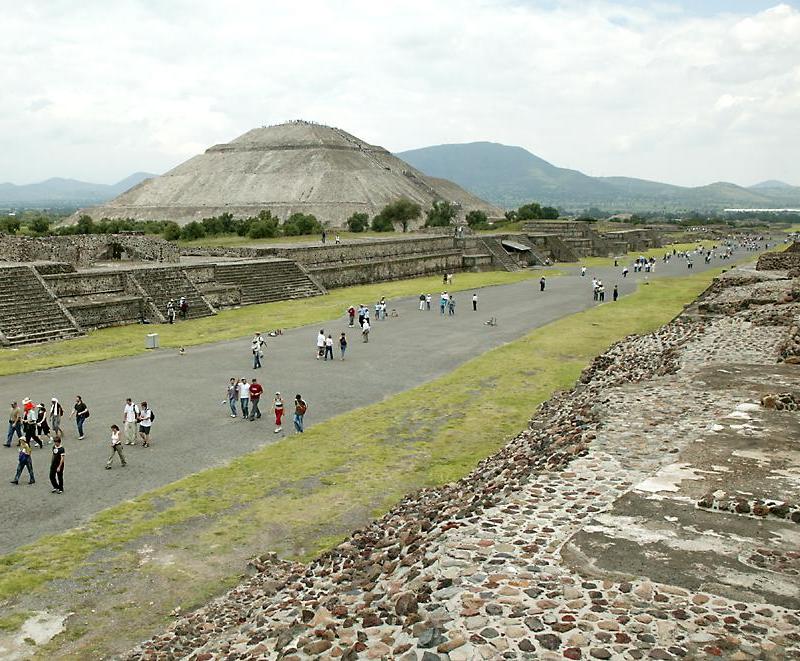
Teotihuacan once occupied an area of over 30 square kilometers and had a population of between 150,000 and 200,000 people; in 600 AD it is estimated to have been the sixth largest city in the entire world. It is bisected by this broad road running north and south, which nowadays is called The Avenue of the Dead, because of the mistaken Aztec belief that the buildings which lined it were tombs. The Pyramid of the Moon is at the avenue's northern end and the Pyramid of the Sun, which you can see here, is to its east, about 500 meters south of the Pyramid of the Moon. Look closely and you'll see a large number of people standing on the summit. |
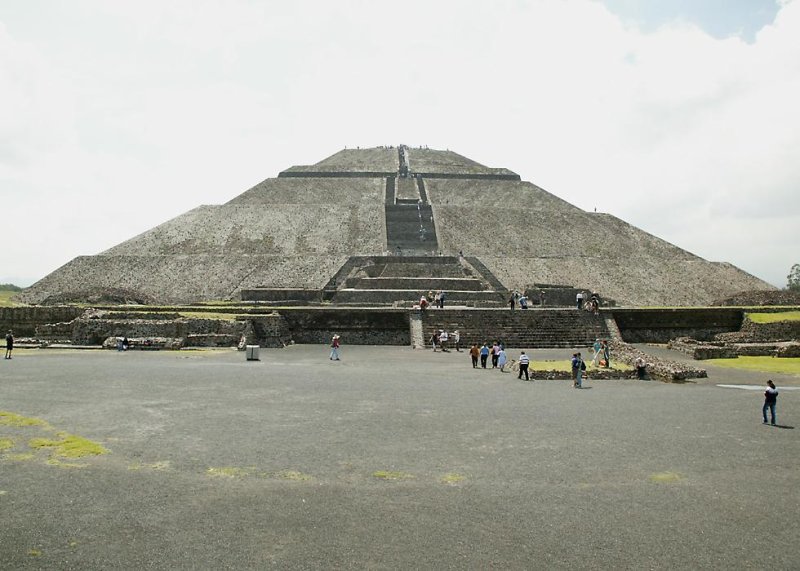
The Pyramid of the Sun, with an estimated weight of three million tons, is much larger than the Pyramid of the Moon, and was also built earlier. Each side is 222 meters long and it's over 70 meters high, making it the third largest pyramid in the world by volume, after the Great Pyramid of Cheops in Egypt and the unrestored pyramid at the Mexican city of Cholula. Unfortunately because of the building method a lot of reconstruction was needed to get it to its current state, and there's considerable uncertainty about its original appearance. |
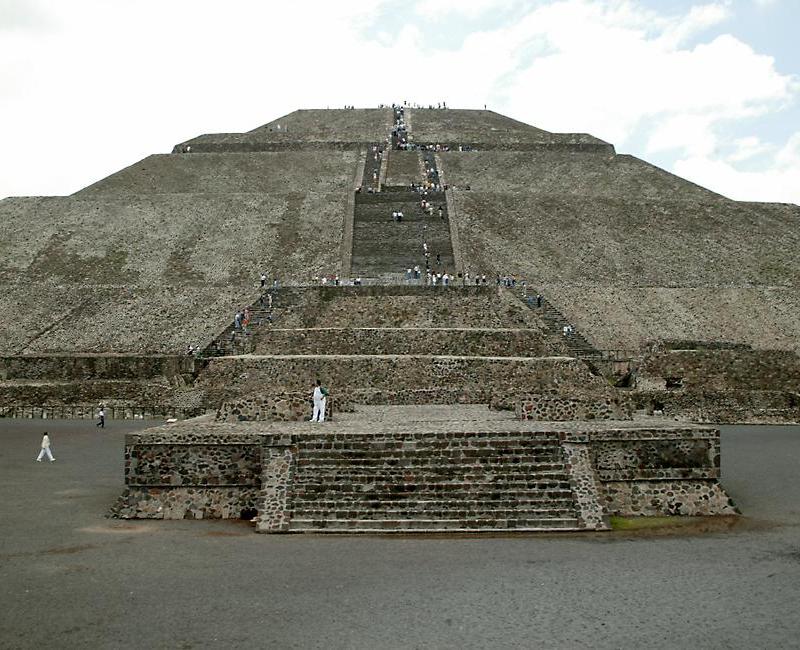
The Aztecs believed that this pyramid was dedicated to the worship of the sun god, and archaelogical research on the site appears to give support to the idea. In 1971 a 100 meter long tunnel was found leading from the pyramid's west side to a cave and a spring with religious items directly beneath its center. It's thought that the pyramid was once covered in a layer of plaster painted red, and that there was a temple at the summit. |
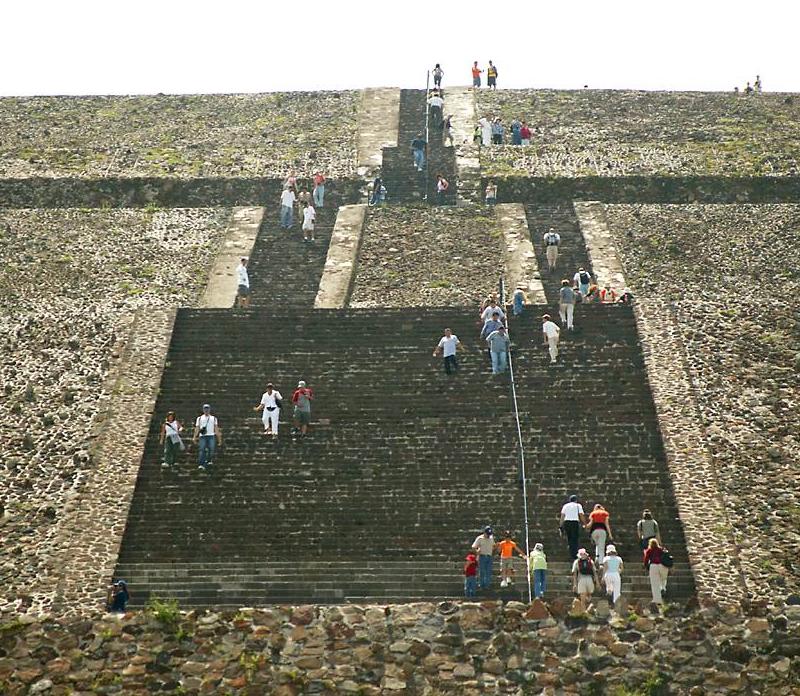
There are 248 steps up to the top, making it quite a long haul - higher than a 21 storey building, and the altitude at this location makes it seem even higher! However the view from the top is excellent and it's worth going up to take in the sights with all of the other tourists and, sometimes, the crystal wielding New Agers who are still drawn by the mystical power of this place. There are also a surprising number of butterflies up there, participating in the mating behavior known as "hill topping". |
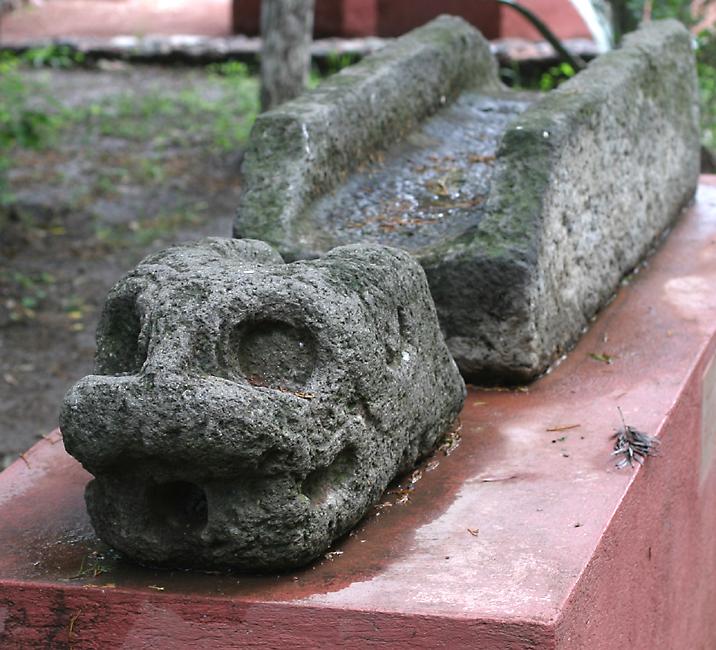
Just to the south of the Pyramid of the Sun is the main site museum, which is the primary repository for artifacts discovered here. There's a sculpture garden outside the museum where stone items are displayed, like this water drain and end piece, looking for all the world like a gargoyle from one of the water drains on a medieval cathedral in Europe. There's another museum with murals and other items on the far western side of the site near gate two, but unfortunately I didn't have time to visit. |
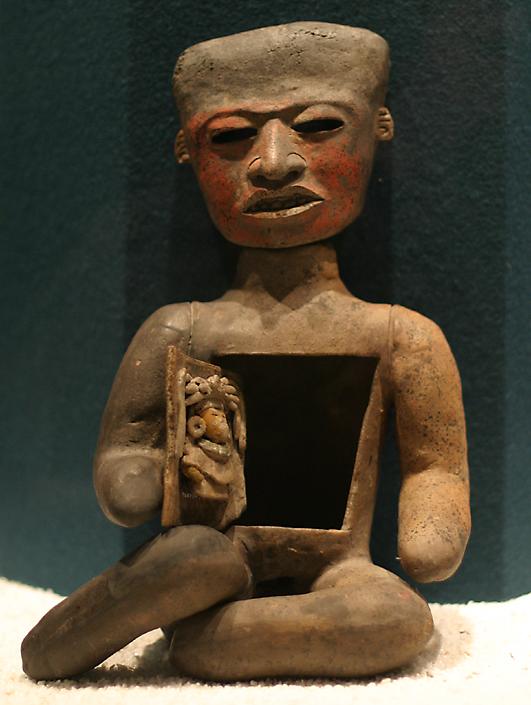
There's a very large collection on display inside the modern looking site museum, including a huge model of the city as it would have been in its heyday, right in front of a gigantic glass wall looking out on the Pyramid of the Sun. Teotihuacan was the center of a large trading empire which included nearby cities such as Cholula as well as much more distant population centers like Tikal in present-day Guatemala, so there are also displays of trade items found at Teotihuacan which originated from other sites. There's even evidence that different ethnic groups might have had separate living areas within the city. Central Mexico was a source of obsidian, highly prized here and elsewhere as a material for making sharp knives. There are also tools such as mortars and pestels made from rock, as well as pottery items. There are a couple of transplanted burial sites found here, showing how the bodies were laid out with some of their possessions. There's also a large collection of pottery containers and figures depicting gods like Tlaloc as well as workers going about their trades, and nobles in their costumes. Some of the figures are very imaginative, like the extraordinary article shown here. |
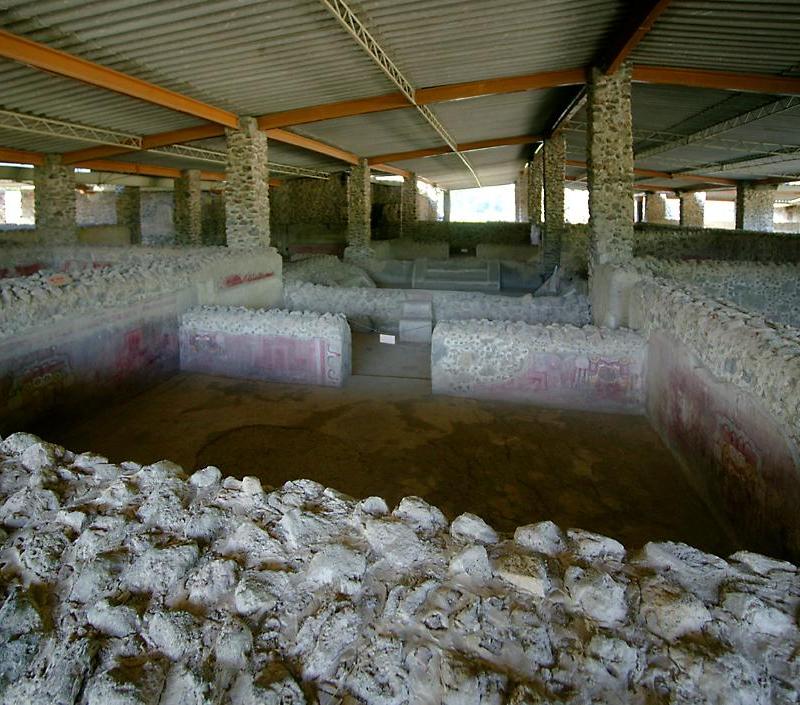
On the far western side of the present-day archaeological site, a little under a kilometer south of the Pyramid of the Sun, is a complex excavated in the 1940s which is now called the Palace of Tetitla. There's nothing much in the way of monumental architecture, but it's famous for the murals which you can see here, which once covered the walls of the many living areas within the complex. Unfortunately, as elsewhere in Teotihuacan, most of the buildings have been demolished nearly down to ground level, but what little remains is remarkable for its wealth of artistry. |
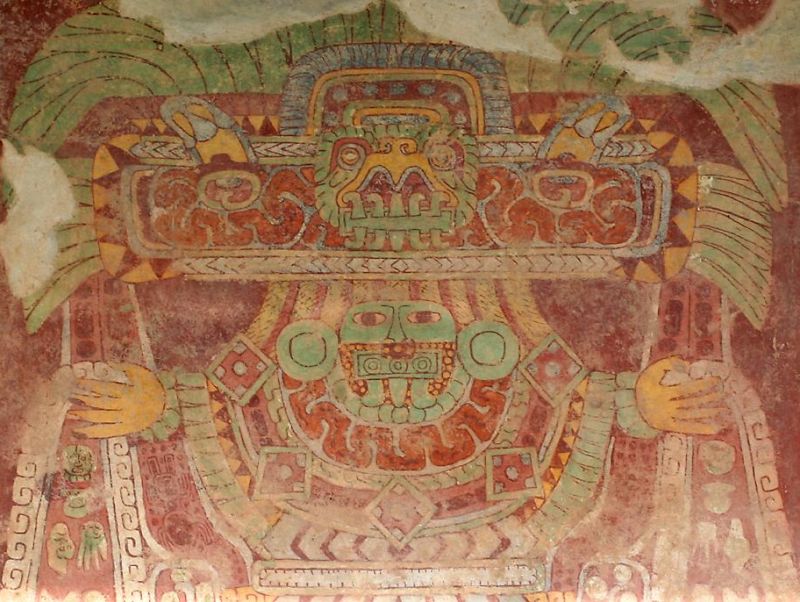
Here's a mural on one of the best preserved walls, identified as portico 11, mural 3. It shows The Great Goddess, with various motifs to represent agricultural fertility. It's incredible that so much of the rich red, yellow, blue and green has survived in such a damp environment, especially since the surrounding building was derelict and unable to provide much protection. I'm not sure how long articles like this will survive being unearthed - although there was a sign directly above this mural saying "no flash [photography]", the screen in front had not been drawn, and sunlight was falling directly onto it. |
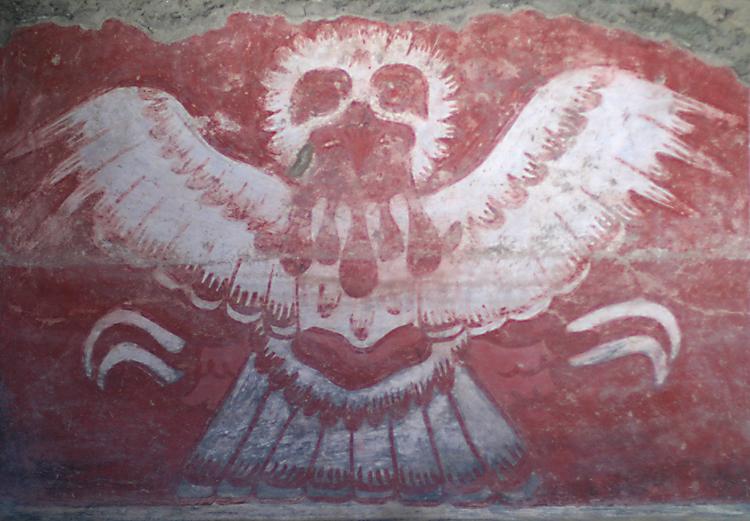
Here's one of several eagle images at this location, other animals include dogs, jaguars, birds and snails. People are depicted performing ceremonies, and also secular acts like swimming with nets and collecting shell fish. |
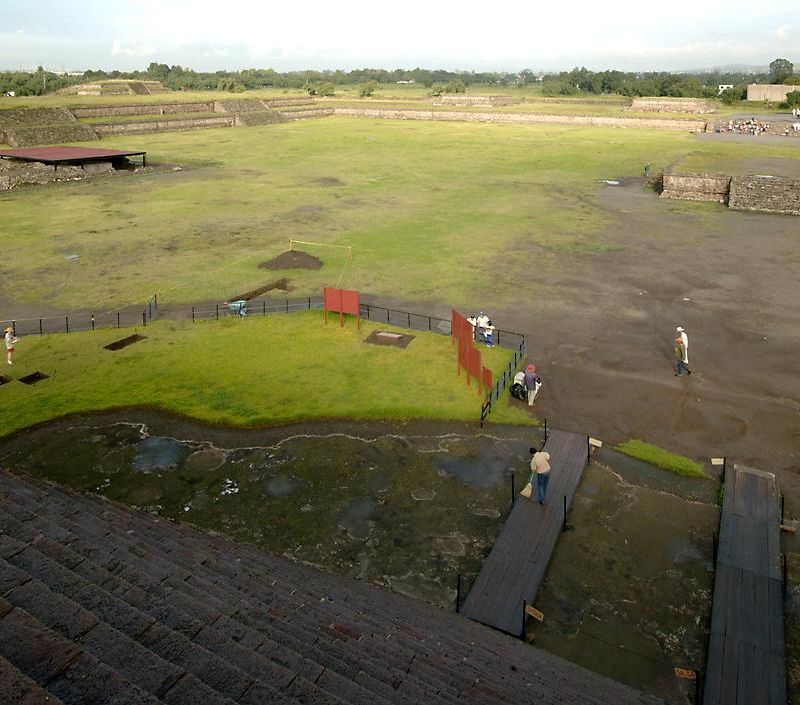
At the southern end of the Avenue of the Dead is the 400 meter square sunken complex which the Spaniards called The Citadel, mistaking its high walls and central courtyard for a fortification. In fact Teotihuacan seems to have been a peaceful place until its fiery end came, and there are no clear depictions of warriors or battles amongst its many murals. Rather, the citadel seems to have been a living area for many of the city's elite residents, and possibly a ceremonial area where most of the city's inhabitants could be gathered together. |
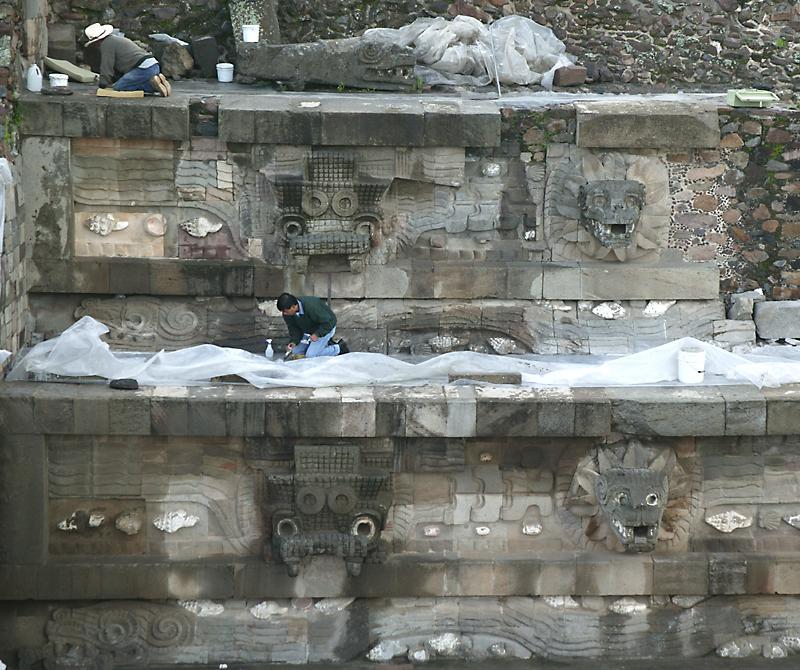
The most interesting structure within the citadel is the Temple of Quetzalcoatl, the "plumed serpent", which was undergoing major restoration when I visited in August of 2004. There are actually two temples, the later of which completely covered the earlier one, in typical central American fashion. This is the only structure at Teotihuacan whose stone carvings are still intact. The figure with large eyes and two fangs immediately above the lower worker in this figure is thought to be either the rain god Tlaloc or the fire serpent which carried the sun on its daily journey. The plumed serpent itself is on the right, its head protruding from a necklace of petals, and the three-part item to the left of each plumed serpent head is said to be the rattle at the end of its tail. Conches, scallops and other sea shells appear between the protruding carvings, together with water motifs. |
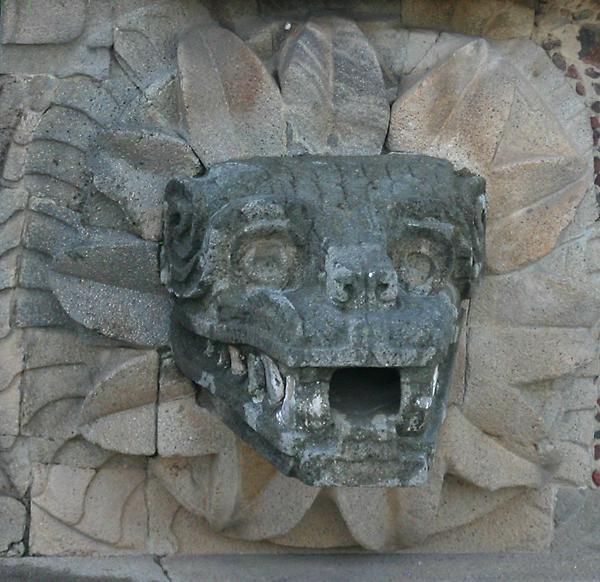
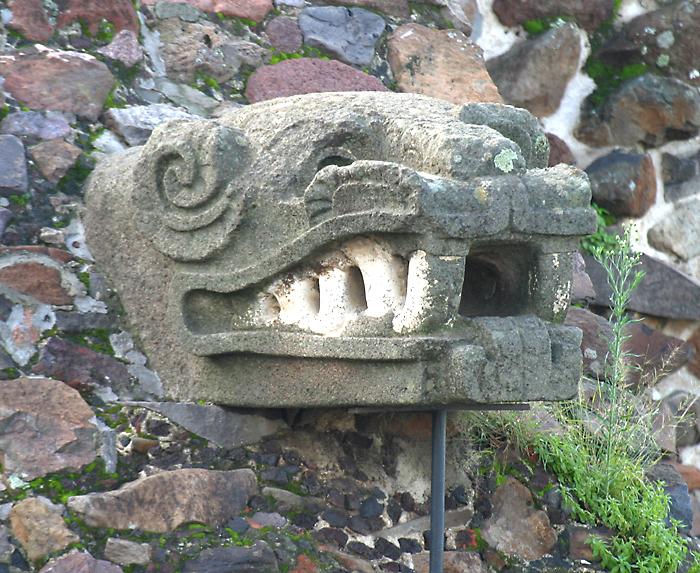
Here's a close up view of the plumed serpent. Quetzalcoatl is usually shown surrounded by 11 petals, which are also interpreted as feathers or plumes. A steep set of stairs ascends the western side of the Temple of Quetzalcoatl, with more figures of the plumed serpent on either side. The temple is originally thought to have had six tiers, but only four still exist. A few traces of color remain, but it's believed that the entire temple would once have been painted in bright red, white and green. |
In the 1980s several mass graves were discovered under the temple. In all, 137 bodies were discovered, and it seems that the people were probably sacrificed when the temple was built, since their hands were tied behind their backs. Graves have also been found under the Pyramid of the Moon, and some people believe that there's probably a royal tomb located somewhere under the pyramid. The pyramid grave included various valuables, as well as the remains of eight hawks and two jaguars, which might have been buried alive. |