| Highlights
of the Red Flag 07-2 Military Exercise |
| Although
the United States air force achieved a roughly 10-to-1 kill ratio over
communist forces during the Korean war, by the time of the Vietnam war
the ratio had fallen to about 2-to-1, and for a period during 1972 it fell
to 1-to-1. An air force analysis determined that pilots who
survived their first ten combat sorties would likely survive the remainder
of their tour, so the air force set up the Red Flag military exercise to
provide a very realistic simulation of combat conditions. |
 |
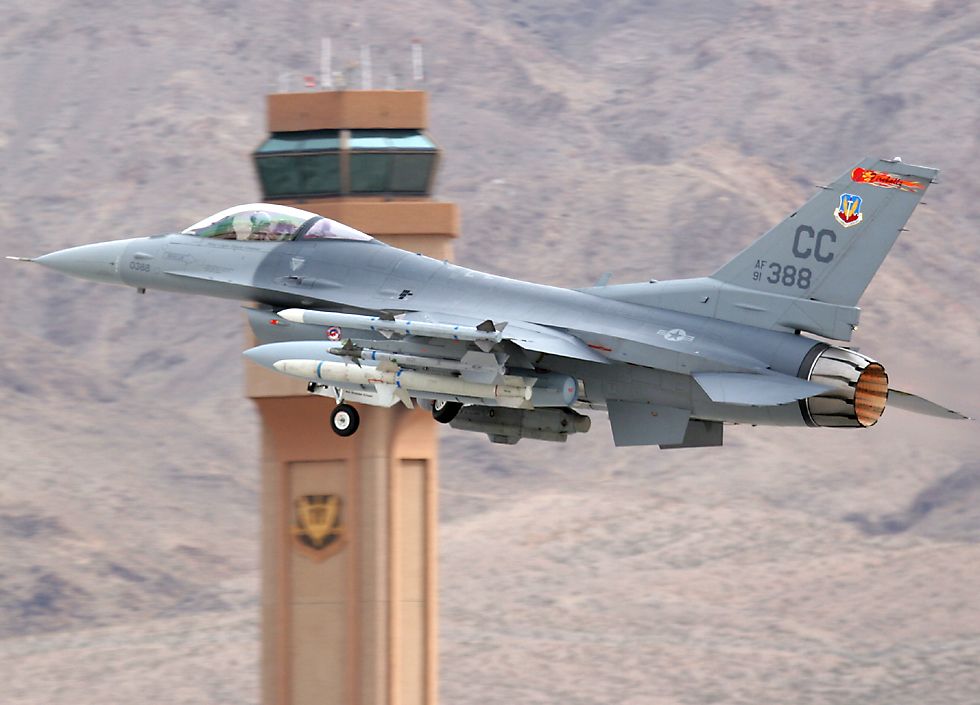
| These
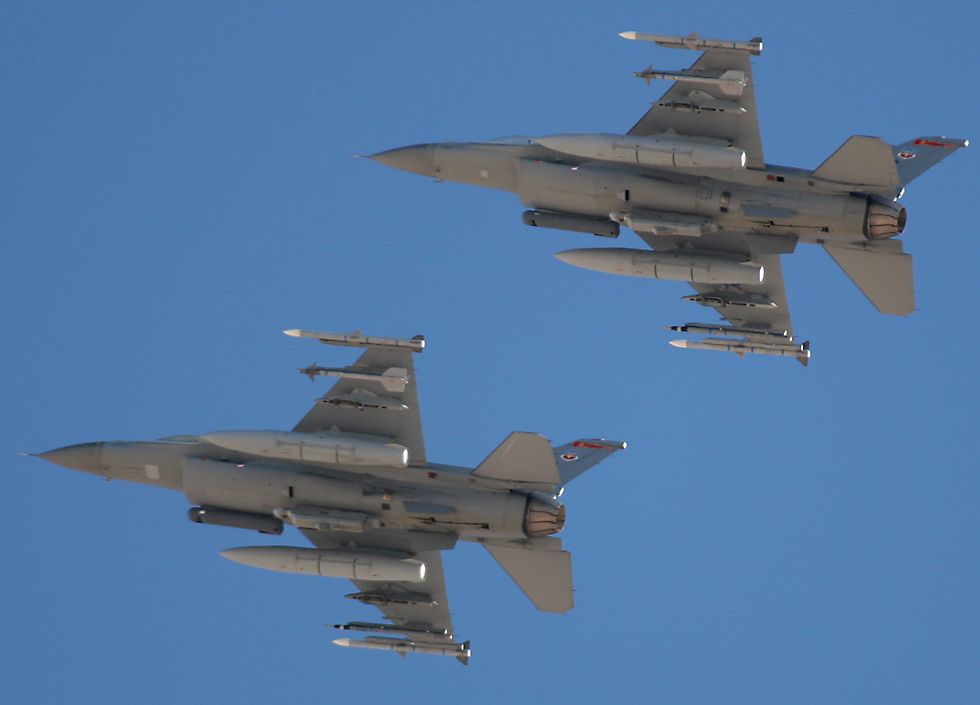
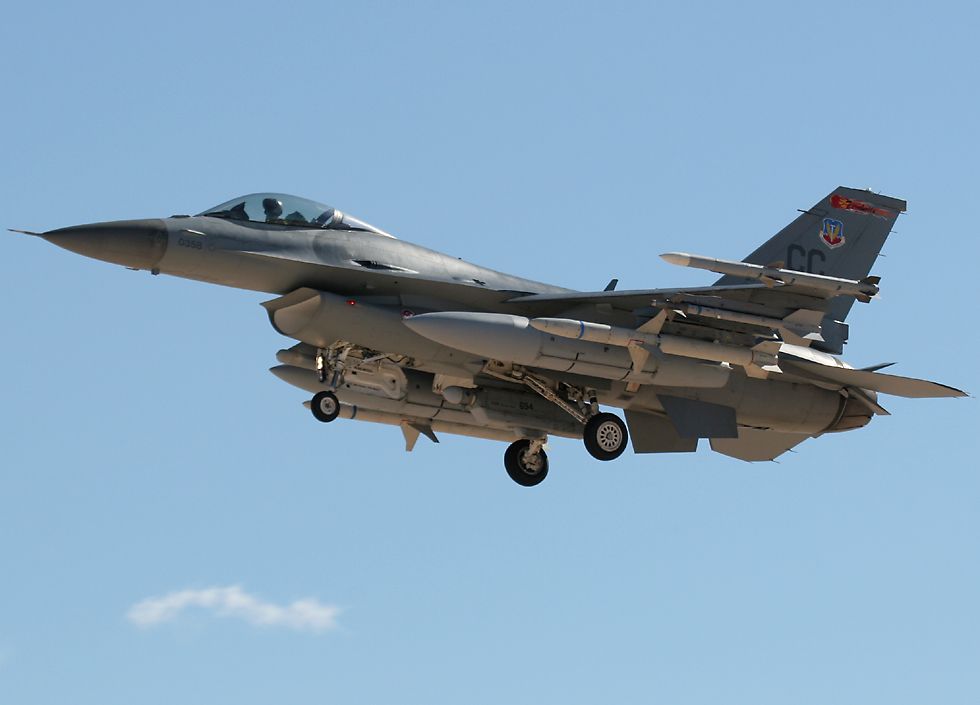
well-appointed F-16 Fighting Falcons belong to the 27th fighter wing based
at Cannon air force base in New Mexico, nicknamed the "Fireballs".
The Fireballs started transitioning to F-16s from the F-111 Aardvark in
1995. |
 |
| Aircraft
at Red Flag use a mixture of live ordnance and dummies for ground strike
missions, but of course for simulated air-to-air combat live missiles can't
be used, instead missile locks are used to confirm kills. |
 |
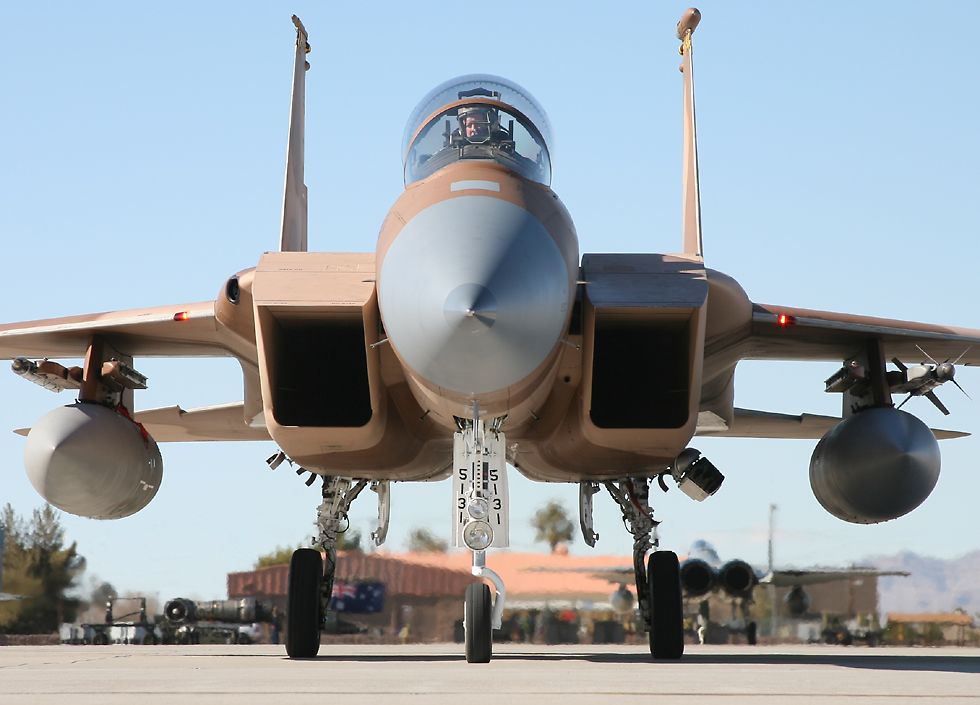
| Red
Flag pits a "blue team" representing forces allied to the United States
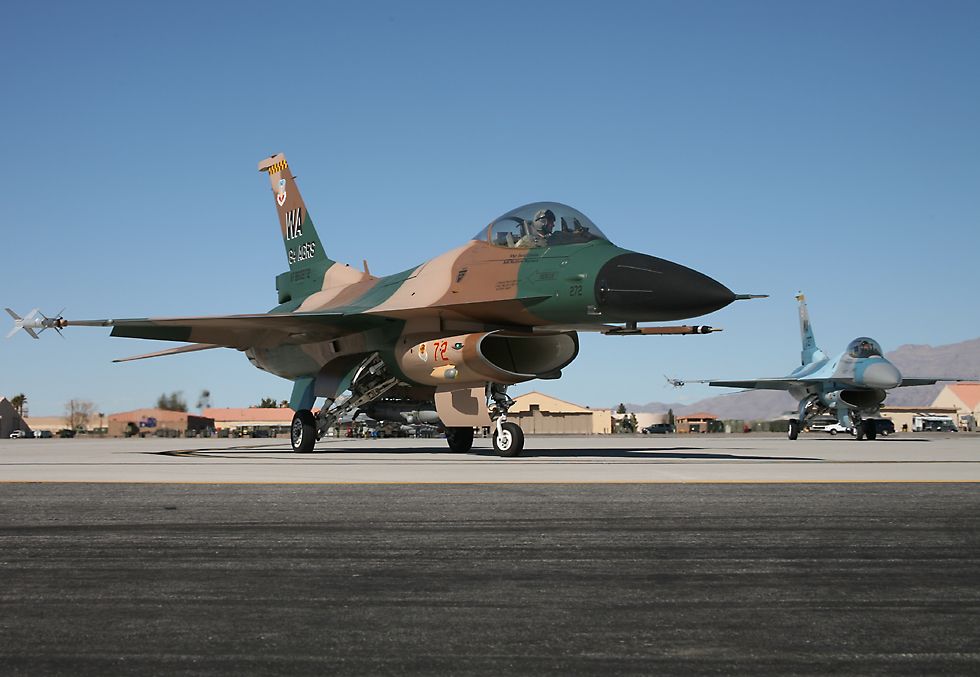
against a "red team" which represents enemy forces. The F-16s
in these colorful paint schemes belong to the 64th aggressor squadron,
they either attack the blue team aircraft defending a target, or defend
their own target against the blue team. |
 |
| The
64th aggressor squadron provides a more powerful red team capability, flying
F-15 Eagles to simulate Russian aircraft like the
Sukhoi Su-27 "Flanker". The air force puts its best pilots
into the aggressor aircraft, teaching them to fly using Soviet military
tactics. Aircrews who want to have close contact with Soviet aircraft
can also drop into the
Nellis air force base Threat Training Facility, sometimes referred
to as the "petting zoo", to see the real thing at close range. |
 |
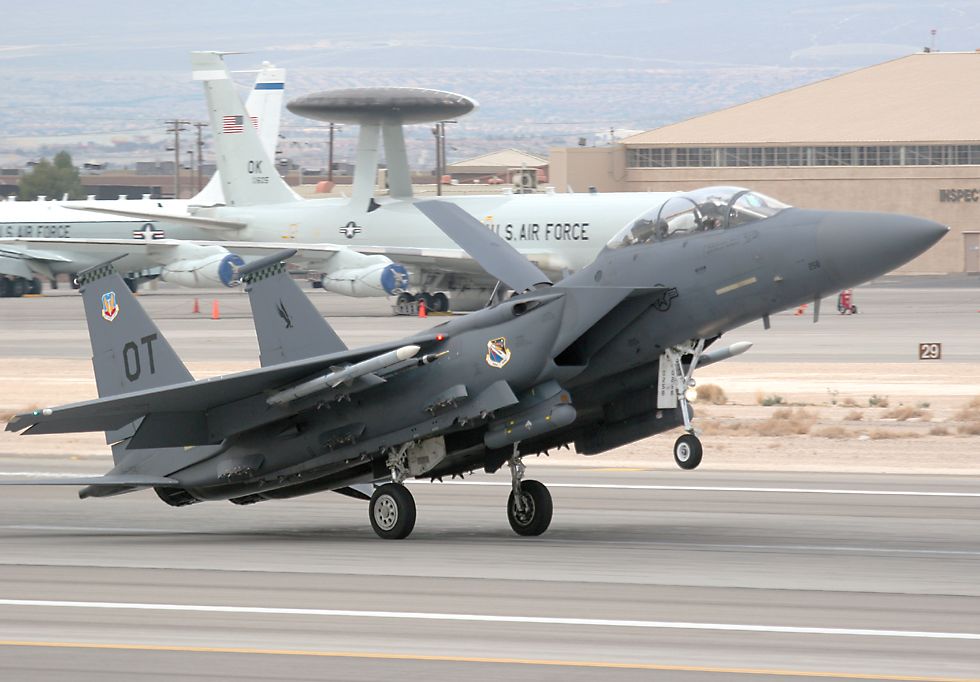
| Eagles
fly both on the blue and on the red teams, and the blue teams now include
two-seat F-15 Strike Eagles like this one, shown during landing with the
large speed brake on its back extended. |
 |
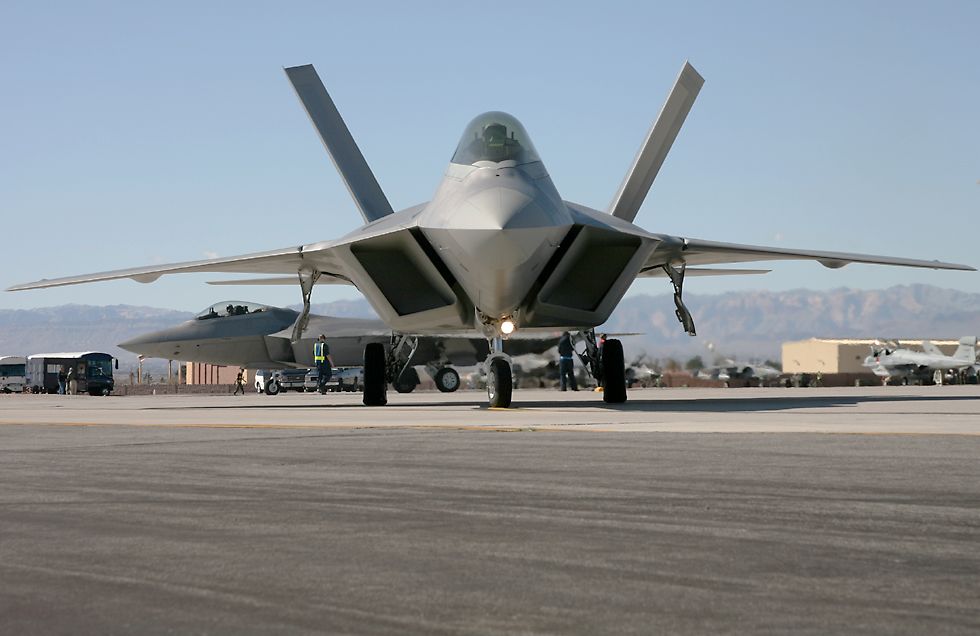
| The
F-15s used to be top of the heap in the air force, but that position now
belongs to this aircraft, the F-22 Raptor. Although they've
been around for some time, this is the first Red Flag exercise where they've
been deployed. Since they represent such a leap in capability
beyond existing aircraft, it's been difficult to know how to integrate
them into Red Flag, since any aircraft it's deployed against will likely
be shot down before it's even aware of the Raptor's presence, which doesn't
provide very good training for its opponents! You can see more
of this aircraft type by looking at the
2005 Edwards airshow F-22 demonstration. |
 |
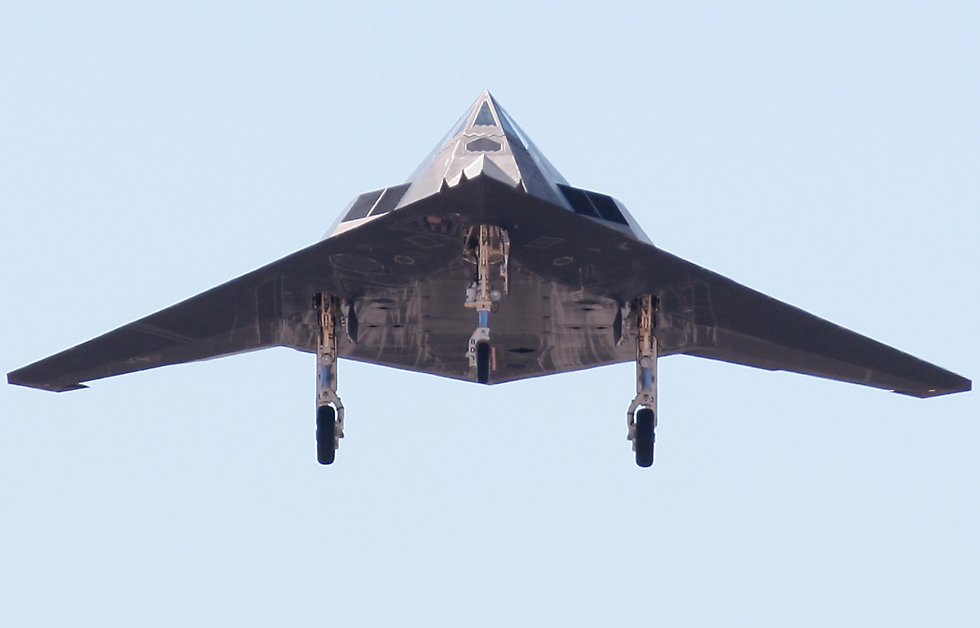
| The
Raptor wasn't the only stealth aircraft at Nellis air force base near Las
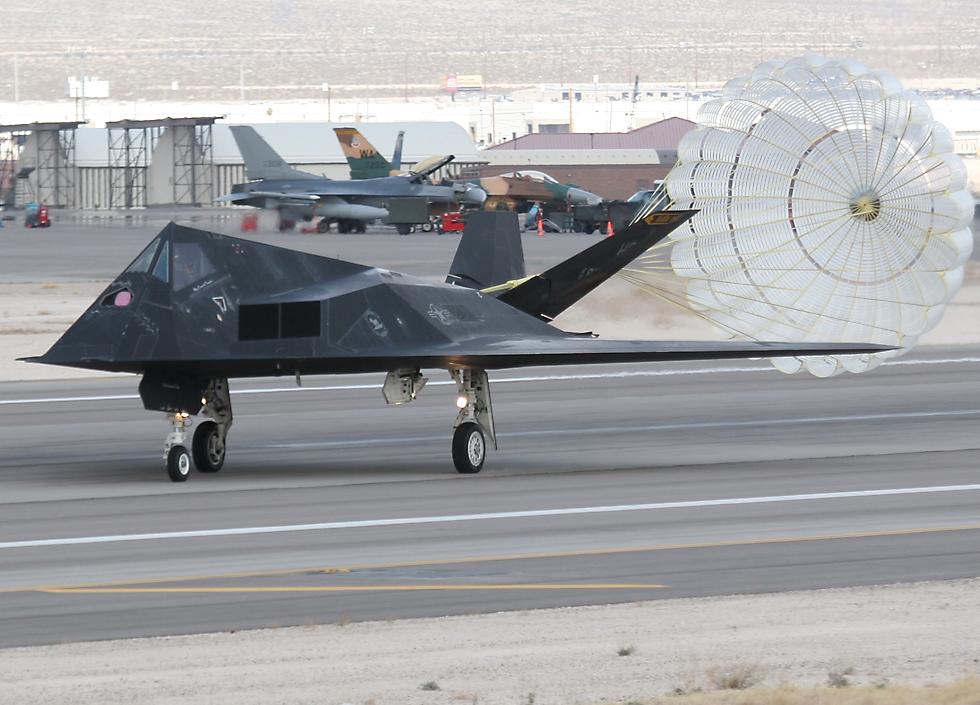
Vegas, which is where Red Flag is held. Here's the first true
stealth aircraft, the F-117 Nighthawk which, in spite of its fighter designation
and "stealth fighter" moniker, is really a ground attack aircraft.
The curved lines of the Raptor show how far the technology has developed,
and it's certainly obvious from these two head-on views of the aircraft
how much poorer the Nighthawk pilot's forward view is! |
 |
| The
Nighthawk will soon be retired, replaced by the Raptor, so this is one
of its last outings at Red Flag. The F-22 can only carry two
1000 pound bombs internally, against the two 2000 pound bombs of the F-117,
but the air force feels that the change is justified by the huge cost of
keeping even a small fleet of the single-purpose Nighthawk, compared to
keeping a fleet of dual-purpose Raptors. |
 |
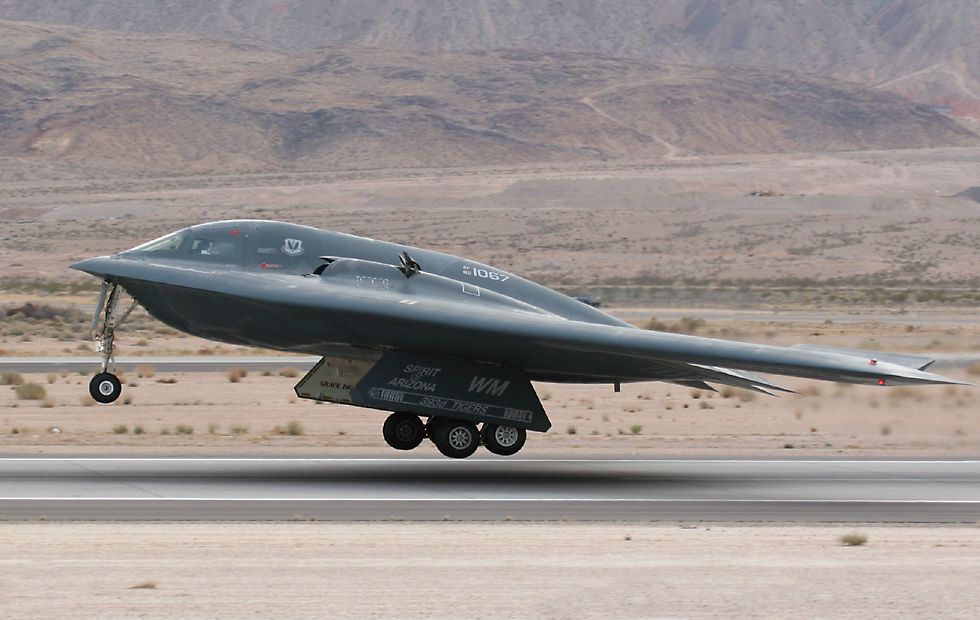
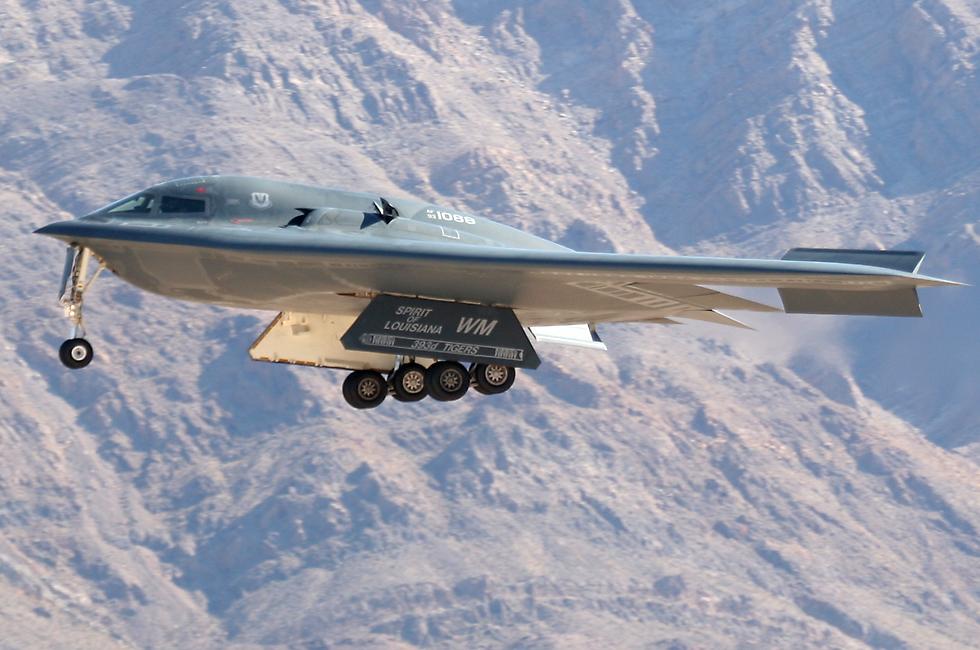
| The
third member of the stealth trio was here too, in the form of four B-2
Spirit stealth bombers. Although it's also a very expensive
aircraft, the B-2 is somewhat easier to maintain than the first-generation
Nighthawk, and its large payload and long range ensure that it's not going
to be replaced anytime soon. |
 |
| Although
there were four B-2s present, only one at a time flew during the media
days. And since there are so many excellent aircraft to put
on this page, you'll have to go to look at the
2005 Edwards airshow B-2 demonstration if you want another fix of this
amazing aircraft. |
 |
| Another
type which isn't in any danger of being replaced is the A-10 Thunderbolt
II, which has been so successful in the close air support role that it
has survived in spite of receiving a considerable amount of disdain from
the air force during its early career. |
 |
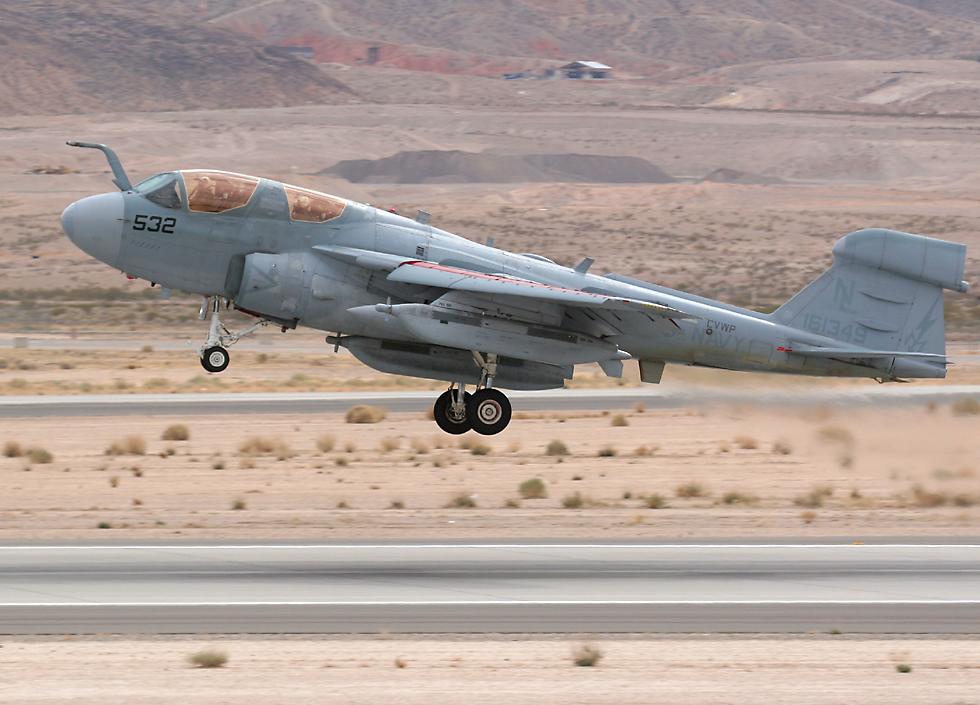
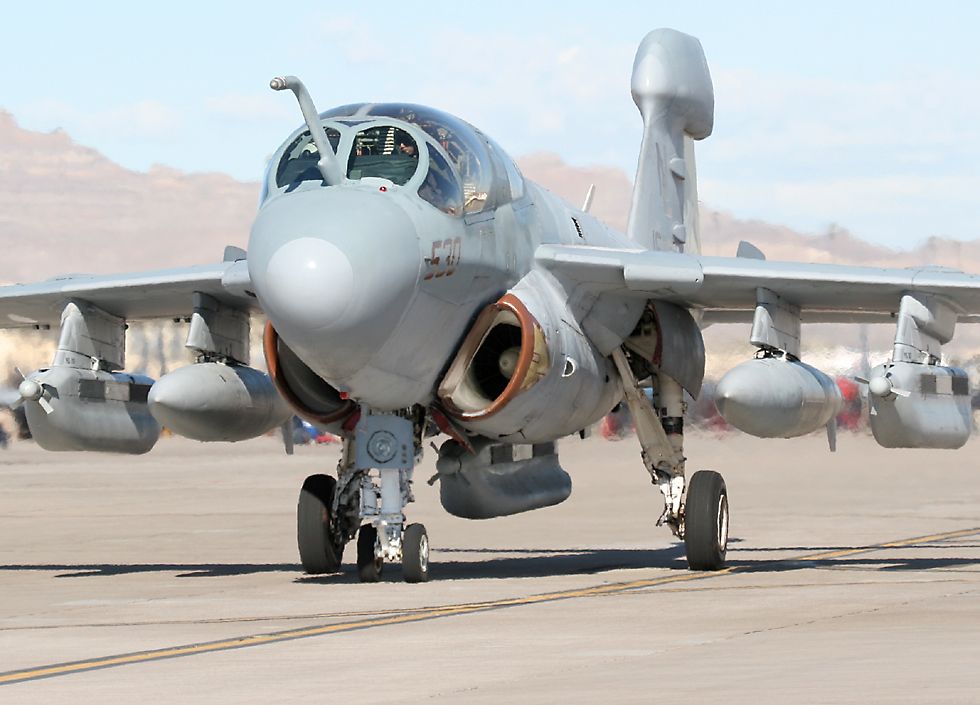
| Although
all of these previous aircraft are interesting, I was especially pleased
to see this EA-6B Prowler in action. I've seen all of the other
aircraft types flying during airshow many times, but the Prowler belongs
to that group of "unsexy" military aircraft which is virtually never seen
in the air at shows, and it doesn't even appear in the static display very
often. Although it's a navy aircraft, the Prowler is an indispensable
part of air force exercises like Red Flag, since it's the only dedicated
radar jamming and radar attack aircraft in the arsenal, now that the air
force has retired the F-4 Wild Weasel and EF-111 Raven. |
 |
| The
four-seat EA-6 Prowler was derived from the two-seat A-6 Intruder ground
attack aircraft. The pilot is accompanied by three electronic
counter-measure officers who attend to the radar detection and counter-measure
units housed in the pods under the aircraft and at the top of the tail. |
 |
| The
Prowler is another aircraft type which is due to be retired in the not
too distant future, to be replaced by the EA-18 Growler, a derivative of
the F-18 Hornet. |
 |
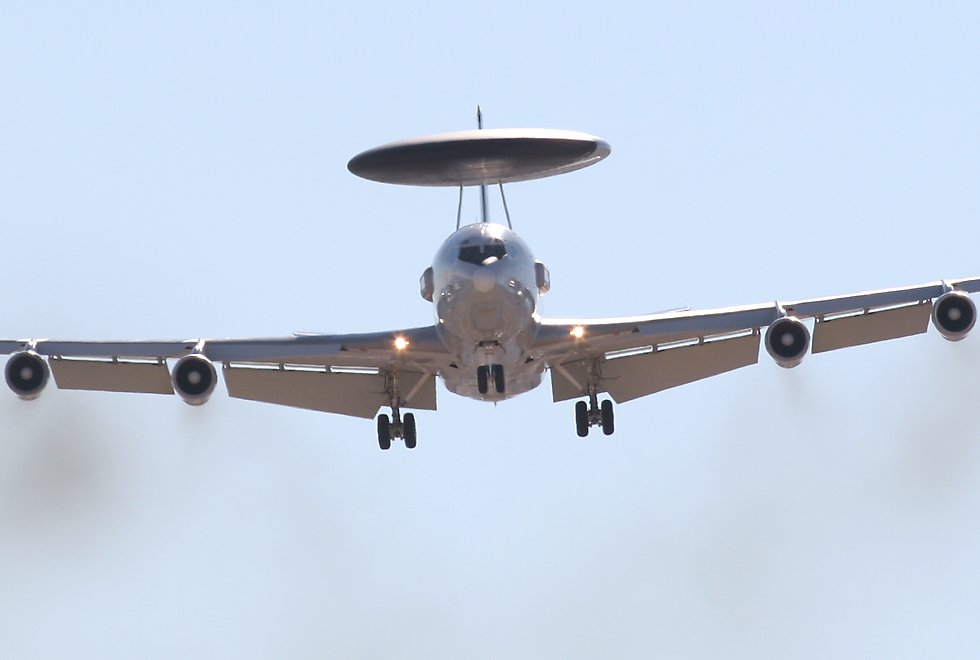
| This
E-3 Sentry AWACS plane is another part of the electronic umbrella which
supports and protects the fighter, ground attack and bomber assets.
Use of all of these aircraft types adds significantly to the realism of
the exercises, which is vital if they are to achieve their goal of preparing
aircrews for real-world combat. The AWACS planes also monitor
the blue and red teams to determine their location and who is downing who. |
 |
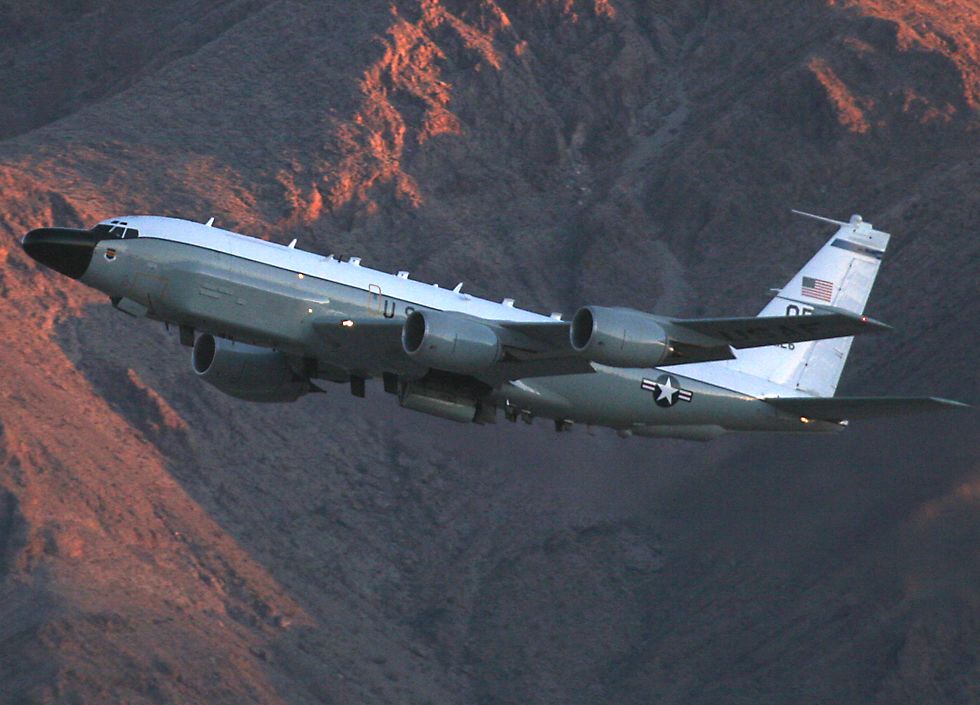
| The
E-3 is only one of many Boeing Dash 80 derivatives, better known to many
people in its incarnation as the Boeing 707 airliner. As well
as the E-3, this Red Flag included several KC-135 aerial refuelling planes,
an E-8 JSTARS ground target surveillance plane and this RC-135 Rivet Joint
electronic surveillance aircraft, which took off late in the day for one
of Red Flag's many night training sessions. |
 |
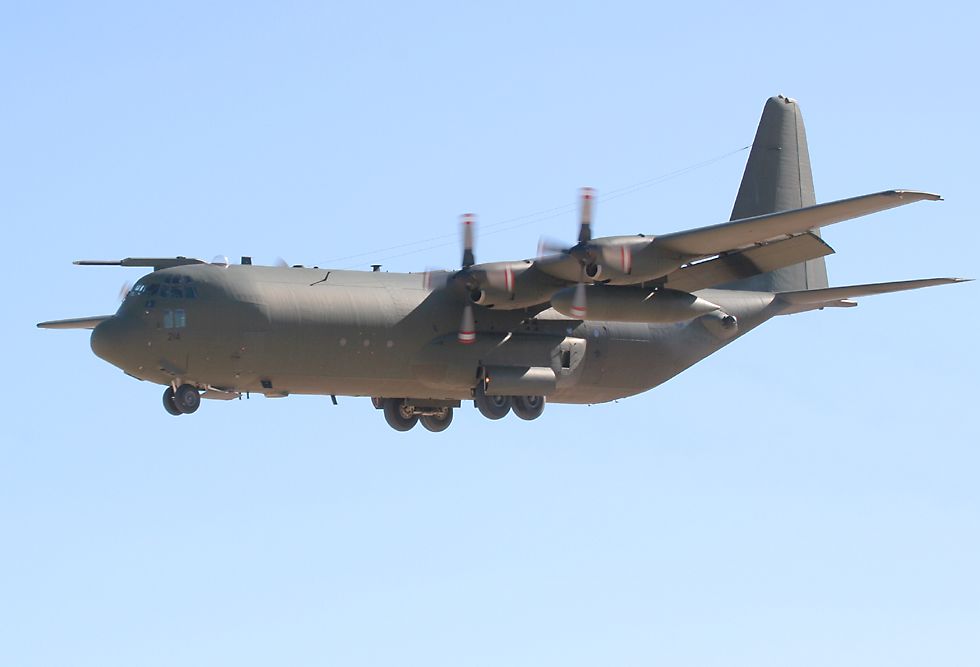
| Participation
in Red Flag and sister exercises like Green Flag isn't limited to American
forces. There were Belgian
air force planes in the Green Flag exercises last November, and both
the Royal Air Force and the Royal Australian Air Force came to this Red
Flag exercise. The Australians brought support equipment here
in their brand-new, one and only C-17 Globemaster III, but it returned
home straight away. However the British and Australians both
had C-130 Hercules transport aircraft flying during the exercise, and in
the case of the British it was one of their very rarely seen special forces
planes, which is distinguished by the large refuelling probe above the
nose, and various lumps and bumps scattered around the fuselage. |
 |
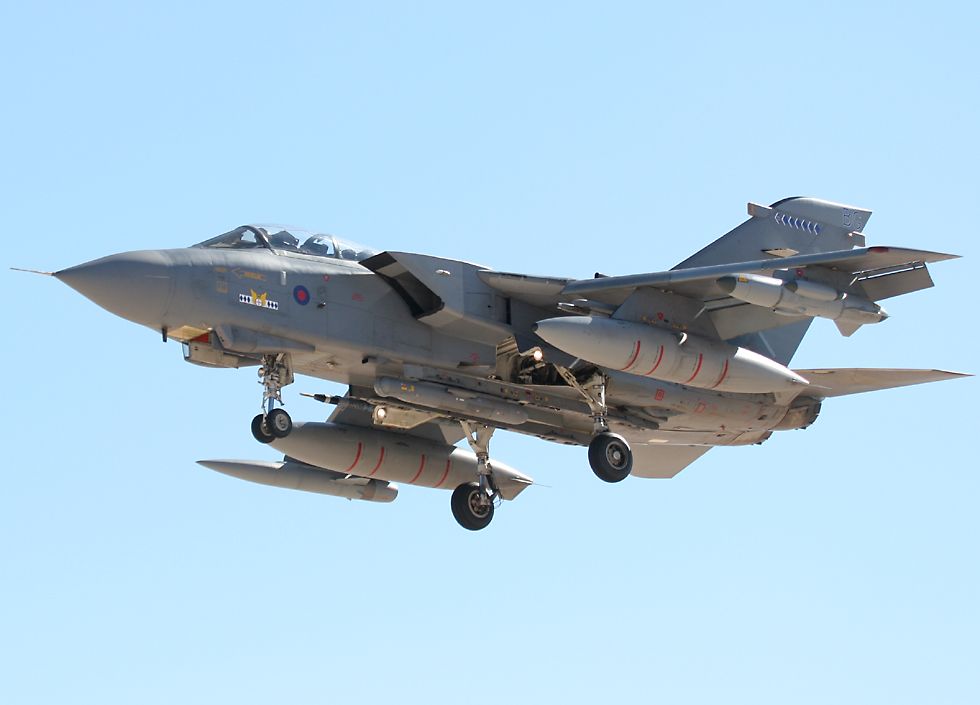
| As
in previous years, the main component of the British team consisted of
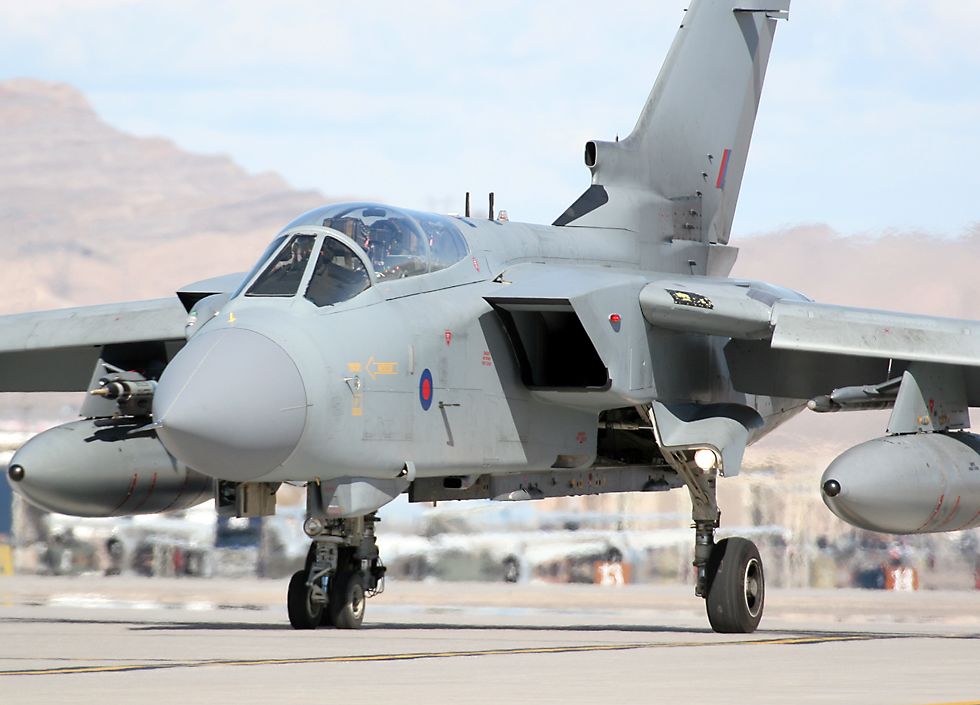
the Tornado fighter-bomber. In British service, the Tornado
comes in two flavors, the Air Defence Variant (ADV) and the Interdictor/Strike
(IDS) type which came to this Red Flag. Here you can see a
Tornado taking off with the blue afterburner flame which is typical of
this aircraft type. The British bring along their own concrete-filled
practice bombs for use on the test range, you can see a couple of them
hanging under the fuselage. |
 |
| A
Tornado takes off with the RAF special forces Hercules in the background,
parked next to its American equivalent, the MC-130E Combat Talon I.
Although it's primarily a strike aircraft, the Tornado IDS retains air-to-air
capability with the same sidewinder air-to-air missiles as its ADV brother,
and the same 27mm cannon located just behind the nose. The
Tornado IDS is broadly equivalent to the Strike Eagle, though it entered
service much earlier. |
 |
| The
Tornado is a swing-wing design, and the outer wing pylons cleverly swivel
in order to keep their load pointing straight ahead. In this
case a "Sky Shadow" ECM pod is on the port pylon, and a dispenser for chaff
and flares on the starboard outer pylon. The thin, sharply
pointed unit inboard of the starboard fuel tank is a transponder used to
track the various aircraft participating in the exercise, which is why
you'll see it fitted to several of the aircraft types. |
 |
| The
Tornado was an international project jointly developed by companies in
the UK, Germany and Italy, and it has been very successful, with around
1000 aircraft manufactured. The only export customer has been
Saudi Arabia, which operated its aircraft alongside British and Italian
Tornados during operation Desert Storm. Although it has a smaller
weapons load and shorter range than the Strike Eagle, the Tornado has low-level
capabilities which made it the only aircraft in the coalition capable of
performing the tasks it was assigned. |
 |
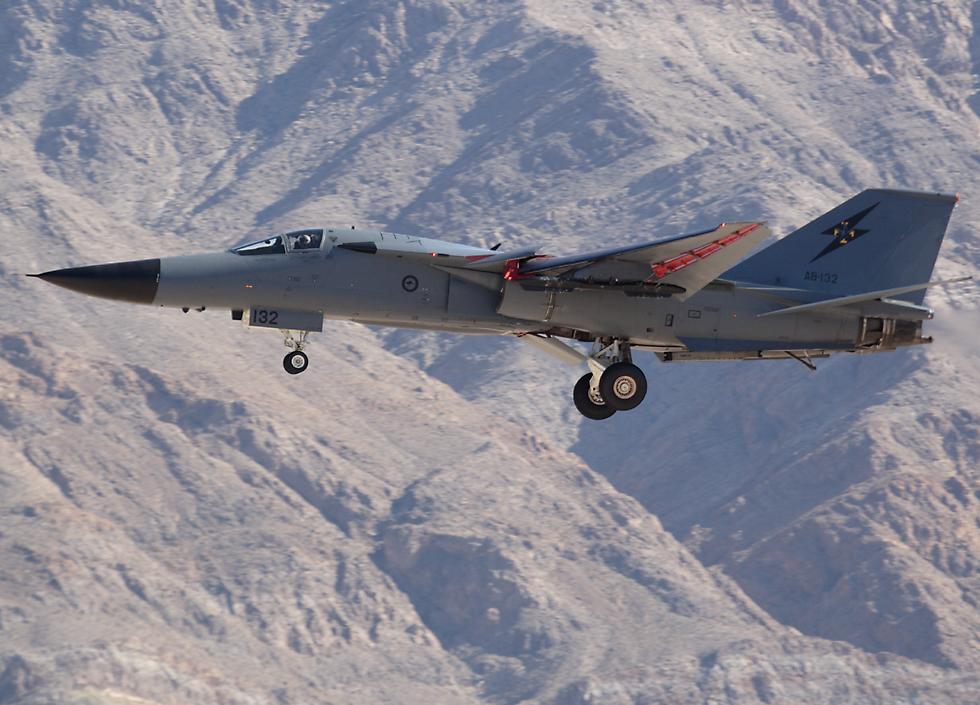
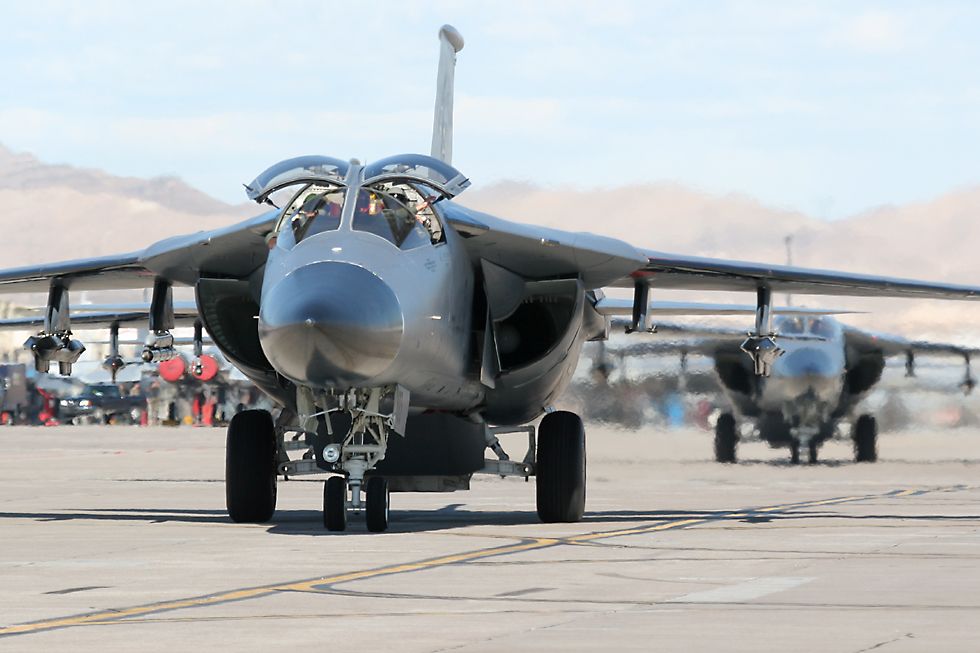
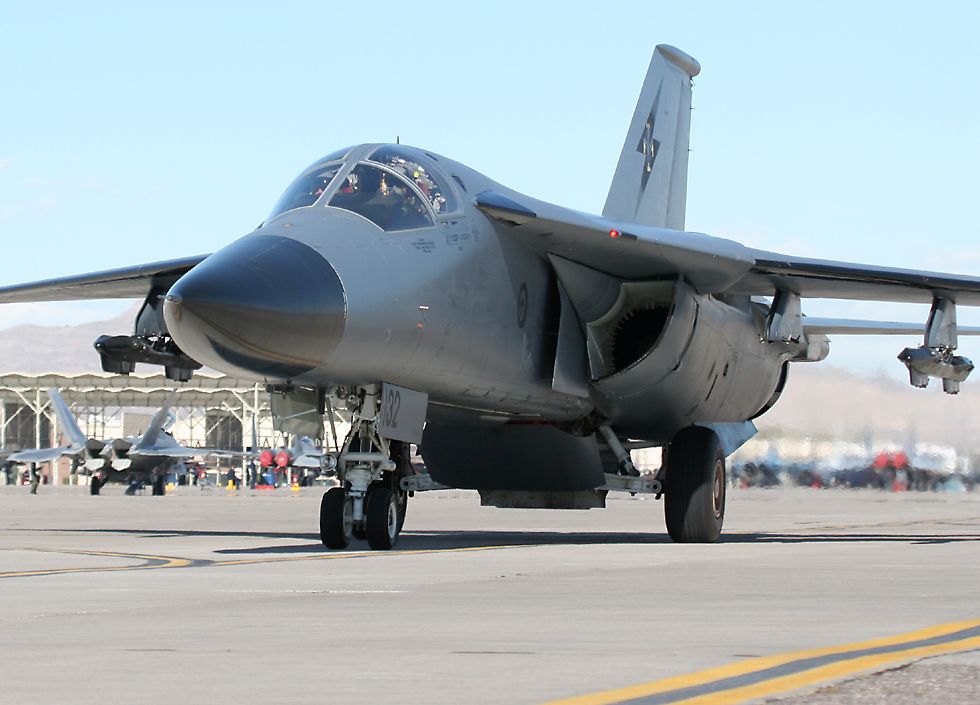
| The
Tornado and the Prowler made the trip to Red Flag worthwhile, but there's
no doubt what the real drawcard was, bringing aviation enthusiasts from
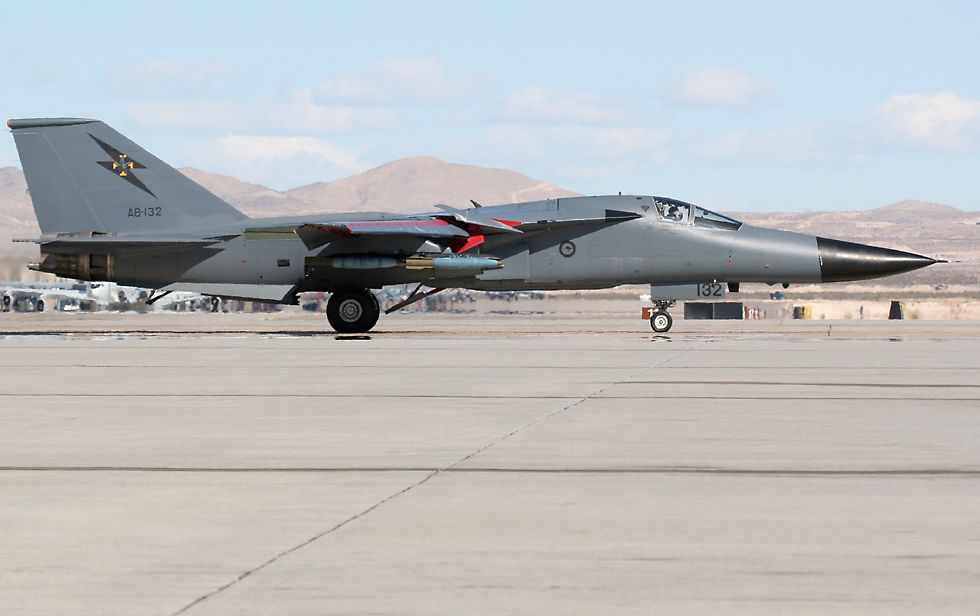
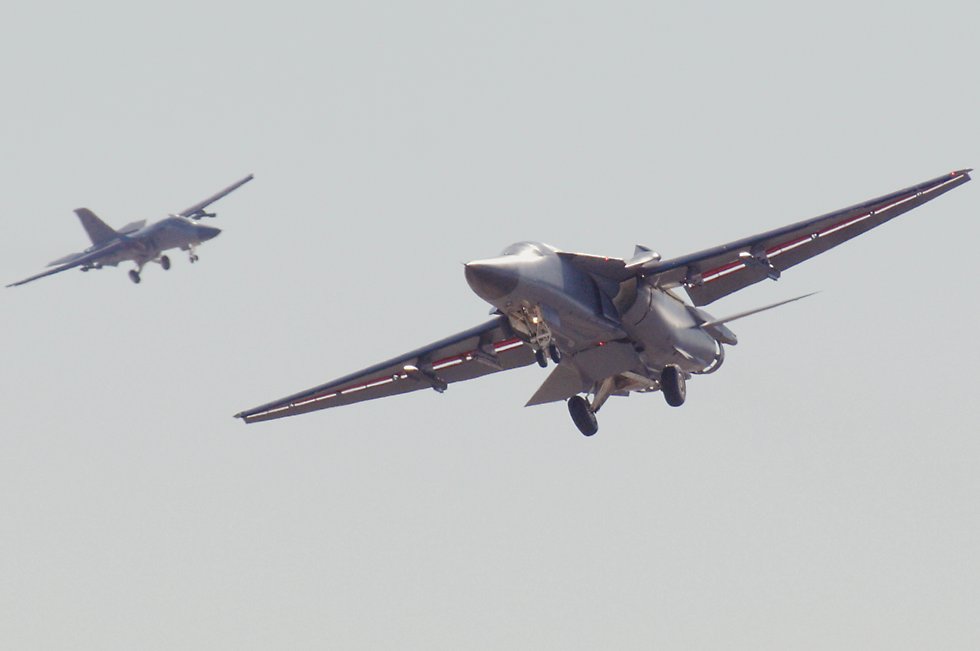
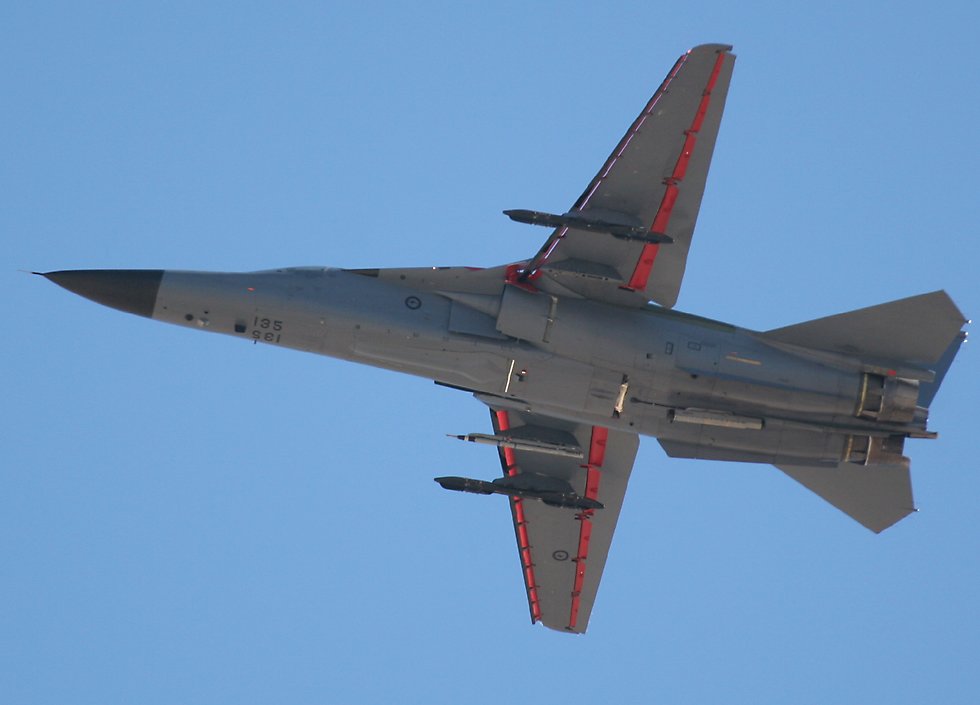
Canada, the UK and even Japan. This is the F-111C Aardvark
strike aircraft, operated by the Royal Australian Air Force. |
 |
| Like
the Tornado, the Aardvark is a swing-wing design, in fact it was the first
operational aircraft with this so-called "variable geometry" wing.
This arrangement improves low-speed performance, allowing the plane to
fly into and out of shorter runways than would otherwise be possible. |
 |
| Originally
intended as a pure strike aircraft replacement for the F-100 Super Sabre
and the F-105 Thunderchief, the air force then decided to add on fighter
capability, specifying a top speed of Mach 2.5 at high altitude.
These difficult engineering requirements were then complicated even further
by the politicians when the secretary of defense Robert McNamara insisted
that the plane be suitable for both the air force and the navy. |
 |
| The
Tornado suffered from a similarly broad set of requirements, the German
press labelled it the "egg-laying wool milk pig", but it ended up as a
success, whereas the TFX program to develop the F-111 largely failed.
Eventually the navy F-111B version was cancelled completely, the F-14 Tomcat
being developed instead. The air force never used the Aardvark
as a fighter, early versions operating entirely in a strike role, while
later FB-111s flew as strategic nuclear strike aircraft, and EF-111A Ravens
operated as an electronic warfare and suppression type. |
 |
| The
naval F-111B wasn't the only aircraft killed by the program.
The British cancelled their extremely innovative TSR.2, which had a low-level,
high-speed strike role which was very similar to the Aardvark, and even
included the same short takeoff and landing requirement, though the TSR-2
achieved that with blown flaps rather than the F-111's more complex swing-wing. |
 |
| In
1965 the British cancelled the TSR.2 in favor of the F-111, and the Australians
also transferred their support from the TSR.2 to the American plane, however
the Aardvark ran far over the promised schedules and costs, so the British
cancelled their order. The Australians eventually received
theirs in 1973, six years late and at twice the forecast price. |
 |
| The
only place you'll see a TSR.2 nowadays is in
a museum. The last USAF F-111s were withdrawn in 1998,
but the Australian F-111s are still going strong; the current plan is to
retire them in 2010, when they'll be replaced by yet more F-18 Hornets,
just like the Prowler. |
 |
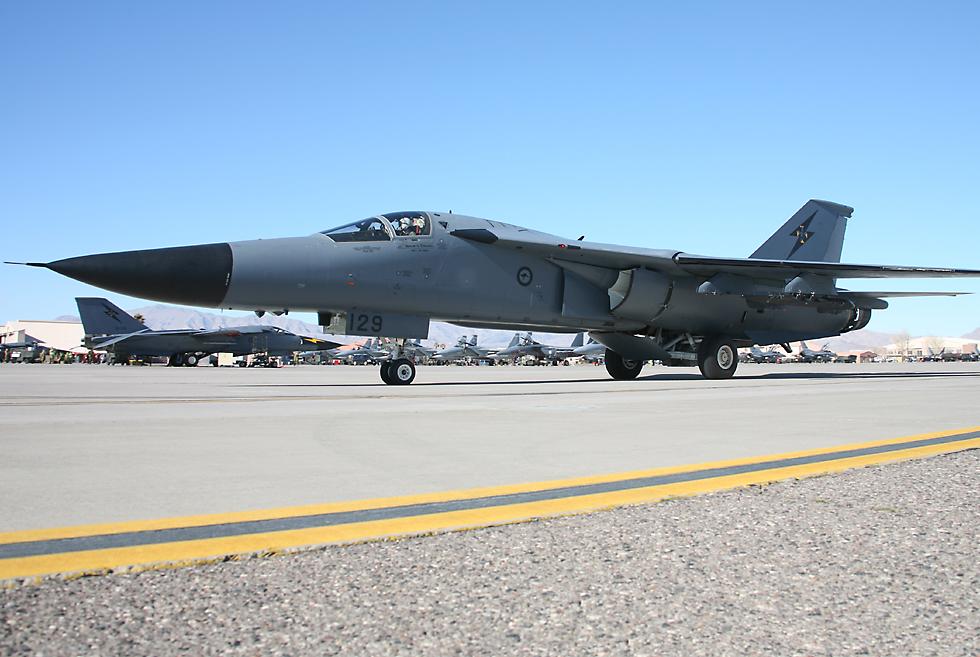
| The
F-111 certainly had a troubled development and the early years of operational
use were also plagued by serious avionics and mechanical problems, but
it ultimately matured into a very worthwhile aircraft, performing well
at low altitude and in all weather conditions. Despite limitations
caused by the non-swivelling wing pylons, the Aardvark could carry four
times the bomb load of the F-4 Phantom II. |
 |
Visit
the
Nellis AFB Threat Training Facility, or see aircraft
participating in a Green Flag exercise.
 |